


| IN A NUTSHELL |
|
In the ongoing battle against rising urban temperatures, a groundbreaking innovation offers a promising solution. A team of international researchers has developed an advanced paint that can reduce building temperatures by 10 to 36 degrees Fahrenheit. This innovation, harnessing the power of artificial intelligence, could significantly transform energy management in cities and mitigate the effects of urban heat islands. As the world grapples with escalating heat waves, this novel approach may provide a sustainable alternative to traditional air conditioning, which burdens electrical grids and exacerbates greenhouse gas emissions.
AI-Powered Paint: A Breakthrough in Thermal Management
The development of this innovative paint is rooted in a simple yet bold idea: using AI algorithms to overcome the limitations of conventional thermal material design. Traditional methods often rely on incremental adjustments and trial-and-error processes. In contrast, the research team, led by experts from the University of Texas at Austin and other global institutions, employed machine learning to design materials based on desired thermal properties. According to Yuebing Zheng, a professor involved in the project, this approach allows for starting from the target properties to design the appropriate structure.
The AI framework used in this research can process vast amounts of experimental and theoretical data. This capability enabled the researchers to generate over 1,500 formulations of thermal meta-emitters, featuring complex 3D geometries and varied compositions. Such materials are nearly impossible to achieve with conventional design tools. The automation has revolutionized the way materials are created, allowing for superior performance that was previously unimaginable. Additionally, the speed of this method is a significant advantage. What once required months of testing can now be achieved in days, enabling the exploration of a much broader design space and applications that were once out of reach.
“They’ve Been Hiding This Monster”: Student Discovers 23 Foot Killer Dinosaur In Museum Storage
Impressive Results Under Direct Sunlight
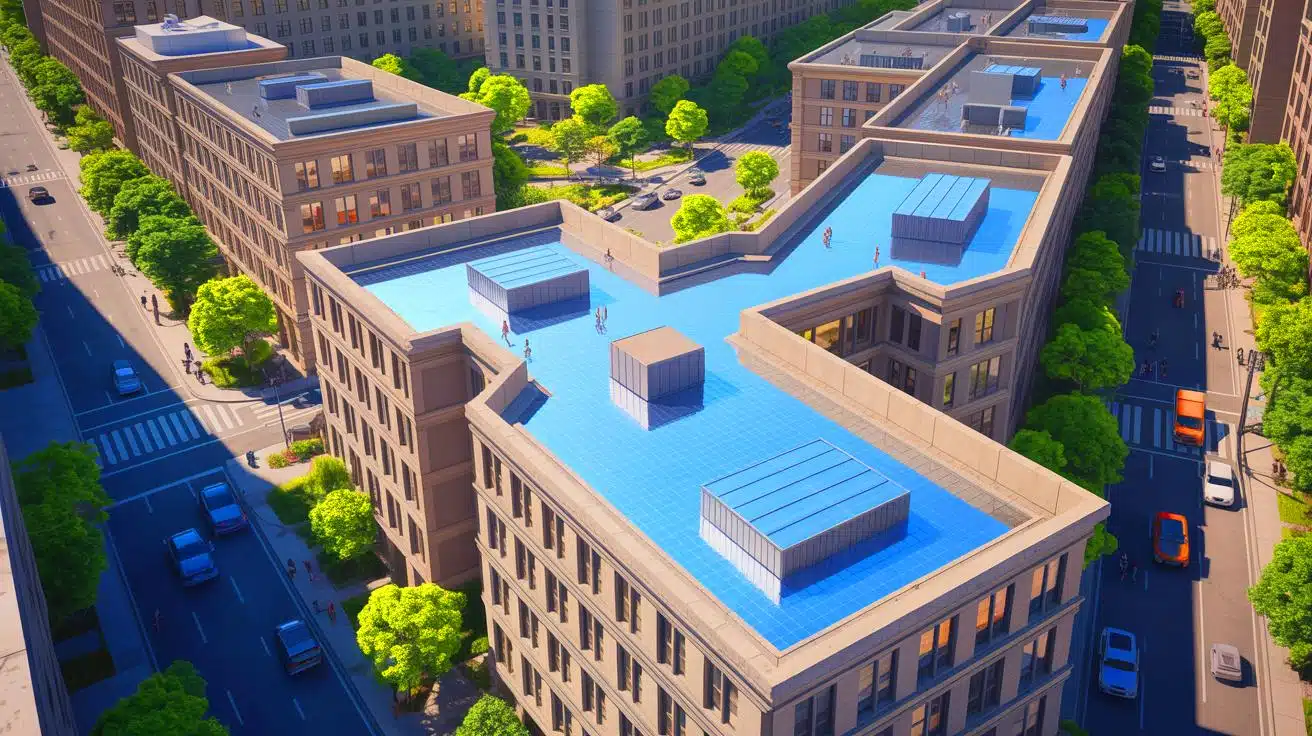
To assess the effectiveness of these new coatings, the research team conducted a series of experiments on building models exposed to direct sunlight for four hours. The results were striking: the roofs covered with the AI-designed paint exhibited temperatures 10 to 36 degrees Fahrenheit lower than those treated with standard white or gray paints. Han Zhou, a co-author of the study, noted that this thermal difference is substantial enough to significantly reduce air conditioning usage in hot areas.
Energy savings potential is substantial. The team calculated that coating a four-story building's roof with this material in cities like Bangkok or Rio de Janeiro could save approximately 15,800 kilowatt-hours annually. For context, a typical domestic air conditioning unit consumes around 1,500 kilowatt-hours per year. This means that coating 1,000 buildings could power over 10,000 air conditioners for an entire year. The efficacy of these materials is due to their dual action as thermal meta-emitters. They effectively reflect solar radiation while emitting accumulated heat as infrared waves in specific spectral bands. These bands, known as "atmospheric windows," lie in the infrared spectrum where greenhouse gases absorb minimal radiation, thereby preventing surface heating and atmospheric overheating.
“We’re Powering Moon Bases With Nuclear Waste”: Company Reveals Secret Space Energy Revolution
Beyond Earth: Expanding Applications of the Paint
The efficiency of these coatings extends beyond building rooftops. Their ability to reflect sunlight and emit heat as infrared radiation makes them particularly suitable for combating urban heat islands. Cities often record temperatures several degrees higher than their outskirts. By targeting surfaces that accumulate the most heat, these coatings could become a crucial tool in climate change adaptation, as noted by researcher Cheng-Wei Qiu.
Researchers are also exploring diverse applications. In the automotive sector, covering car bodies and interiors could reduce heat buildup during sunny parking. In the textile industry, incorporating these materials into technical fabrics could offer clothing that maintains a stable body temperature in hot environments. Moreover, the coatings hold potential for thermal management in satellites and other space vehicles, where extreme temperatures can jeopardize onboard instruments. These meta-emitters could effectively reflect solar radiation and dissipate internal heat in a controlled manner.
This Reactor That Recycles Its Own Nuclear Waste And Putin Hides The Energy Revolution
Toward a New Generation of Intelligent Materials
Dr. Alex Ganose from Imperial College London highlights the rapid evolution in this field. Many startups have been attempting to use generative AI for materials over the past year. Microsoft has developed MatterGen, a platform leveraging AI to design complex materials for various industrial uses. These include new crystalline structures for energy, alloys for aerospace, and medical composites, all created virtually before physical testing.
This approach signals a profound shift in research. Digital simulation combined with deep learning is replacing extensive experimental trials. Scientists behind the meta-emitter project see this as a promising convergence, potentially accelerating the discovery and industrialization of new materials. As AI becomes integral to materials science, it emerges as a strategic tool to address 21st-century challenges. However, experts caution that while AI can generate high-performing theoretical models, experimental validation remains essential to avoid creating materials that are impractical at scale or have undetected limitations.
The integration of AI in material science promises transformative impacts across various sectors. Yet, it also raises critical questions about the balance between innovation speed and scientific rigor. As researchers continue to explore the potential of AI-designed materials, how might these developments reshape our approach to sustainability and energy conservation in the future?


This paint sounds incredible! Does it come in different colors? 🎨
Wow, 36 degrees cooler? Is it available for home use yet? 🏠
This sounds amazing, but how expensive is this paint going to be?
Wow, 36 degrees?! That’s a game-changer. How long until this is available to the public?
Can it be applied to existing buildings, or is it only for new constructions?
Sounds promising, but won’t the paint just peel off in a few years? 🤔
I hope this doesn’t mean a job loss for all those in the air conditioning industry. 😟
Imagine painting your house and saying goodbye to AC bills forever! 😮
AI is taking over everything, even paint now? What’s next?! 🤖
Is the paint eco-friendly? I’m worried about the environmental impact.
Is this really the end of air conditioning, or just another overhyped tech story?
Anyone else think this sounds too good to be true?
Can this paint be applied to existing buildings, or does it only work on new structures?
How long does the cooling effect last?
This is amazing work! Thank you to the researchers who made this possible! 🌟
Can it be used on cars to keep them cooler in the summer? 🚗
36 degrees cooler?! That’s like cheating summer! 😎
Is this paint available in different colors or just white?
Great innovation! Thanks to the researchers for their hard work! 🙌
How does this paint hold up in rainy climates?
Interesting, but I’d love to see some real-world applications before believing it.
So AI can invent cooling paint, but it can’t clean my house? 😂
Can we expect this to be commercially available soon?
Hope it doesn’t peel off easily. What’s the durability like?
This could revolutionize urban planning and architecture!
Is it safe for kids and pets?
I’m suspicious. Anything that sounds this good must have a catch, right?
Does this mean we can finally say goodbye to crazy electric bills? 💸
I’m worried about how this affects indoor air quality. Any studies on that?
Hope it doesn’t get banned for some weird reason. 🤞
AI is truly changing the world, one paint job at a time!
Could this paint affect the structural integrity of buildings?
How does it compare in cost to traditional cooling methods?
Imagine painting entire cities with this! Future is here. 🏙️
Fantastic news! How soon can we see this in stores? 🛒
Wonder how it’ll behave in extreme temperatures, both hot and cold.
What’s the lifespan of this paint once applied?
Anyone else thinking about painting their driveway with this? 😂
Are there any downsides to using AI-designed materials?
Can this be used on textiles to make clothing cooler? 🧥
Thank you for this breakthrough! It could save so much energy!
Is this just another AI hype or something genuinely beneficial?
What about aesthetic appeal? Does it look good on buildings?
Now I’m waiting for AI to invent a paint that cleans itself. 🤔