



| IN A NUTSHELL |
|
As the world faces the escalating threat of climate change, an alarming new study reveals the potential impact on a crucial marine organism: Prochlorococcus. These tiny cyanobacteria, despite their minute size, play a significant role in sustaining life on Earth by producing about 20% of the planet’s oxygen. Researchers have raised concerns that global warming could severely impact their population, leading to dire consequences for the global oxygen supply. This article delves into the complexities surrounding these microorganisms, the potential scenarios of their decline, and what this means for our planet’s future.
The Invisible Powerhouses of Oxygen Production
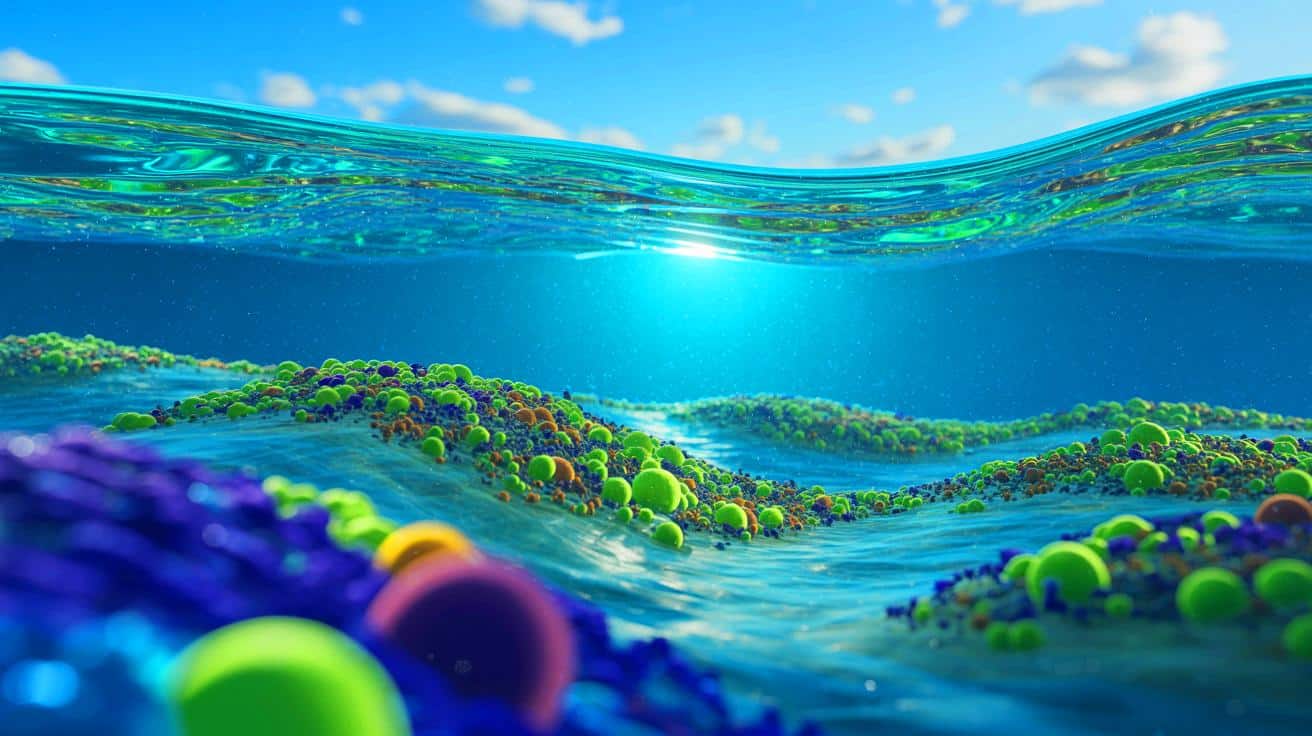
Despite their microscopic size, Prochlorococcus cyanobacteria are invisible powerhouses when it comes to oxygen production. These tiny organisms are the most abundant photosynthetic bacteria in the oceans and are responsible for generating roughly one-fifth of the Earth’s oxygen. Occupying the sunlit, or euphotic, zone of the oceans, these bacteria thrive between latitudes 40°N and 40°S where they receive ample sunlight for photosynthesis.
The density of these bacteria can reach up to 100,000 cells per milliliter, underscoring their essential role in marine ecosystems. For years, Prochlorococcus marinus, the sole species within this genus, went unnoticed due to its diminutive size, classified as picoplankton. Measuring between 0.2 and 2 micrometers, these organisms are now recognized for their critical contribution to the global oxygen cycle.
However, as climate change intensifies, researchers are concerned about the stability of Prochlorococcus populations. Contrary to earlier assumptions that these bacteria might expand their range with warming oceans, recent studies suggest otherwise. A significant study led by Washington State University’s School of Oceanography indicates that rising temperatures could actually constrain their distribution, potentially leading to a reduction in their oxygen-producing capacity.
Varying Severity Based on Climate Scenarios
The study, conducted from 2010 to 2023, utilized data collected from instruments aboard ships traversing the tropical and subtropical Pacific Ocean. The researchers observed that the division and growth rates of Prochlorococcus marinus are closely tied to ocean temperature. Notably, their concentration decreases when water temperatures exceed 82.4°F (28°C).
This finding is particularly troubling as it contradicts previous predictions of exponential growth at higher temperatures. Researchers modeled these observations against various climate change scenarios, known as Representative Concentration Pathways (RCPs). Under the RCP 4.5 scenario, which projects a temperature increase of 1°F to 8.1°F by 2100, a 17% decline in P. marinus productivity is expected. The more severe RCP 8.5 scenario, forecasting a rise of 4.7°F to 8.6°F, predicts a staggering 51% reduction in productivity.
While these projections are concerning, the researchers acknowledge potential limitations in their sampling methods. They suggest the possibility of heat-tolerant strains of P. marinus existing in the hottest tropical regions, which were not included in the study. Further exploration is needed to identify and understand these potentially resilient strains.
Implications for Global Oxygen Supply
The potential decline of Prochlorococcus populations poses a significant threat to the Earth's oxygen supply. Given their role in producing 20% of the planet's oxygen, a decrease in their numbers could have far-reaching consequences. Oxygen, a critical component for life, supports respiration in almost all living organisms, and any disruption to its availability could impact biodiversity and ecosystem stability.
Moreover, the decline of these cyanobacteria could disrupt marine food webs. As primary producers, they form the base of the oceanic food chain, supporting a wide range of marine life. A reduction in their population could lead to cascading effects throughout the marine ecosystem, affecting species diversity and abundance.
Addressing this issue requires a multifaceted approach, including reducing greenhouse gas emissions to mitigate climate change. Additionally, further research into the resilience and adaptability of Prochlorococcus is crucial. Understanding how these bacteria respond to environmental changes will be key to developing strategies for preserving their populations and, by extension, the global oxygen supply.
Future Research Directions
The study's findings highlight the need for comprehensive research to better understand the dynamics of Prochlorococcus populations under changing environmental conditions. Exploring the genetic diversity within these bacteria could reveal adaptive traits that enable survival in warmer waters. Such insights could inform conservation efforts and help predict the responses of other marine organisms to climate change.
Furthermore, investigating the interactions between Prochlorococcus and other marine species could provide a deeper understanding of their ecological roles. Collaborations between oceanographers, microbiologists, and climate scientists will be essential to develop holistic strategies for preserving the health of marine ecosystems.
As global temperatures continue to rise, the fate of these vital bacteria hangs in the balance. The challenge lies in balancing human activities with the preservation of essential natural processes. How can we ensure the survival of these microorganisms, given their critical role in maintaining the Earth's oxygen levels?

Is there any hope that Prochlorococcus can adapt to rising temperatures? 🤔
Wow, I had no idea bacteria could have such an impact on our oxygen levels! 😮
Thanks for the informative article! I had no idea these bacteria were so important to our oxygen supply.
Is there any way to artificially boost Prochlorococcus populations?
This sounds serious, but how accurate are the climate models predicting this decline? 🤨
Great article! It’s both fascinating and terrifying to learn about these tiny creatures.
Why isn’t this being talked about more in the media? Seems like a big deal! 📢
Great article! Can we do anything to help these bacteria survive?
Can we engineer heat-resistant strains of Prochlorococcus to counteract climate change effects?
If Prochlorococcus dies off, what other effects might we see in the ocean ecosystem?
This sounds like a plot from a sci-fi movie. Are we sure this is real? 🤔
So basically, we’re doomed? 🌍💀
Interesting read. Are there any organisms that could replace the role of Prochlorococcus if they decline?
Thanks for shedding light on such an important issue. More people need to know about this!
Why doesn’t the article mention any specific actions being taken to address this issue?