



| IN A NUTSHELL |
|
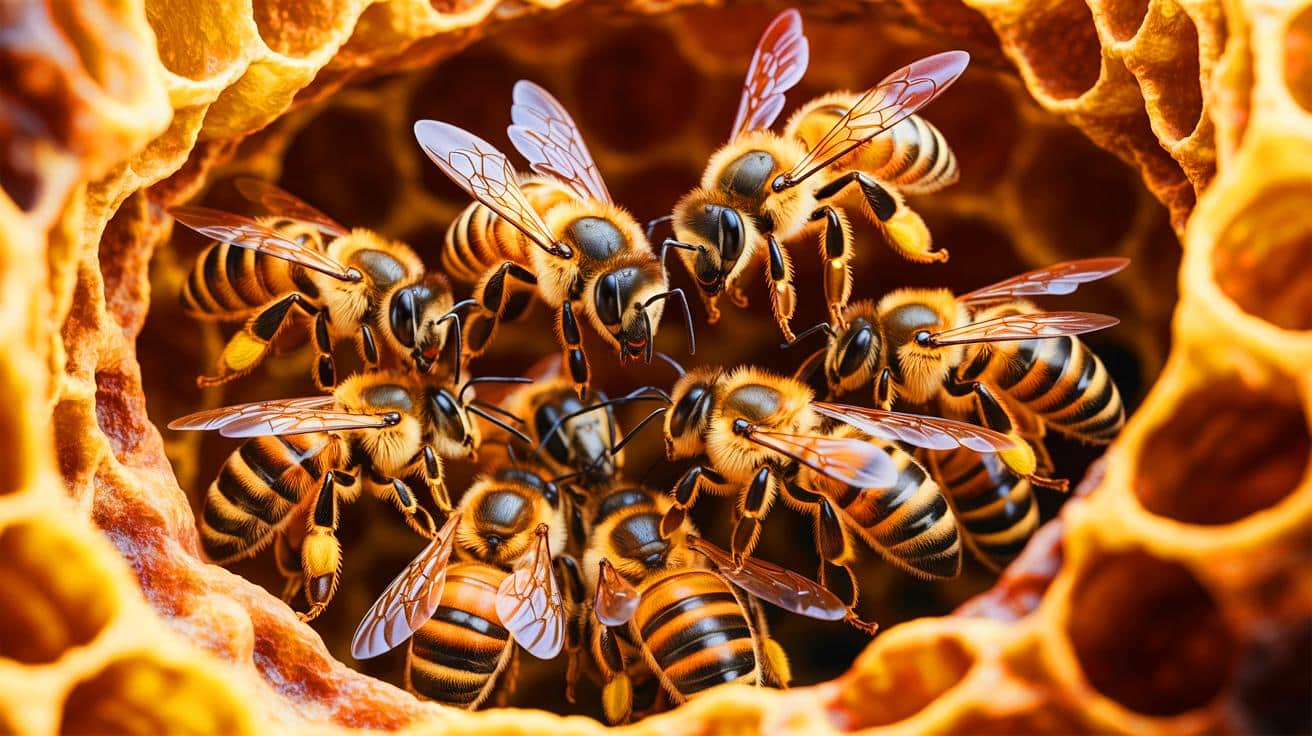
The intricate communication methods of honeybees have long fascinated scientists and laypeople alike. Recent research has unveiled a startling new layer to the already complex “waggle dance” performed by honeybees. Traditionally thought to convey only basic vector information, such as direction and distance from a hive to a food source, this dance has now been found to carry even more sophisticated data. Researchers have discovered that honeybees integrate memory of their environment into their flights, effectively demonstrating a form of spatial intelligence. This groundbreaking study sheds new light on the cognitive abilities of these tiny yet remarkable creatures, adding a new dimension to our understanding of animal communication.
The Waggle Dance: More Than Just Directions
The honeybee’s waggle dance has been a subject of fascination for decades. Traditionally, it was understood as a way to communicate the location of resources to fellow bees. However, a recent study published in Current Biology reveals that the waggle dance serves an even more intricate purpose. Researchers trained a group of forager bees to visit a feeder located north of their hive along a gravel road. By releasing the bees from three different sites, they discovered that the dance was more complex than originally thought.
Using harmonic radar tracking, researchers could record the detailed flight paths of individual bees. They found that bees did not merely follow the dance’s vector information. Instead, they integrated it with their memory of the landscape features they would encounter. In the absence of expected landmarks, their search behavior became more exploratory, flying farther and in less straight paths. This suggests that the waggle dance includes spatial information that helps bees anticipate environmental features during their flight.
Jaya Anand Singh’s Research Path : A Journey from Curiosity to Contribution
A Truly Intelligent and Efficient Form of Communication
The findings from this study highlight the sophistication of honeybee communication. The bees demonstrated an ability to integrate multiple forms of information, effectively creating a cognitive map of their surroundings. This ability allows them to form expectations about the landscape they will traverse, enhancing their navigational efficiency. According to the study authors, this complex form of communication shows that bees are not merely following a set of instructions. They are actively engaging with their environment, using both the dance’s vector information and their spatial memory.
This behavior points to a higher level of cognitive complexity in honeybee communication. The study’s findings challenge previous notions that the waggle dance was a simple directional cue. Instead, it is a multifaceted form of communication that involves both symbolic and experiential elements. This discovery offers new insights into the cognitive abilities of bees, demonstrating that their communication methods are far more advanced than previously believed.
The Implications of Cognitive Mapping in Bees
The concept of a cognitive map in honeybees offers fascinating implications for our understanding of animal intelligence. The study suggests that bees use a shared spatial reference frame, combining symbolic communication with personal experience. This ability to integrate different forms of information into a cohesive navigational strategy is a hallmark of advanced cognitive function. It implies that bees possess a level of spatial awareness and memory integration that rivals more complex animals.
This discovery raises intriguing questions about the evolution of communication in the animal kingdom. If bees can create cognitive maps to navigate their environment, what other animals might possess similar capabilities? The study opens the door to further research into the cognitive abilities of insects and other animals, potentially revealing new insights into the evolution of intelligence and communication.
F-Sync Wins 2025 Red Dot Design Award in Brands & Communication Category
Future Directions in Honeybee Research
This study is just the beginning of understanding the full range of cognitive abilities in honeybees. Future research could explore how various environmental factors influence the waggle dance and its effectiveness in communicating spatial information. Additionally, scientists may investigate how these communication strategies affect the overall success of a hive in resource acquisition and survival.
The potential for interdisciplinary studies combining behavioral science, ecology, and technology could further illuminate the complexities of bee communication. As we continue to unravel the mysteries of the honeybee waggle dance, we gain not only a deeper appreciation for these insects but also valuable insights into the fundamental nature of communication and intelligence in the animal world.
The discovery of cognitive mapping in honeybees challenges our understanding of animal intelligence and communication. As scientists continue to explore the capabilities of these remarkable creatures, new questions arise. How might these findings influence our broader understanding of intelligence in the animal kingdom? What other surprising abilities might we uncover in the future?



This is absolutley mind-blowing! I always knew bees were smart, but this takes it to another level! 🐝
Wow, who knew bees were such geniuses? 🐝
So if bees can map their environment, does this mean they have a sort of “bee GPS”? 🤔
This is fascinating! How do scientists even track these tiny creatures with radar?
Thank you for this fascinating article! It really makes me appreciate the complexity of nature. 🌼
Is this why bees never get lost? 😄
Pretty sure my GPS doesn’t work as well as these bees… 😂
Great article! I had no idea bees had such complex communication methods. Thank you!
How do they actually track the bees? Sounds complicated!
Does this mean honeybees are smarter than some people? 🤔
I never thought I’d be jealous of a bee’s navigational skills.
This is mind-blowing! What else do we not know about bees?
Do other insects have this ability, or is it unique to honeybees?
How do bees remember all this information without a GPS?
Great read! I always learn something new about bees. Thanks for sharing!