



| IN A NUTSHELL |
|
In the world of innovation, where technology continuously reshapes the boundaries of possibility, the story of Tsung Xu stands out as a remarkable testament to individual ingenuity. Without a formal background in aerospace engineering, Xu embarked on an ambitious journey to design and build a fully functional vertical takeoff and landing (VTOL) drone using 3D printing technology. His achievement is not just a personal victory but a significant milestone in amateur aerospace engineering. This article delves into the fascinating process and the groundbreaking outcome of Xu’s project, highlighting how consumer-grade technology is redefining the limits of what individuals can achieve.
First-Time Maker’s Drone
Xu’s journey into drone-making began with a bold vision and an unwavering commitment to innovation. Despite lacking formal training in aerodynamic modeling, 3D printing, or computer-aided design (CAD), Xu managed to execute his project within a mere 90 days. This undertaking was a testament to his dedication and resourcefulness. He meticulously documented the process, offering a detailed build log and a compelling video presentation on YouTube, which serves as both an inspiration and a guide for other aspiring creators.
The drone was crafted entirely from scratch, with Xu adopting a bottom-up approach. He designed, modeled, and printed each aerodynamic surface and structural component himself, relying on a Bambu Lab A1 3D printer. This desktop device, rated 4.5 out of 5 stars in independent reviews, proved to be the backbone of his prototyping efforts. The printer allowed Xu to rapidly iterate on complex aerodynamic shapes, facilitating the creation of the drone’s composite parts. Critical non-printable components, such as radio equipment, motors, and electronic speed controllers (ESCs), were sourced separately, but Xu skillfully integrated these systems to ensure seamless functionality.
130-Mile Range
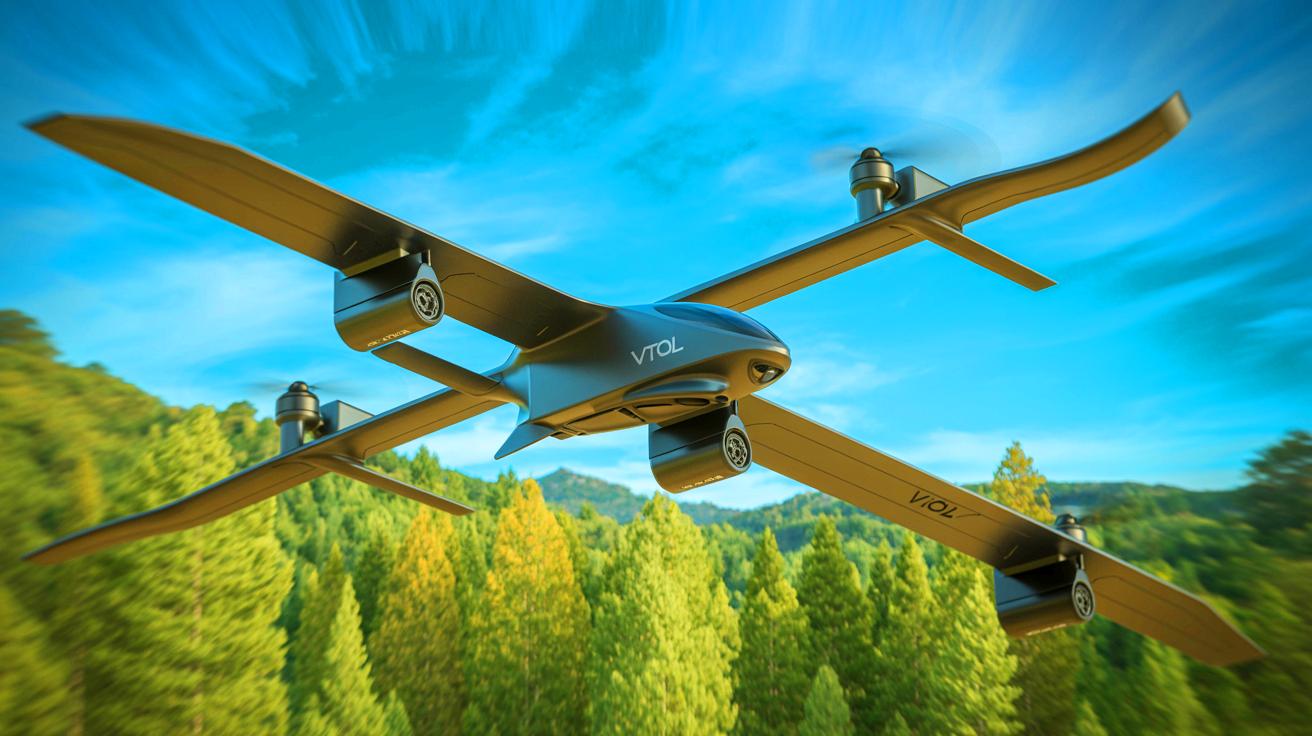
The drone’s impressive capabilities stem from its efficient design and power optimization. With a wingspan tailored for optimal glide and a robust VTOL propulsion system, the drone achieved an endurance of approximately three hours. This allows it to cover a distance of 130 miles on a single charge. Such performance is typically reserved for advanced military or commercial unmanned aerial systems (UAS), underscoring the significance of Xu’s achievement.
The winged VTOL design enables vertical launch and recovery without the need for a runway, transitioning to efficient forward flight once airborne. This capability, combined with Xu’s strategic endurance planning, demonstrates how consumer-accessible technologies are rapidly closing the gap between hobbyist experimentation and advanced aerospace development. Although Xu did not provide a full technical breakdown, he emphasized the steep learning curves he faced, including understanding flight dynamics, sourcing components, and identifying design failures during the printing and assembly process.
Innovation in DIY Aerospace
Xu’s project is a microcosm of a broader trend in the world of aerospace and defense technology. As institutions like the U.S. Army expand their initiatives to incorporate additive manufacturing and autonomous systems, Xu’s civilian project echoes these trends by showcasing the potential of low-cost, decentralized innovation. His achievement highlights how individuals, armed with determination and accessible technology, can contribute to fields traditionally dominated by large corporations and government entities.
This democratization of technology has profound implications for the future of research and development. Xu’s work demonstrates that groundbreaking advancements are no longer confined to well-funded labs but can emerge from garages and small workshops. His drone serves as a proof of concept for the power of consumer-grade innovation, potentially inspiring a new generation of inventors to explore uncharted territories.
The Future of Consumer-Grade Innovation
The success of Xu’s project raises important questions about the future of consumer-grade innovation. As technologies like 3D printing become more accessible and affordable, the line between professional and amateur innovation blurs. This democratization empowers individuals to tackle complex challenges, potentially leading to breakthroughs in areas as diverse as aerospace, healthcare, and environmental science.
Xu’s journey is a reminder that innovation is not the sole domain of experts, but a field open to anyone with passion and perseverance. His VTOL drone, a product of creativity and resourcefulness, challenges us to rethink what is possible and encourages us to explore our own potential. As we look to the future, we must ask ourselves: How will the next wave of consumer-grade innovation reshape our world, and what role will we play in it?



Wow, this is amazing! How did Xu manage to do all this with no experience? 🤔
Did Xu have any help or was this a solo project?
I’m curious about the materials he used for printing. Anyone knows?
This is a great example of what’s possible when you mix creativity with technology! 👏
Can someone point me to the YouTube video? I want to see the drone in action!
Is there any way to join a community of makers like Xu?
How much did it cost him to build this drone?
Is it just me, or does this sound too good to be true? 😬
The whole idea of a consumer-grade VTOL drone is fascinating. What’s next? 🚀
Xu’s story makes me want to pick up 3D printing again. Thanks for the motivation!
I wish there were more details on the electronics he used. 🔌
Did he have any previous experience with 3D printing at all?
Great article! How can we encourage more people to innovate like this?
What kind of battery does it use to fly 130 miles?
Can someone explain what VTOL means? I’m new to this. 😅
As someone who loves drones, this is truly inspiring. Keep it up, Xu! 🚁
Any tips for beginners who want to start building drones?
How does this compare to professional drones? Is it really as good as it sounds?
That’s one heck of a printer to be able to make a drone! 🖨️
What challenges did Xu face during the project?
Is there a community where Xu shares his knowledge and experience?
Wow, this is really pushing the boundaries of what’s possible with 3D printing!
I’m not sure I believe this. Where’s the proof? 🤨
Is there a way to get in touch with Xu for collaboration? 🤝
How did he manage the weight distribution of the drone?
Did Xu document his entire process somewhere? Would love to see his build log.
Can someone explain the difference between consumer-grade and professional-grade drones?
This is what innovation looks like. Hats off to Xu! 🎩
Absolutely inspiring! What’s Xu’s next project? 🤔
130 miles in 3 hours? That’s some serious engineering! 🚁
Does anyone know if Xu plans to share the design files for his drone?
This is the future of innovation! Go Xu! 🌟
Wait, so he built this in 90 days? That’s faster than most of my projects. 😂
Impressive achievement, but I wonder how he handled the legal aspects of flying drones over such a distance.
I’m skeptical. How reliable is a 3D-printed drone in real-world conditions? 🤔
Thank you for sharing this story! Truly inspiring. 🙌