




| IN A NUTSHELL |
|
Engaging a dog’s attention can often be a challenging task, whether due to its innate character or environmental distractions. Many dog owners have experienced the frustration of their pet ignoring a tennis ball right in front of them or becoming fixated on a squirrel in the park. However, recent research offers a promising solution to this common problem. This study provides a scientifically-backed technique to capture and maintain a dog’s attention, revolutionizing the way we interact with our furry companions.
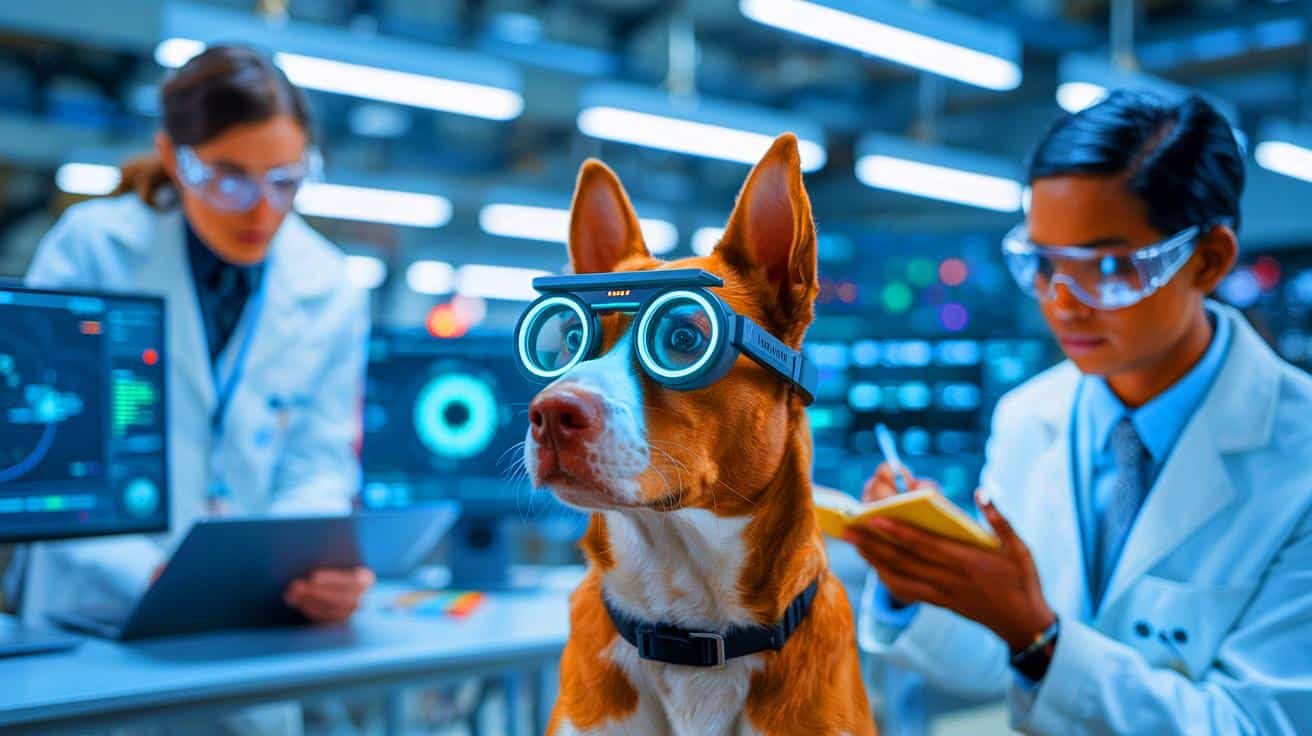
Dogs Equipped With Special Glasses
The concept of referential communication involves pointing to an object while speaking, a fundamental aspect of human communication that aids language learning in infants. Interestingly, dogs exhibit a similar capability to follow these referential cues, although the optimal method for engaging them has been uncertain. Many pet owners struggle to direct their dog’s attention to specific elements in their environment.
In a groundbreaking study, Austrian scientists employed eye-tracking devices on dogs to observe their responses to human cues. These devices recorded the dogs’ eye movements to determine how frequently they followed the experimenter’s gestures and obeyed given commands. Initially involving around thirty dogs, the experiment continued with twenty dogs due to some animals being uncomfortable with the ski goggle-like eye-tracking equipment. The study included eight mixed breeds, four terriers, two Australian Shepherds, two poodles, a collie, a flat-coated retriever, a German shepherd, and a Rhodesian Ridgeback.
Conducted at the Clever Dog Lab of the University of Veterinary Medicine, Vienna, the experiment placed each dog in front of a kneeling experimenter with two bowls on either side, only one of which contained a hidden treat. The dogs participated in five different scenarios, each repeated six times. These scenarios included the experimenter pointing at the bowl while looking at the dog, pointing and looking at the bowl simultaneously, or simply gazing at the bowl. They even tested a common owner’s trick: pretending to throw a ball towards the bowl while keeping it in hand.
The Results of These Experiments
As reported in the Proceedings of the Royal Society B: Biological Sciences, combining gaze and pointing gestures proved to be the most effective technique for guiding dogs towards a specific direction or indicating a hidden treat. While the gaze and gesture are impactful individually, “together, they are more powerful”, remarked Christoph Völter, the lead author and researcher at the Austrian university.
The eye-tracking data revealed that dogs performed best when the experimenter simultaneously pointed and looked at the treat-containing bowl. Conversely, their performance dropped when the human pretended to throw a ball.
“These findings might explain why prior research struggled to convincingly show that dogs follow eye or hand cues when presented separately,”
https://www.sustainability-times.com/research/nasa-is-panicking-about-this-discovery-second-earth-found-40-light-years-away-that-destroys-everything-we-knew/
Völter suggested. The key seems to lie in the combination of these signals.
This might be attributed to the difficulty dogs face in averting their gaze from a human who is simultaneously pointing and staring at them.
Questions About Dogs’ True Understanding
This discovery implies that dogs respond to human referential cues rather than merely directional signals. Essentially, dogs appear to understand the indication’s meaning (i.e., a treat is in a specific direction) rather than merely following a pointed direction.
However, researchers caution against drawing premature conclusions. Völter notes that despite empirical evidence supporting the gaze-point combination’s effectiveness, it is too early to assert that dogs fully grasp the communicative nature of these signals like humans do. “Is this an imperative directive for them, indicating where to go? Or do they perceive it as a more complex form of communication?”, he questions. Further studies are required to explore this aspect.
The team is keen to replicate the study with a larger sample of dogs. Additionally, they aim to leverage these insights to determine if dogs can learn and remember information more effectively using this method, potentially unlocking further secrets of canine cognition.
Understanding the Implications for Dog Training
The findings from this study could transform traditional dog training methods. By demonstrating the power of combined visual and gestural cues, trainers and owners alike can enhance their interactions with dogs. This approach may lead to more effective communication, fostering stronger bonds between humans and their canine companions.
Such insights not only improve training outcomes but also enrich our understanding of how dogs perceive and process information. This could pave the way for developing new training tools and techniques that align with dogs’ natural abilities to interpret human signals.
As we continue to explore these interactions, the potential to deepen our connection with dogs increases, offering more fulfilling relationships grounded in mutual understanding and respect.
As we uncover more about how dogs perceive and respond to human cues, this research opens new avenues for enhancing how we communicate with our pets. What further insights into canine cognition could transform our understanding of these loyal companions in the future?



Wow, spy glasses for dogs? What’s next, secret agent cats? 😂
Wow, spy glasses for dogs? What’s next, a canine James Bond? 🕵️♂️🐶
Interesting research! How long did it take for the dogs to get comfortable with the glasses?
Fascinating study! Do you think this will change how we train service dogs?
I wonder if my dog would still ignore me even with these high-tech glasses. 🤔
Are these eye-tracking devices safe for dogs to wear for extended periods?
Grate article! I always thought my dog understood me better than I realized.
So, are these glasses available for purchase? Asking for a friend. 🐶
Am I the only one worried about dogs becoming too smart with this tech? 😅
This is fascinating! Could this research help improve service dog training programs?
Thank you for this insightful article! It’s amazing how much we can still learn about dogs.
I’m skeptical. How do we know the dogs weren’t just following the scent of the treat?