




| IN A NUTSHELL |
|
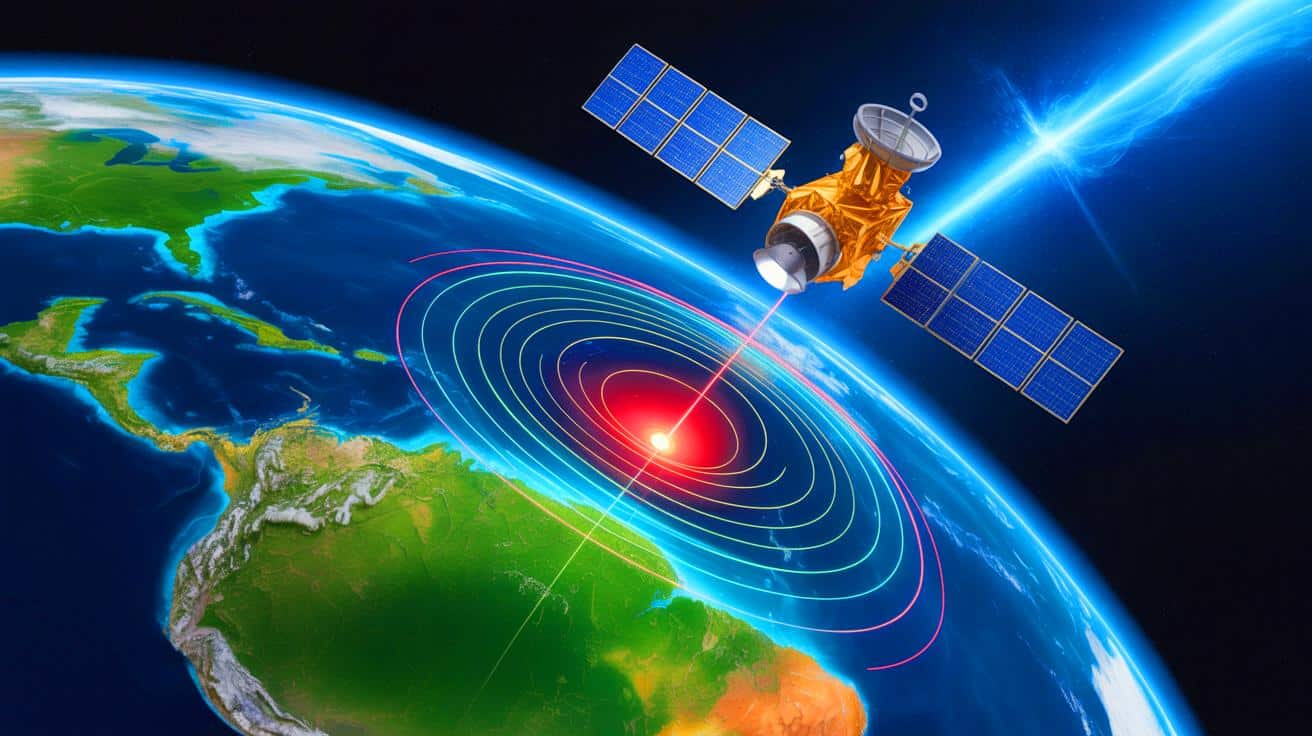
The South Atlantic Anomaly (SAA) is a region of weakened magnetic field that has become a focal point for scientists worldwide. Situated over South America and the South Atlantic Ocean, the SAA poses unique challenges for space technology. As Earth’s magnetic shield weakens in this area, satellites and other space instruments are increasingly vulnerable to high-energy particles. NASA has been at the forefront of monitoring and studying this phenomenon to mitigate its impacts on space missions. This article delves into the intricate dynamics of the SAA, its threats to technology, and the ongoing efforts to understand its evolution.
Deep Origins and Complex Mechanisms
The South Atlantic Anomaly is a geomagnetic phenomenon that presents both curiosity and concern. It is defined by a significant reduction in magnetic intensity compared to surrounding regions. This weakness allows high-energy solar particles to come dangerously close to Earth’s surface, posing a threat to technological systems. The origins of the SAA are tied to the geodynamo process within Earth’s outer core, where the movement of molten iron and nickel generates the planet’s magnetic field.
Key factors contributing to the SAA include the tilt of Earth’s magnetic axis relative to its rotational axis and the influence of the African Large Low Shear Velocity Province, a dense structure located about 1,800 miles beneath the African continent. These disruptions lead to a local polarity reversal and weaken the dipole field intensity in this area. Understanding these complex mechanisms is crucial for predicting how the SAA will evolve and what challenges it may present to our technological infrastructure.
“They’ve Been Hiding This Monster”: Student Discovers 23 Foot Killer Dinosaur In Museum Storage
A Threat to Space Technology
The SAA presents significant risks to space technology, with satellites being particularly vulnerable as they pass through this region. The high levels of energetic protons can lead to single event upsets (SEUs), causing temporary malfunctions, data corruption, or even permanent system damage. Satellite operators often shut down non-essential systems when traversing the anomaly to mitigate these risks.
The International Space Station (ISS) also crosses the SAA on each orbit. While the ISS's shielding protects astronauts, external instruments are more susceptible to disruptions. Bryan Blair, deputy principal investigator for the GEDI instrument on the ISS, notes occasional glitches and resets, leading to data loss. Other missions, like the Ionospheric Connection Explorer (ICON), have adapted their operations to account for these vulnerabilities. These efforts highlight the ongoing need for vigilance and adaptive strategies in managing space technology risks associated with the SAA.
Dynamic Evolution and Challenges
The South Atlantic Anomaly is not static; it is dynamically evolving. Recent data from the ESA's Swarm constellation and NASA's SAMPEX mission reveal that the anomaly is drifting northwest, expanding, and beginning to split into two distinct lobes. This bifurcation creates additional zones of minimum magnetic intensity, increasing the hazards for spacecraft.
As the SAA changes, scientists face the challenge of developing predictive models to ensure the safety of current and future satellites. Continuous monitoring is essential to adapt operations and mitigate potential disruptions. Terry Sabaka of NASA emphasizes the importance of understanding the anomaly's morphology to safeguard technological assets in space. The evolving nature of the SAA underscores the need for ongoing research and adaptation in space mission planning.
Anticipating the Invisible
NASA employs a combination of satellite data and core simulations to refine predictions of the SAA's evolution. Global models like the International Geomagnetic Reference Field (IGRF) track changes in Earth's magnetic field, aiding in mission planning and providing insights into the planet's internal structure. These models work similarly to weather forecasting but on much longer timescales, allowing scientists to estimate secular variation.
While the current evolution of the SAA is unprecedented in the space era, geological records indicate that such anomalies are not unique over long timescales. Importantly, the SAA is not considered an early indicator of a magnetic pole reversal, a rare phenomenon occurring over hundreds of thousands of years. Nonetheless, studying the SAA remains crucial for protecting space technologies and understanding the forces shaping our planet.
As the South Atlantic Anomaly continues to evolve, the scientific community remains vigilant in its efforts to understand and mitigate its impact. With its potential to disrupt satellite operations and influence our understanding of Earth's magnetic field, the SAA poses intriguing questions about the future of our planet's magnetic dynamics. How will these changes shape our technological and scientific pursuits in the years to come?




Wow, science never fails to amaze me! How do they even track these high-energy particles? 🤯
Wow, this sounds like something out of a sci-fi movie! Are we gonna see satellites falling from the sky anytime soon? 🚀
Is there any chance the SAA could affect our daily GPS usage? 🤔
Is this the first time the South Atlantic Anomaly has split into multiple zones?
Thank you for the informative article, it’s fascinating to see how NASA is tackling these challenges.
I’m curious, could this anomaly have any impact on airplanes flying over the region? ✈️
Should we be worried about the SAA affecting our internet or cell phone signals?
It’s amazing how dynamic Earth’s magnetic field is! Nature never ceases to amaze me. 🌍
Thanks for the detailed explanation, but I’m wondering if this could affect GPS accuracy?
Why isn’t the SAA more widely talked about? Seems like a pretty big deal for space tech!
So the SAA is like a Bermuda Triangle for satellites? 😅
Does this mean we’ll need to launch fewer satellites in the future to avoid these dangerous zones?
So, are we safe from the SAA on the ground, or could it have some impact here too?
This is all very interesting, but how does it affect my Netflix streaming? 😂
Are there any specific satellites currently at risk that we should know about?
Could the SAA have any impact on the upcoming Mars missions?
I always thought the magnetic field was static. Guess I was wrong! 🌈
Is there any way to strengthen the Earth’s magnetic field to counteract the effects of the SAA?
Thanks for shedding light on this complex topic. More articles like this, please!
How do these particle storms compare to solar flares in terms of damage potential?
Will this affect satellite TV reception? Asking for a friend! 📡
Can we expect any breakthroughs in technology to mitigate the effects of the SAA in the near future?
Is it possible that the SAA could lead to a pole reversal sooner than expected?
What are the long-term implications for space exploration if the SAA continues to expand?
How does the anomaly affect the International Space Station? Do astronauts feel anything? 🧑🚀
I’m curious about how the African Large Low Shear Velocity Province influences the SAA. More details, please!
Great article! It’s reassuring to know NASA is on top of this. Thanks! 🙌
With the SAA changing, are there any new strategies in place for satellite launches?
Does the SAA have any noticeable effects on Earth’s weather patterns?
How do satellite operators decide which systems to shut down when passing through the SAA?
Is the anomaly visible to the naked eye, or is it only detectable with instruments?
Does the SAA pose any threat to space tourism, like the upcoming missions from SpaceX or Blue Origin?
Wasn’t there a similar issue with the Bermuda Triangle? Or am I mixing things up? 🤷♂️
How often do satellites experience malfunctions when passing through the anomaly?
Are there any plans to reposition existing satellites to avoid the SAA’s effects?
Is this just another example of how unpredictable and amazing our planet is? I think so! 🌎
I’m glad to see ongoing research in this area. Continuous learning is key! 📚
How does the SAA compare to other geomagnetic anomalies around the world?
Fascinating stuff! Could this anomaly affect navigation systems in planes? ✈️