




| IN A NUTSHELL |
|
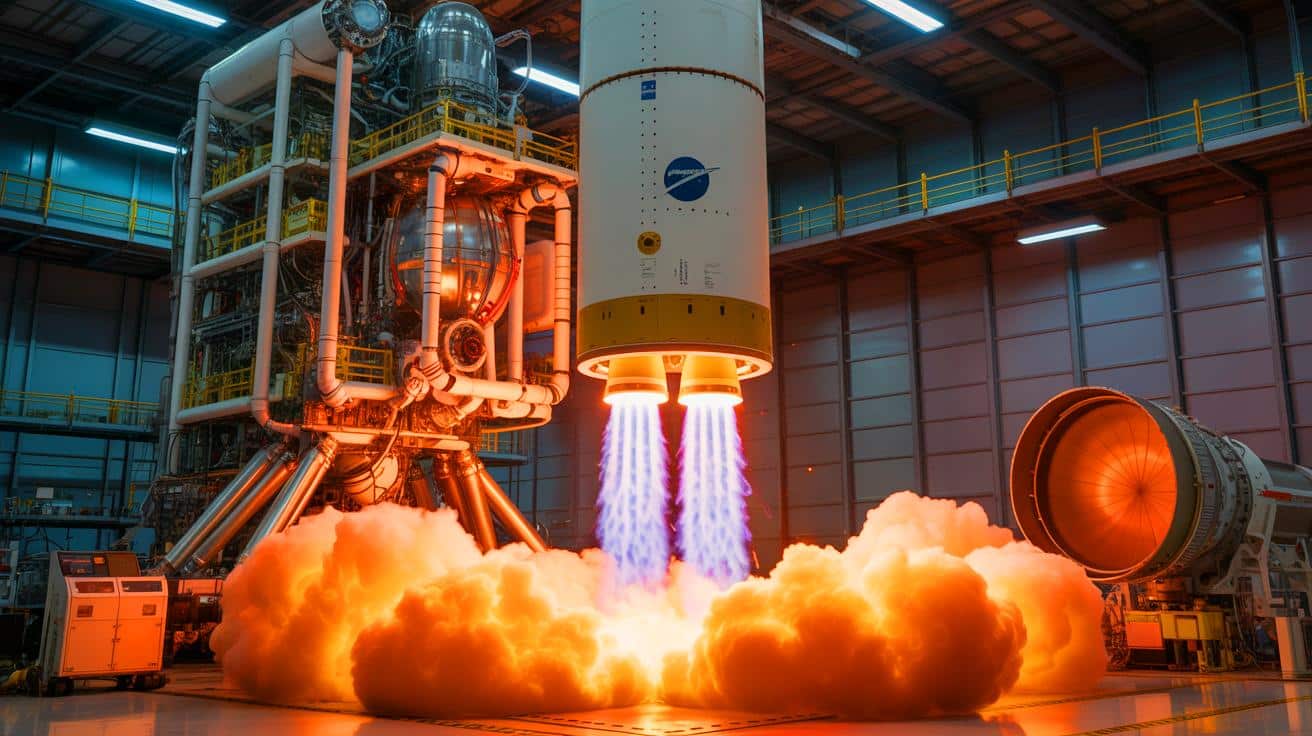
In a groundbreaking development, Northrop Grumman’s laboratories in Maryland recently witnessed the third successful test of a rocket engine designed for an unprecedented mission. This engine is not just an ordinary piece of technology; it signals a revolutionary shift in space exploration. The engine is intended for a task never before attempted by humanity: launching an orbital rocket from the surface of another planet. This ambitious endeavor aims to bring back the first authentic samples from Mars to Earth, a mission that could reshape our understanding of the red planet and our place in the universe.
A Technological Marvel
Creating a rocket capable of launching from Mars is a monumental technological challenge. The Mars Ascent Vehicle (MAV) is designed to achieve this feat. Standing at just 10 feet tall and weighing approximately 990 pounds, the MAV must function flawlessly after enduring a months-long journey through space and years of waiting in Mars’ harsh environment. It must then reach Mars orbit with surgical precision.
The MAV represents a leap in engineering, as it must perform its mission in an environment where every ounce counts, and any failure could jeopardize decades of effort. Unlike terrestrial rockets, the MAV must operate under conditions where even slight miscalculations can lead to mission failure. The success of this mission could pave the way for future endeavors to retrieve samples from other celestial bodies.
The Quest for Martian Treasures
This technical achievement is part of one of the most ambitious missions ever conceived: returning the first genuine samples from Mars to Earth. The Perseverance rover is currently traversing the Martian landscape, meticulously collecting rock and soil fragments with its advanced drilling system. These samples are carefully stored in sealed containers, creating a planetary treasure map.
The collected samples will await the arrival of a second, more specialized rover. This future mission will gather the samples and prepare them for the journey back to Earth. The significance of these samples lies in their potential to provide unprecedented insights into Mars’ geological history and the possibility of past life on the planet.
A Complex Space Ballet
The sequence of events following the sample collection requires intricate coordination. Once the samples are secured in a special container, the MAV will spring into action. Within minutes, it must accelerate its valuable cargo to speeds of nearly 9,000 miles per hour, sufficient to escape Mars’ gravitational pull and reach orbit.
In orbit, an automated spacecraft will rendezvous with the MAV to retrieve the sample container and embark on the long journey back to Earth. This complex choreography requires perfect synchronization among multiple international missions, presenting logistical challenges that surpass any previous space endeavors. The mission’s success hinges on seamless collaboration across nations and agencies.
Innovation in Every Detail
Recent tests conducted by Northrop Grumman have revealed fascinating innovations. The engine utilizes an advanced composite propellant, likely based on ammonium perchlorate mixed with powdered aluminum and resilient polymers. This formulation, derived from the company’s proven STAR motors, must withstand Mars’ extreme temperatures while adhering to strict planetary protection standards.
An intriguing detail emerged during testing: the rocket rapidly rotated during combustion. This rotation indicates the MAV will use gyroscopic stabilization, a proven technique to maintain precise trajectory without complex guidance systems. This innovation highlights the meticulous attention to detail required to ensure mission success.
The Dawn of a New Era
Beyond the technical feat, this mission marks a significant conceptual shift. For the first time in the history of space exploration, we are not just sending robots to observe and analyze on-site; we are bringing back physical fragments of another world to our terrestrial laboratories. Jeff Bemis, program manager at Northrop Grumman, expressed confidence in the project: “We have demonstrated a flight-ready design.” This statement underscores the promise of a new era in space exploration, one that redefines our relationship with the cosmos.
Budgetary Clouds on the Horizon
Despite the technical optimism, a significant uncertainty looms over the project’s financial future. Initially estimated to cost several billion dollars, the Mars Sample Return (MSR) mission faces substantial budget overruns, raising concerns in the U.S. Congress. The astronomical costs of this international collaboration have sparked heated debates over space priorities.
This budgetary pressure creates a frustrating paradox: while engineering advancements, such as the successful MAV tests, continue to progress, political uncertainty threatens to jeopardize one of the decade’s most promising missions. The race against time now involves not only technological prowess but also the political will to fully fund this Martian dream.
The MAV project and its associated missions underscore the complexity and ambition of modern space exploration. As we stand on the brink of a new era, the success of these missions will depend on overcoming technical challenges and securing the financial and political support necessary to bring Martian samples back to Earth. What innovative solutions and collaborative efforts will emerge as we strive to unlock the secrets of the red planet?




Wow, launching a rocket from Mars?! That’s mind-blowing! 🚀
Isn’t the cost of this mission a bit too high? 🤔
Why do we need to bring samples back? Can’t we just study them on Mars?
How will this affect future Mars colonization plans?
Great article, when is the launch date set for?
Hope this doesn’t turn into another budget disaster. 😅
What materials are being used to build the MAV?
Are there any risks of contaminating Earth’s environment with Martian samples?
Could this lead to a space race with other countries?
Will the MAV be reusable, or is it a one-time use rocket?
Thank you for keeping us updated on space exploration news!
What happens if the MAV fails to launch? 😬
How will this mission impact NASA’s future projects?
Isn’t it risky to rely on so many international partners? 🌍
How can they ensure the samples won’t be lost on return to Earth?
Exciting times ahead for space enthusiasts!
How do they plan to deal with Mars’ harsh weather during launch?
Are there any backup plans if the engine fails?
Will this mission help us learn more about potential life on Mars?
Could this mission be delayed due to budget cuts?
What kind of propulsion system is the MAV using?
I’m curious, how will they track the rocket once it’s launched from Mars?
Hope they have enough funding to see this through! 💸
Is this mission part of a larger plan to bring humans to Mars?
How often will these launches happen in the future?
Why is Northrop Grumman leading this project and not NASA directly?
How precise does the MAV need to be when launching from Mars?
Are there any environmental concerns with launching rockets from Mars?
What does this mean for the future of Mars exploration?
Seeing America is footing the bill for all this development I’ll start buying ‘Cheerios’ .
Just like to add it’s a damn shame we(humans) are confined to using single burn rockets.
I was writing a story about humans having a base on Mars I came up with few nifty ideas.
One of the objectives was to be able to return back t a craft that was orbiting Mars.
What involved was an umbrella frame partially open with a rocket in the middle bit like playground umbrella and astronauts would be tied to outer ribs. The idea was have as little weight as, possible then the whole thing would float to surface to be used again.
Why has my comment been deleted 😔