




| IN A NUTSHELL |
|
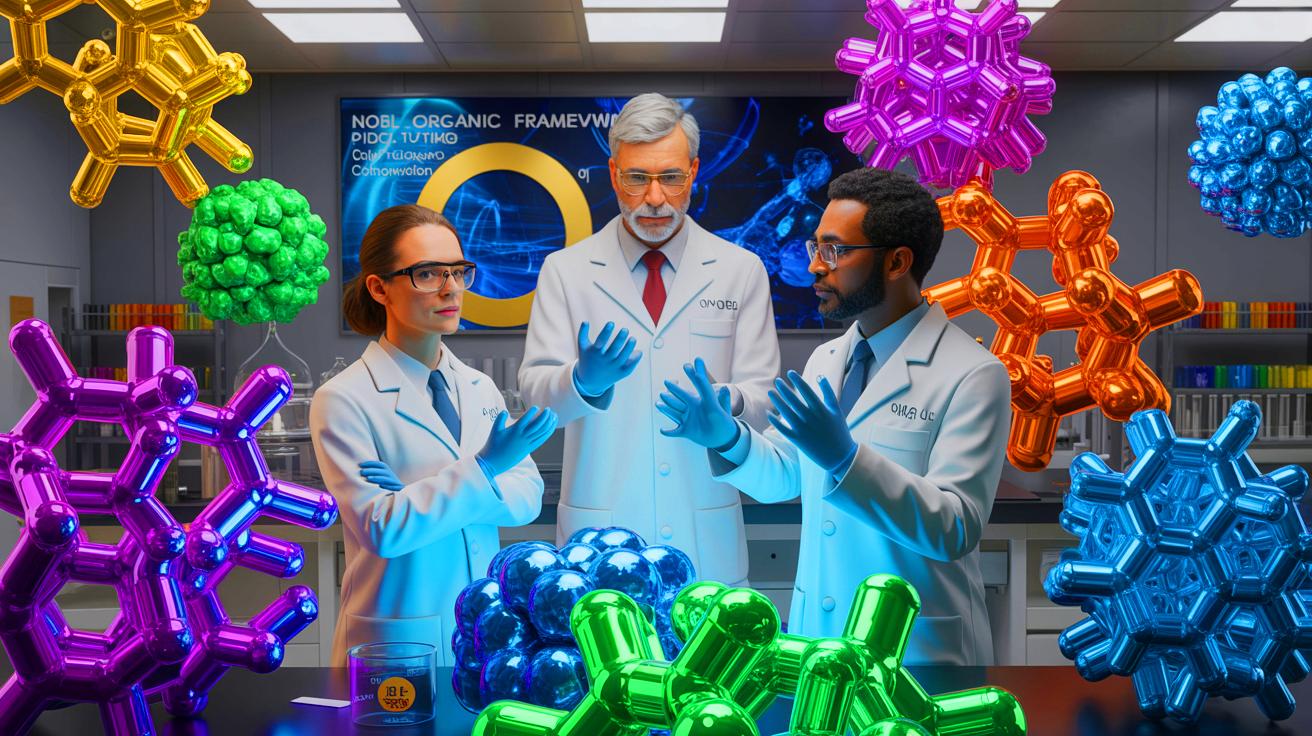
In a remarkable achievement that bridges the realms of science and imagination, three scientists have been honored with the 2025 Nobel Prize in Chemistry for their pioneering work on metal-organic frameworks. These structures, reminiscent of the magical storage capacity found in the fictional world of “Harry Potter,” have the potential to revolutionize how we store and use materials. Susumu Kitagawa, Richard Robson, and Omar M. Yaghi have created materials capable of storing large volumes of gas within tiny cavities, providing a practical solution to many modern challenges. Their work, which began decades ago, continues to inspire innovations in material science and beyond.
The Groundbreaking Discovery
The journey of this Nobel-winning research commenced in 1989 when Richard Robson combined copper atoms with a unique molecule to create a crystal resembling a diamond filled with microscopic compartments. This foundational discovery laid the groundwork for further exploration into metal-organic frameworks (MOFs). MOFs are composed of metal ions and organic molecules organized in a crystalline structure, enabling them to capture and store gases in a manner akin to Hermione Granger’s enchanted handbag in “Harry Potter.”
The analogy holds because, like the magical bag, these frameworks allow for the storage of more than what seems possible, without defying the laws of physics. This breakthrough was further developed by Omar M. Yaghi and Susumu Kitagawa, who between 1992 and 2003, enhanced the stability, flexibility, and modifiability of these frameworks, making them suitable for a wide range of applications. The Royal Swedish Academy of Sciences recognized this innovation as a significant advancement in chemistry, awarding the trio with the prestigious Nobel Prize.
Applications and Implications
Metal-organic frameworks have opened up a world of possibilities in material science and environmental management. Researchers have harnessed these structures to perform various tasks, such as capturing toxic gases necessary for semiconductor manufacturing, harvesting water from arid environments, and catalyzing chemical reactions. Their ability to break down hazardous chemicals, including PFA plastics and pharmaceutical runoff, highlights their potential in addressing environmental issues.
Kitagawa, one of the laureates, envisions an even broader application for MOFs. His dream is to capture and separate components of air, such as carbon dioxide and oxygen, transforming them into valuable resources using renewable energy. This vision aligns with ongoing tests aimed at using MOFs to capture carbon dioxide emissions from industrial sources, which could significantly mitigate the impact of greenhouse gases on the climate.
Jaya Anand Singh’s Research Path : A Journey from Curiosity to Contribution
The Road to Recognition
The announcement of the Nobel Prize in Chemistry took place in Stockholm, Sweden, during a ceremony that celebrated the 117th awarding of this esteemed honor. The prize includes a substantial cash award of 11 million Swedish kronor, equivalent to $1.2 million, underscoring the significance of their contribution to the field. The acknowledgment of this work represents a recognition of decades of dedication and innovation in the realm of chemistry.
Kitagawa expressed his deep gratitude for the recognition, highlighting the potential of their research to change how we interact with materials found in the air. He emphasized the importance of separating these materials, which hold the elements for vital resources, thus paving the way for future advancements. This recognition serves as a testament to the transformative power of scientific inquiry and the pursuit of knowledge.
Looking Toward the Future
The implications of metal-organic frameworks extend far beyond their current applications. As researchers continue to explore their capabilities, the potential for new innovations in various industries becomes increasingly apparent. The ability to capture and store gases efficiently could revolutionize sectors such as energy, transportation, and manufacturing, providing more sustainable and efficient solutions.
As the world grapples with the challenges posed by climate change and resource scarcity, the work of Kitagawa, Robson, and Yaghi offers a glimpse into a future where scientific advancements can address some of humanity’s most pressing issues. Their achievements not only inspire the scientific community but also encourage a broader dialogue on how we can harness technology for the betterment of society. What other groundbreaking discoveries might emerge from the continued exploration of metal-organic frameworks, and how might they reshape our world?


Wow, this is like sci-fi coming to life! Can’t wait to see how it’ll be used! 🚀
Wow, metal-organic frameworks sound like something straight out of a sci-fi movie! Can they really help with carbon capture? 🤔
This could be big for renewable energy. Bravo to the scientists involved! 🌟
What are the potential downsides or risks of using these MOFs?
I love when science and magic collide! This is the future. 🧙♂️
How expensive is it to produce these MOFs on a large scale? 💰
Finally, a solution that might actually help tackle climate change. 👏
Is this something that will be accessible to developing countries too?
Could this technology be used in everyday products soon? 🤞
Can someone explain how these frameworks actually work? I’m intrigued but confused. 😅
Thank you for such an insightful article, very well explained!
How do these frameworks compare to other carbon capture technologies?
Will this be the magic bullet for environmental issues? Only time will tell.
Interesting read, but a bit skeptical about this “storage” concept. 🤨
I’d love to see an animated video explaining this process! 🎥
Does this mean fewer greenhouse gases? Hope we start seeing changes soon.
Sounds like a Nobel-worthy discovery indeed. Congratulations to the team! 🏆
Could this technology help with air quality in urban areas?
Congratulations to the scientists! Their hard work is truly changing the world. 🌍
I wonder how long it’ll take before this is implemented globally?
Great article! But what happens if the gases escape from these crystals?
Are there any known side effects of using MOFs in different environments?
The science behind this is fascinating! More articles like this, please!
Hope this isn’t just another overhyped scientific breakthrough. Let’s see results!
Can these MOFs be recycled or reused once they’re saturated with gases?
Do we know how sustainable the production of these MOFs is? 🌱
Kind of feels like we’re stepping into a new era of chemistry. Exciting! ⚛️
Is there a way to support research in this area? Would love to contribute.
Such an inspiring breakthrough! Makes me hopeful for future generations. 😊
Does this tech have potential military applications? Always a concern.
MOFs capturing toxic gases sounds like a game changer for industries!
Can these frameworks make air travel more eco-friendly? That would be huge! ✈️
Does this mean we can finally clean up our air for good? Fingers crossed! 🌍
How scalable is this technology? Can it be used on a global industrial level to make a real impact?
Sounds promising, but when will we see real-world applications? 🤔
This is amazing, but how do they ensure the gases stay trapped inside?
It’s like magic but real? Sounds too good to be true! What’s the catch?
So, basically, Hermione’s handbag is real now? 👜😂
I’m curious, how long did it take for this discovery to get recognized with a Nobel Prize?
Why did it take so long to recognize their work? Seems like a game-changer!