



| IN A NUTSHELL |
|
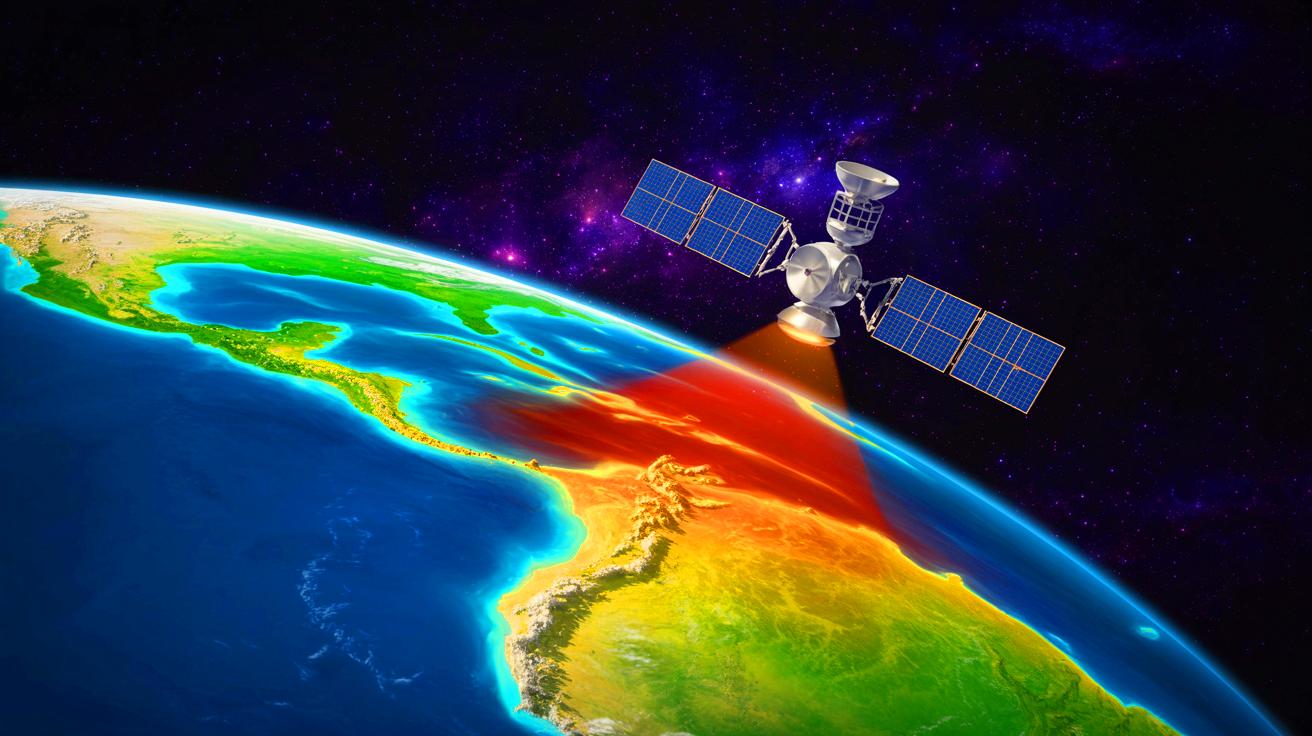
The South Atlantic Anomaly (SAA) represents a significant topic of interest and concern within the scientific community. Located over South America and the South Atlantic Ocean, this region is characterized by a weakened magnetic field. This phenomenon, while naturally occurring, poses potential risks to space technology and has implications for our understanding of Earth’s magnetic dynamics. As the anomaly continues to evolve, researchers are focusing on understanding its origins, mechanisms, and potential impact on our technological infrastructure, emphasizing the importance of continued study and monitoring.
Understanding the South Atlantic Anomaly
The South Atlantic Anomaly (SAA) is a geomagnetic phenomenon that captures the attention of scientists worldwide. It is defined by a significant reduction in magnetic field intensity over a vast area. This decrease allows high-energy solar particles to penetrate closer to Earth’s surface, presenting a challenge for researchers and space agencies. The anomaly’s origins are traced back to the geodynamo, a process involving the movement of molten iron and nickel in Earth’s outer core. This movement generates the magnetic field that protects our planet.
The formation of the SAA is influenced by two main factors: the tilt of Earth’s magnetic axis relative to its rotational axis and the presence of the African Large Low Shear Velocity Province, a dense structure located deep beneath the African continent. These factors interfere with the magnetic field generation, leading to a local polarity reversal and a weakened dipole field intensity in the region. Understanding these underlying mechanisms is crucial for predicting the anomaly’s future behavior and mitigating its impact on space technology.
Implications for Space Technology
The presence of the South Atlantic Anomaly presents a substantial challenge to space technology. Satellites passing through this region are exposed to high levels of energetic protons, which can cause single event upsets—temporary malfunctions or data corruption. In severe cases, critical systems may suffer permanent damage. To mitigate these risks, satellite operators often shut down non-essential systems when traversing the SAA. The International Space Station (ISS), which crosses the anomaly on each orbit, employs shielding to protect its crew, though external instruments remain vulnerable.
For instance, the GEDI instrument on the ISS experiences occasional glitches and resets, resulting in data loss. Missions like the Ionospheric Connection Explorer (ICON) closely monitor the anomaly and adjust their operations to minimize disruptions. These precautions highlight the need for ongoing research and adaptation to ensure the safety and functionality of space missions operating within or near the SAA.
Dynamic Changes and Challenges
Recent data indicate that the South Atlantic Anomaly is not a static phenomenon. Observations from the ESA’s Swarm constellation and NASA’s SAMPEX mission reveal that the anomaly is slowly drifting northwest and expanding. Since 2020, it has begun to split into two distinct lobes, creating dual centers of minimum magnetic intensity. This bifurcation increases the number of hazardous zones for spacecraft, complicating the task of scientists developing predictive models of geomagnetic conditions.
Continuous monitoring and adaptation in satellite operations are necessary to mitigate potential disruptions caused by the anomaly’s evolving morphology. Terry Sabaka of NASA stresses the importance of understanding these developments to ensure the safety of current and future satellites. As the anomaly continues to change, researchers are tasked with developing more accurate models to predict its behavior and adjust space missions accordingly.
Predictive Modeling and Future Research
To refine predictions and enhance understanding, NASA integrates satellite data with simulations of Earth’s core dynamics. These inputs support global models like the International Geomagnetic Reference Field (IGRF), which track the evolution of Earth’s magnetic field. These models are invaluable for planning space missions and gaining insights into the planet’s internal structure. The approach is akin to weather forecasting, allowing scientists to estimate secular variation—the slow yet persistent changes in the magnetic field over extended periods.
While the current evolution of the SAA is unprecedented in the space era, geological records suggest that such anomalies are not exceptional over long timescales. Importantly, scientists assert that the current SAA is not an early indicator of a magnetic pole reversal, a natural but rare event occurring over hundreds of thousands of years. Ongoing study of the SAA is crucial for protecting orbiting technologies and deepening our understanding of the forces shaping our planet.
The South Atlantic Anomaly continues to captivate and challenge the scientific community, prompting questions about its impact on space technology and Earth’s magnetic dynamics. As researchers strive to unravel its complexities, the anomaly poses intriguing questions about the future of our technological and scientific endeavors. How will ongoing changes in the SAA shape our understanding of Earth’s magnetic field and influence the safety and success of future space missions?




Is there any chance this anomaly could lead to a magnetic pole reversal? 🤔
Great article, but what exactly is a “single event upset”? A bit of clarification would help!
Is this anomaly responsible for the auroras we see over South America?
How long has the SAA been around, and how was it first discovered?
With the anomaly splitting into two lobes, will the risks increase exponentially?
Can the anomaly affect communication systems on Earth, or is it just a space issue?
Very informative piece! I hope more people become aware of these hidden planetary forces.
Does the SAA have any effects on animals, like migratory birds or marine life?
So, when’s the next big Hollywood blockbuster about this ‘burning’ shockwave? 🎬
How often do satellites have to shut down systems to avoid damage from the SAA?
I’m curious if there’s any connection between the SAA and earthquakes or volcanic activity.
Thank you for such an insightful article! I had no idea about the South Atlantic Anomaly until now.
Thanks for sharing this. It’s amazing how dynamic our planet really is! 🌍
Who knew the Earth’s magnetic field was so complex? I sure didn’t! 🤯
Is there a possibility of this anomaly moving over populated areas and affecting daily life?
Could the SAA impact future plans for human space travel, like missions to Mars?
What measures are in place to protect the International Space Station from this anomaly?
Love articles like this that make science accessible to everyone. Keep them coming!
How do researchers simulate the magnetic field in their models? Sounds fascinating!
The fact that this anomaly is evolving makes me wonder about the long-term implications.
Is there any historical record of similar anomalies affecting early human civilizations?
What are the chances of this anomaly leading to a global tech blackout? Seems alarming! ⚠️
So, are we looking at a future where tech companies will have to redesign satellites?
It’s surprising how much we still have to learn about our own planet! 🌎
Does the anomaly have any connection to solar flares or other solar activities?
Why is this not more widely reported? Seems like a huge deal! 🤷
Is there a risk of this anomaly affecting GPS systems and causing navigational errors? 🚗
Is NASA doing enough to protect satellites from these high-energy particles? 🛰️
Why does China blame the US for this? Seems like a bit of a stretch. 🤨
I’d love to read more about how the anomaly affects everyday life for people on the ground.
Does the SAA have any impact on climate change, or is it strictly a space tech issue?
It’s burning? Sounds more like a sci-fi movie than reality! 😅
Are there any plans to develop better shielding for satellites passing through the SAA?