



| IN A NUTSHELL |
|
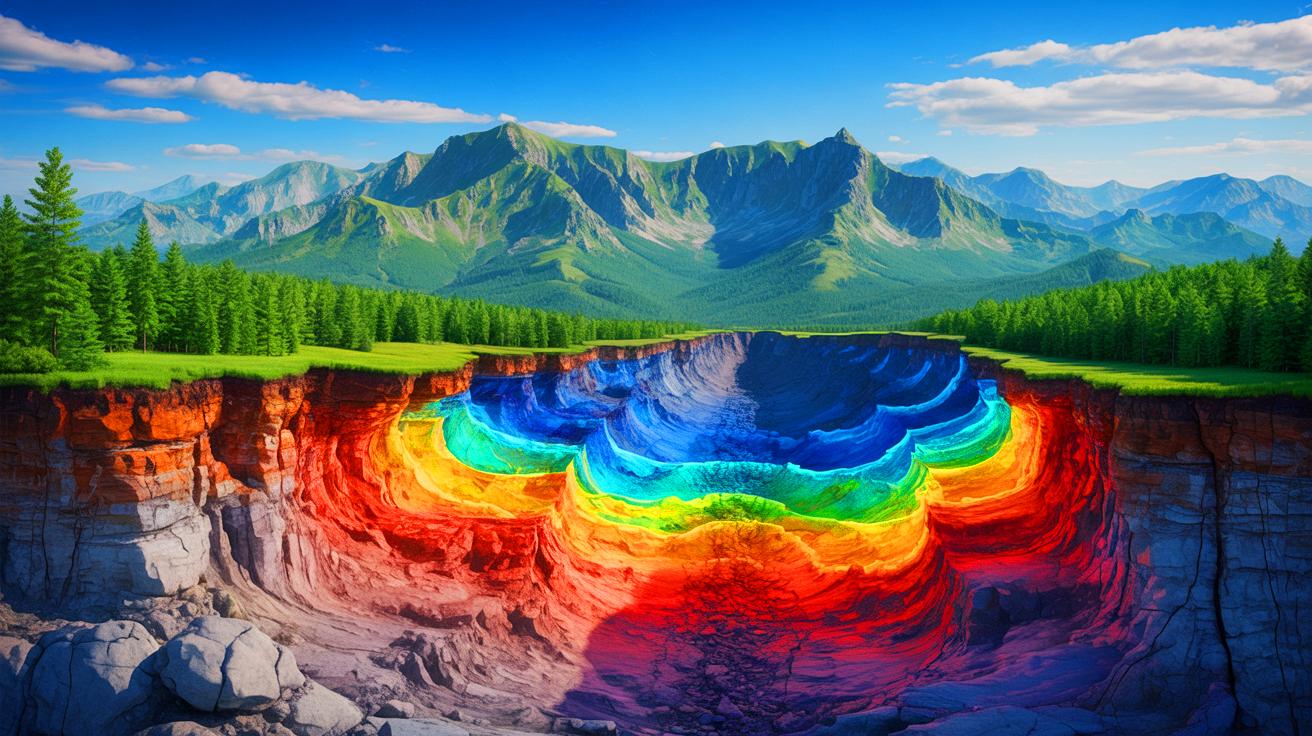
Deep beneath the Appalachian Mountains lies a vast, warm rock mass that might be linked to the ancient tectonic events separating Greenland and North America. This intriguing geological feature, known as the Northern Appalachian Anomaly (NAA), challenges previous assumptions about the region’s tectonic history. New research from the University of Southampton reveals that this anomaly is not a relic of North America’s split from Northwest Africa, but rather a product of a much more recent separation. The findings not only reshape our understanding of North American geology but also highlight the enduring influence of deep Earth processes on the continent’s surface features.
The Northern Appalachian Anomaly: A Geological Enigma
The Northern Appalachian Anomaly (NAA) is a vast region of warm rock located approximately 200 kilometers beneath New England. This anomaly spans about 350 kilometers and has mystified scientists for years. Its existence beneath a tectonically quiet area raises questions about its origin and impact. The prevailing theory suggested that the NAA was a remnant of North America’s separation from Northwest Africa about 180 million years ago. However, recent research proposes a different narrative, linking it to the separation of Greenland and North America roughly 80 million years ago. This new understanding challenges long-held beliefs and opens the door to fresh insights into Earth’s geological history.
Researchers from the University of Southampton, the Helmholtz Centre for Geosciences in Potsdam, and the University of Florence have provided compelling evidence that the NAA is part of a larger, slow-moving process. This process, occurring deep underground, helps explain why ancient mountain ranges like the Appalachians continue to stand tall. The heat at the continent’s base weakens and removes part of its dense root, making the landmass lighter and more buoyant. This, in turn, could have caused the ancient mountains to uplift further over the past few million years.
Unveiling the ‘Mantle Wave’ Theory
The scientists’ analysis is grounded in a new theoretical framework called the ‘mantle wave’ theory. This groundbreaking concept was even named a finalist for Science magazine’s 2024 Breakthrough of the Year. The mantle wave theory describes how hot, dense rock gradually detaches from the base of tectonic plates after continents split. The process resembles blobs rising and falling in a lava lamp, creating slow-moving waves that travel along the underside of continents for millions of years.
By combining geodynamic computer models, seismic tomography, and reconstructions of past plate positions, researchers traced the NAA back to the period when the Labrador Sea opened, and Greenland pulled away from Canada 90 to 80 million years ago. This innovative approach sheds light on uncommon volcanic eruptions and elevated terrains far from plate boundaries, offering a new lens through which to view Earth’s dynamic processes.
Slow-Moving Rock ‘Drips’ Beneath the Continent
One of the study’s co-authors, Professor Sascha Brune, head of the Geodynamic Modelling Section at GFZ, explained the phenomenon of convective instabilities. These instabilities cause chunks of rock, several tens of kilometers thick, to slowly descend from the Earth’s outer layer, known as the lithosphere. As the lithosphere thins, hotter mantle material rises to fill the void, creating a thermal anomaly.
These ‘drips’ of rock, as described in earlier research, form in series, akin to dominoes falling one after the other, and migrate sequentially over time. The feature observed beneath New England is likely one of these drips, originating far from its present location. The NAA appears to be moving southwest across the North American lithosphere at about 20 kilometers per million years. With its size and depth aligning with predictions for these mantle instabilities, researchers estimate that the anomaly could pass beneath the New York region in about 15 million years.
Exploring a Greenland Counterpart
The study suggests that a similar warm anomaly exists beneath north-central Greenland. This feature may share the same origin as the NAA, having formed on the opposite side of the Labrador Sea during the breakup. Beneath Greenland, the deep heat source increases temperatures at the bottom of the thick ice sheet, influencing ice flow and melt patterns today. As Professor Tom Gernon noted, these ancient heat anomalies continue to play a critical role in shaping the dynamics of continental ice sheets.
Dr. Derek Keir, a study co-author and tectonics specialist, emphasized the broader implications of these findings. The idea that continental rifting can generate drips and cells of circulating hot rock spreading thousands of kilometers inland prompts a reevaluation of our understanding of continental edges, both in the present day and throughout Earth’s history. The results underscore the potential for deep Earth processes to persist long after surface activity has ceased, impacting everything from uplift and erosion to volcanic patterns in regions considered geologically stable.
This intriguing research highlights the long-lived processes that continue to shape continents, even in regions perceived as tectonically quiet. The legacy of continental breakup extends far beyond initial rifting events, with ancient geological features still influencing modern landscapes. As scientists deepen their understanding of these phenomena, questions remain about how these processes might affect the future of Earth’s geology. What other secrets might be hidden beneath our feet, waiting to be uncovered?



Wow, a giant heat blob? Can we blame this on climate change too? 🤔
Wow, this is mind-blowing! 🌍 How does the heat blob affect local climates in the U.S.?
Fascinating article! Thanks for shedding light on such an intriguing topic. 🌍
Is there any connection between this heat blob and recent climate changes? 🤔
Does this mean the Appalachian Mountains might not be as stable as we thought?
Another mystery of the Earth unraveled. What’s next, a giant ice cube under Australia? 😂
Why haven’t we heard about this before? Seems like a big deal!
How does this discovery impact our understanding of volcanic activity in the region?
Thanks for this insightful piece! The mantle wave theory sounds revolutionary. 🧪
Honestly, this sounds like the plot of a sci-fi movie. Are we sure this is real? 😂
Greenland’s separation from North America? Sounds like a messy breakup! 😜
Are there any potential dangers from this heat blob to people living in the area?
Great article! Thanks for explaining such a complex topic so clearly.
How accurate are these geodynamic computer models at predicting such phenomena?