




| IN A NUTSHELL |
|
The ancient Chinese invention known as the seismoscope, designed by Zhang Heng nearly 2,000 years ago, is a testament to the ingenuity of early scientific thought. This mechanical device, capable of detecting distant earthquakes with remarkable precision, has long been shrouded in mystery. Modern Chinese scientists are now endeavoring to breathe life back into this legendary instrument. The potential revival of Zhang Heng’s seismoscope could offer new insights into seismic activity and reshape our understanding of ancient technology.
A Mysterious and Ingenious Device
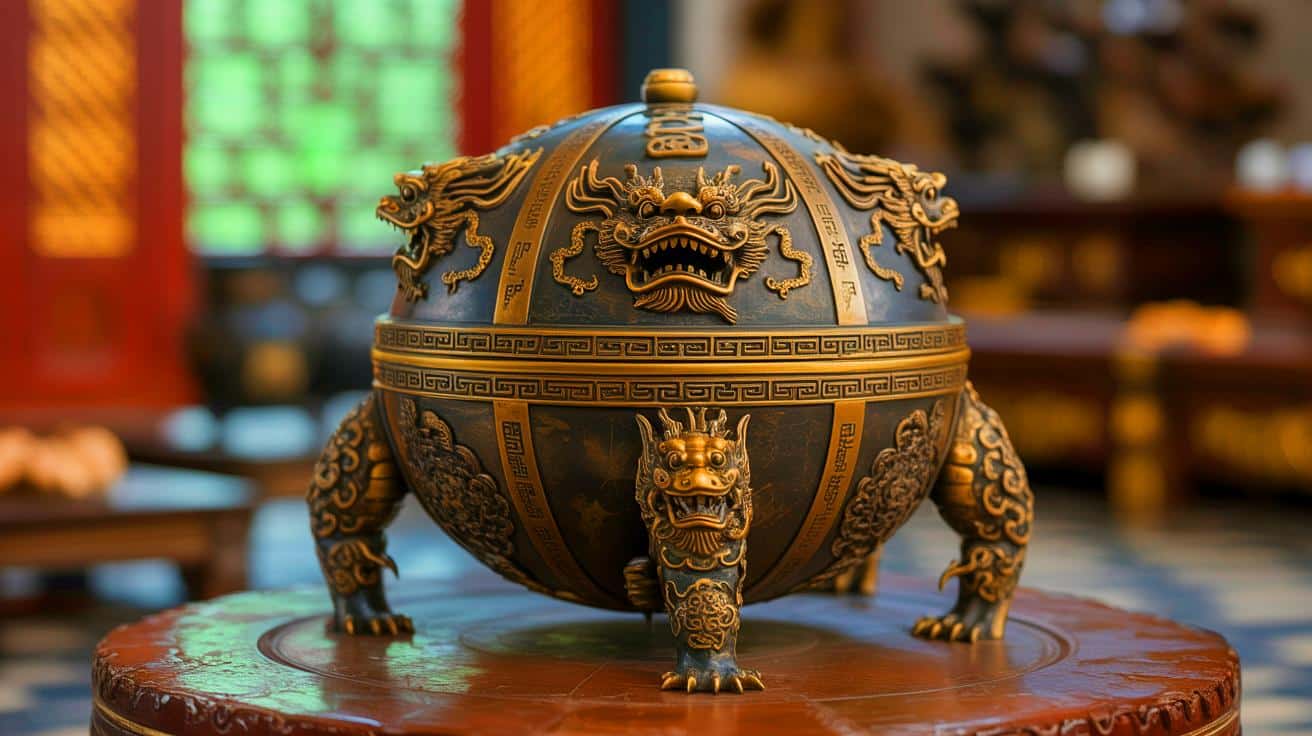
During the Eastern Han Dynasty, the scholar Zhang Heng created a device named Houfeng Didong Yi. Described in ancient texts, it was a bronze urn adorned with eight dragons arranged in a circle, each holding a suspended ball above the mouth of a toad. When an earthquake occurred, the dragon in the direction of the tremor would release its ball into the toad’s mouth. This visual system indicated the earthquake’s epicenter direction, even if the quake itself was not felt locally.
The precision of this invention seems almost unbelievable. Imperial chronicles claim that in the year 138, the device detected an earthquake 528 miles from Luoyang, the empire’s capital. This event was later confirmed by messengers on horseback, showcasing an ability that bordered on the divine. The seismoscope’s capacity to detect such distant tremors attests to the advanced scientific understanding of the time.
From Legend to Educational Silence
Despite its initial impact, the seismoscope gradually vanished from official records. Its complexity, lack of technical blueprints, and the inability to replicate it accurately led to its removal from the Chinese educational curriculum in 2017. This ancient mechanical marvel was relegated to the status of legend.
However, a bold project aims to change this narrative. Under the guidance of Professor Xu Guodong from Hebei’s Disaster Prevention Institute, researchers are attempting to revive the dormant dragon. Their goal is to bring this exceptional mechanism back to life and restore its place in the grand history of scientific discoveries. This endeavor not only seeks to honor Zhang Heng’s legacy but also to inspire a new generation of scientists.
A Reconstruction True to Second-Century Spirit
To achieve this remarkable feat, the team relies on fragments of ancient texts and modern principles of structural dynamics. The prototype is designed around three fundamental modules: the excitation system, the transmission system, and the locking mechanism.
The core of the device is a vertical pendulum, known as the “central pillar,” which detects the slightest ground vibrations. An oscillation of just 0.04 inches at the base of the pendulum triggers a series of L-shaped levers, releasing the ball in the direction of the seismic shock. A blocking system ensures that only one dragon reacts, staying true to the original description: “one dragon speaks, seven remain silent.”
Simulations conducted by researchers demonstrate that the instrument could respond to minute movements of 0.02 inches, without causing false alarms. While modern geophysical data suggests that a single device cannot precisely locate an epicenter, Xu emphasizes that historical geological alignments often match observations from the era.
Zhang Heng: Scientific Genius and Victim of Power
Zhang Heng was more than just an inventor; he held the prestigious position of imperial astrologer in 115 AD, akin to today’s observatory director. He was also the creator of a hydraulic armillary sphere capable of charting the heavens with astonishing accuracy.
In an ancient China where natural disasters were seen as heavenly signs unfavorable to the emperor, a machine capable of predicting earthquakes could become politically inconvenient. Some historians suggest that Zhang’s marginalization in 138 and his sudden death in 139 were more than coincidental. Xu also proposes that the original seismoscope might have been lost during armed conflicts or deliberately hidden by influential aristocratic families.
The revival of Zhang Heng’s seismoscope not only seeks to reconnect with the brilliance of ancient technology but also raises questions about the relationship between science and power. As researchers work to bring this legendary device back to life, it prompts a deeper reflection on how historical knowledge can inform our approach to contemporary scientific challenges. Will the lessons from Zhang Heng’s invention guide future innovations in seismic detection?




Wow, this sounds like something straight out of a fantasy novel! 🐉 How exactly does this device work to detect earthquakes?
Isn’t it amazing how ancient technology can still teach us so much? Kudos to the Chinese researchers for this initiative!
Wait, is this article saying that dragons can predict earthquakes? 😂
Why was the seismoscope removed from the educational curriculum? It seems like such an important piece of history!
Can this revived technology be used in other earthquake-prone areas of the world, or is it specific to China?
This is mind-blowing! How accurate was Zhang Heng’s seismoscope compared to modern technology?