





As the design world ushers in another awards season, an unassuming mobile app centered on indigo cloth is capturing global attention. This week, product designer Yan Zeng’s “Tie-Dye Revival” was honored with a Red Dot: Brands & Communication Award in the Apps category, spotlighting a creative fusion of technology and tradition. The Red Dot Award – one of the world’s most prestigious design competitions, with nearly 70 years of history – spans product, brand, and concept design, drawing thousands of submissions annually. For Zeng’s app to emerge as a category winner signals a design idea of uncommon resonance, one that speaks to innovation grounded in cultural heritage.
Few projects interlace past and future as vividly as Tie-Dye Revival. Zeng’s concept stood out to the Red Dot jury not just for polished UX, but for the cultural richness behind each screen. The app is both a digital craft studio and a living museum of Bai minority tie-dye. Users are invited to explore the centuries-old indigo dyeing technique – designated in China as a national intangible cultural heritage – through an engaging, hands-on interface. “I didn’t want it to feel like just another game or shopping app,” Zeng says. “It needed to carry the soul of the craft – the patience, the stories, the connection to nature.”
Immersive design is at the heart of the experience. Through playful gamification and spatial storytelling, Tie-Dye Revival guides users step by step as if they were apprentices in a Dali workshop. They can virtually fold and stitch a piece of white cloth, choose natural dye pigments, then watch a 3D visualization of the dyeing process as deep blues bloom across fabric. The interface doesn’t overwhelm with flashy graphics or loud prompts. Instead, it invites curiosity. The app even slows down during “drying” periods – a gentle nudge to appreciate the rhythm of traditional craftsmanship. “We added little rituals like waiting for the dye to set, so people understand this isn’t about instant results,” Zeng explains. “It’s about learning why this art has survived so long.”
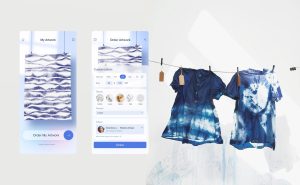
After designing a pattern on-screen, users can order a real-world version of their creation. The app connects directly to Bai artisans in Yunnan, turning personal design into tangible product. This artisan-to-consumer bridge means a teenager in Beijing or New York can tap into a remote village craft and receive a hand-dyed scarf made by a master of the tradition. In-app stories and short videos accompany each step, so that buying a garment also means learning the meaning of its motifs and the lore of its makers.
Zeng’s culturally sensitive approach ensures the community isn’t just a backdrop – it’s a co-creator. “Local artisans were involved at every stage,” she notes. “Their voices and skills shape the app, which is why it feels authentic. It’s their story as much as mine.”
The impact has been more than virtual. In its first year, Tie-Dye Revival generated over $165,000 in revenue and tripled the average income of the participating Bai tie-dye artisans. What began as a design concept quickly proved its real-world value, validating Zeng’s belief that innovation can uplift as well as entertain. “One elder told me she earned more in a few months through the app than in the previous three years,” Zeng recalls quietly. “Hearing that – honestly, it mattered more than the award.”
That humility and focus on purpose echo throughout Zeng’s work. Though trained as a cutting-edge product designer, she speaks less about technology for its own sake and more about technology as a bridge. In Tie-Dye Revival, that bridge spans generations: young users play and personalize, while veteran dyers gain new patrons and pride in their art.
Zeng’s Red Dot win arrives amid a broader conversation about the role of design in cultural preservation. While many award-winning concepts chase futuristic tech, Tie-Dye Revival leans into something deeper – a sense of continuity. The project’s success, recognized by an international jury, suggests that modern design can do more than invent new gadgets; it can rejuvenate a fading art. “I’ve always felt that progress doesn’t mean replacing the old with the new,” Zeng reflects. “Sometimes progress is giving old traditions new tools to thrive.”
As 2025 unfolds, Tie-Dye Revival stands as a compelling case study in immersive heritage design. Yan Zeng’s achievement is not simply about one app or one award – it’s a testament to design’s capacity for empathy and insight. In an industry enamored with disruption, Zeng has embraced something more subtle: using interactivity to cultivate understanding. Her work reminds us that the next big thing in design might not be a flashy device or algorithm, but the quiet revival of something timeless. “Design doesn’t have to shout to make a difference,” she says softly. “It can whisper an old story, and if it’s a good one, people will hear it.”
Partner content



Congrats to Yan Zeng! 🎉 How can I download this app? Is it available on both iOS and Android?
Wow, this app sounds amazing! I’ve always wanted to learn more about traditional crafts. 😊
Is there a way to see user-generated designs in the app? I’d love to see other people’s creations!
This is such an innovative way to preserve cultural heritage. Thank you, Yan Zeng, for your dedication!
How does the app ensure the artisans are fairly compensated for their work?
Great, another app… Does everything have to be digital these days? 🤔
I’m curious if the app offers any educational content about the history of tie-dye.
Love the idea! But what about the environmental impact of producing and shipping these garments?
Can we customize the patterns and colors, or are there preset options?
I’ve tried the app and it’s a fantastic experience. Thank you for bringing this art to the digital age!