



| IN A NUTSHELL |
|
Recent research has unveiled fascinating insights into the creation of Rapa Nui’s iconic moai statues. A detailed 3D model of the Rano Raraku quarry, the primary site of moai production, reveals that these statues, long shrouded in mystery, were carved by numerous independent groups rather than under centralized control. This groundbreaking study, published by PLOS One, challenges longstanding assumptions about the island’s societal organization and monument-building practices. By examining separate carving zones and varied transport routes, researchers have painted a complex picture of Rapa Nui’s past, offering new perspectives on its cultural heritage and raising questions about the nature of collaboration and independence in prehistoric societies.
Decentralized Carving Efforts on Rapa Nui
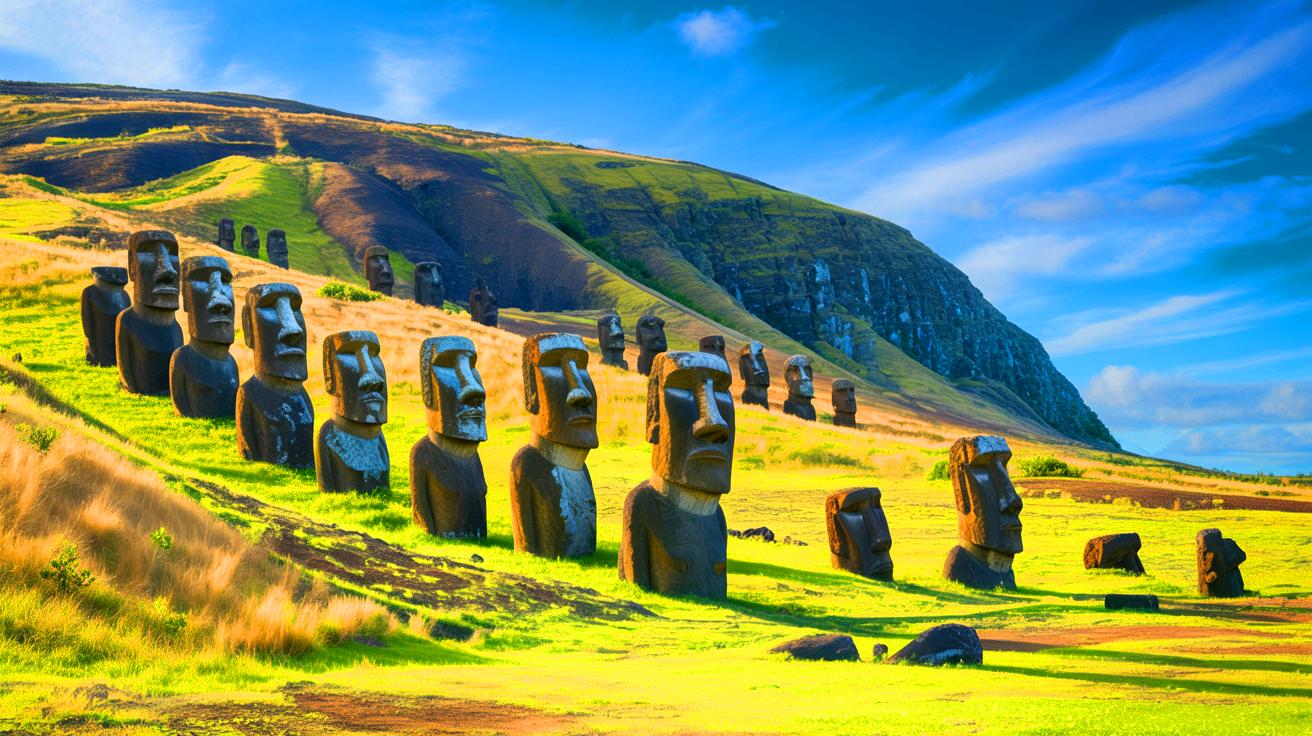
The moai statues of Rapa Nui, also known as Easter Island, have long captivated researchers and the public alike. Historically, these statues were thought to be the result of a centralized effort, reflecting a cohesive societal organization. However, the latest research reveals a different narrative. A high-resolution 3D model of the Rano Raraku quarry has identified 30 distinct work zones. Each zone reflects unique carving styles, suggesting that separate family groups were responsible for different moai.
This decentralized approach aligns with archaeological evidence indicating that Rapa Nui was home to numerous small family groups rather than a unified political system. The creation of the moai, therefore, was less about a singular vision imposed from above and more about a mosaic of independent efforts. This new understanding not only reshapes our perception of Rapa Nui’s past but also offers a framework for considering how cultures can achieve monumental accomplishments without centralized control.
High-Resolution 3D Modeling Techniques
To uncover these insights, researchers employed cutting-edge 3D modeling techniques. They captured over 11,000 photographs of the quarry, which were meticulously combined to create a comprehensive digital reconstruction. This model allowed for an unprecedented examination of the moai, revealing details that were previously inaccessible.
The 3D model not only highlighted the individual carving zones but also suggested multiple transport routes for the statues. This finding supports the notion that the statues were moved by various groups along different paths, further emphasizing the decentralized nature of their production. By employing these advanced methodologies, researchers have set a new standard for archaeological studies, providing a blueprint for future investigations into other historical sites.
Challenging Established Theories
The revelations from this study challenge long-held assumptions about the need for centralized authority in large-scale projects. Typically, such monumental endeavors are associated with strict hierarchical control. However, the evidence from Rapa Nui suggests otherwise. The similarities between moai can be attributed to shared cultural knowledge rather than coordinated efforts.
This finding has implications beyond Rapa Nui, prompting a reevaluation of how historians and archaeologists understand the dynamics of ancient societies. The study emphasizes the potential for collaborative yet independent efforts to achieve significant cultural achievements. It also opens up new avenues for research and conservation, providing a valuable dataset that can inform future studies and guide cultural management at this UNESCO World Heritage site.
Broader Implications for Archaeology
The methods and findings of this study have broader implications for the field of archaeology. By demonstrating the utility of high-resolution 3D modeling, researchers have highlighted a powerful tool for uncovering details of ancient societies. These techniques can be applied to other archaeological sites, offering new ways to explore and understand the past.
The success of this study underscores the importance of interdisciplinary approaches in archaeology. By combining traditional archaeological methods with advanced technology, researchers can gain deeper insights into historical sites and challenge existing narratives. This integration of technology and archaeology not only enhances our understanding of the past but also inspires new questions about the complexities of ancient societies.
This research has transformed our understanding of Rapa Nui’s moai and the society that created them. By revealing the decentralized and collaborative nature of their production, it challenges previous assumptions and opens new avenues for exploration. As we continue to uncover the secrets of ancient societies, what other long-held assumptions might be challenged by future discoveries?


Wow, this is mind-blowing! Who knew Easter Island had such a complex history? 🤯
Wow, fascinating! Who knew Easter Island had such a complex history? 🌎
Is this the first time 3D modeling has been used in archaeological studies like this?
This is mind-blowing. How did they manage to move those massive statues without centralized control?
So, the moai were carved by independent groups? That’s a game-changer!
I always thought the moai were carved by a single group. This changes everything!
Thank you for sharing this fascinating research. Truly enlightening!
Isn’t 3D modeling a bit too modern for such ancient mysteries? 🤔
I’m skeptical about these findings. How reliable is 3D modeling in archaeology?
Centralized control sounds boring anyway. Go team decentralization! 🛠️💪
Thanks for sharing this! It’s amazing to see technology uncover history. 📚
Can the same techniques be used to study other ancient monuments?
Can anyone explain how 3D modeling works in archaeology? I’m curious!
Why did it take so long to discover these decentralized carving efforts?
This is just another theory. I bet it’ll change again in a few years. 😏
Fascinating read! How will this impact current archaeological theories?