




| IN A NUTSHELL |
|
In the arid expanse of the Egyptian desert, a groundbreaking discovery is challenging traditional narratives about ancient engineering prowess. Deep beneath the sands surrounding the Pyramid of Djoser lies a sophisticated water management system that has puzzled and amazed researchers. This revelation highlights a forgotten chapter of human ingenuity, suggesting that ancient Egyptians employed advanced hydraulic techniques in their monumental construction projects. The implications of this finding extend beyond the technological realm and invite a reevaluation of historical perspectives on the architectural feats of the Old Kingdom builders.
Ingenious Stone Dam Capturing Desert Floodwaters
The enigmatic structure at Saqqara, known as Gisr el-Mudir, has long intrigued scholars with its grandeur and mystery. Spanning nearly 1,180 feet, its purpose has been debated for years. Recent research by Xavier Landreau and his team from the CEA Paleotechnic Institute offers a new perspective, suggesting that this massive stone enclosure was not merely ceremonial or defensive. Instead, it functioned as a dam, ingeniously capturing seasonal floodwaters from nearby valleys.
By meticulously analyzing the terrain, ancient watercourses, and erosion patterns, researchers reconstructed a watershed system capable of channeling water to the enclosure. This temporary reservoir, capable of holding up to 14 million cubic feet of water, supported large-scale construction activities. Seasonal floods would deposit nutrient-rich sediments in downstream basins, enhancing the site’s utility. The discovery redefines Saqqara’s historical significance, indicating that its location was chosen for hydrological advantages as much as religious or political reasons.
How Hydraulic Construction of Pyramids Worked
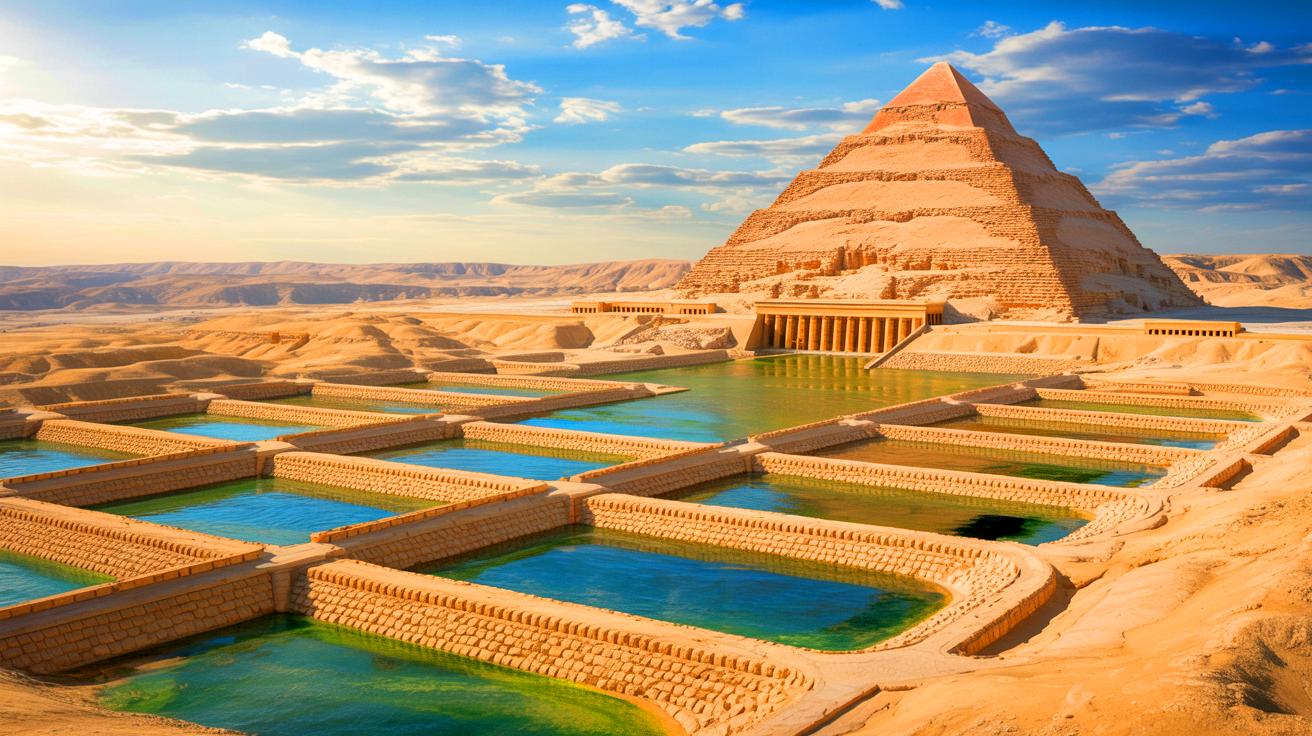
Adequate water storage was crucial, but it was merely the beginning. The real innovation lay in the depths of the Djoser complex, where a vast trench, once thought purely symbolic, revealed a network of interconnected basins and compartments. This “Deep Trench” served as an ancient water treatment system, with heavier sediments settling first and clearer water being transferred further.
This purified water powered a vertical lifting system beneath the pyramid. Two vertical shafts, connected by a 656-foot underground gallery, enabled a flotation device to lift stone blocks. The blocks, placed on a floating platform, were elevated through water pressure injected into the shafts. Once at the desired height, they could be moved onto the structure’s upper tiers. This system resembled a hydraulic elevator, utilizing water’s force to minimize mechanical effort, a testament to the Egyptians’ engineering acumen.
Sophisticated Technology Matching Pharaohs’ Ambitions
While the hydraulic construction hypothesis may seem audacious, it is grounded in concrete evidence from the site. The dam, basins, galleries, and shafts all form a cohesive hydraulic chain. Contrary to common belief, the Egyptians had already mastered various water-related techniques. Their expertise in creating irrigation canals, wooden gates, and agricultural dams highlights their advanced understanding of hydraulics.
This study suggests that such a system could have significantly reduced the need for massive external ramps, lowering labor demands and logistical challenges. The construction process would have gained efficiency, safety, and precision. The Pyramid of Djoser, often seen as a prototype, may represent the zenith of a developed technology that subsequent dynasties struggled to replicate. This finding challenges the conventional narrative of pyramid construction, blending ingenious engineering with environmental adaptation.
How Saqqara’s Hydraulic Remains Alter Our Historical Perspective
Traditionally, pyramids have been examined from symbolic or architectural viewpoints. The discovery of an integrated hydraulic system shifts this focus, revealing that the builders were not solely executing religious projects. They were also crafting sustainable technical ecosystems, adeptly adapting to their environment and available resources.
This multidisciplinary approach, combining archaeology, hydrology, and geotechnics, enriches our comprehension of the past. It unveils a sophisticated work organization, rigorous material management, and a nuanced exploitation of the territory. It is now conceivable that these monumental constructions were not merely the result of massive labor mobilization but also the outcome of underestimated technical genius. This new perspective prompts a reassessment of other ancient sites, searching for similar hidden hydraulic systems.
As we delve deeper into the ancient Egyptians’ engineering marvels, we are left to ponder: What other hidden technologies lie beneath the sands, waiting to redefine our understanding of history once more?



Wow, I never knew the ancient Egyptians were such hydraulic geniuses! 🌊
Wow, this is amazing! How did they even come up with such advanced hydraulic systems? 🤯
Is there any evidence that other pyramids have similar systems? 🤔
So, did this dam system actually help in building the pyramid or was it just a side project?
This article is a real eye-opener. Thank you for sharing!
Great article! Thanks for sharing such a fascinating discovery!
14 million cubic feet of water? That’s a lot of baths! 🛁
Is there any evidence of this technology being used in other ancient Egyptian sites?
So, did they have ancient water slides too? 😜
I always knew the Egyptians were ahead of their time, but this is next level!
How did they manage to keep the water from evaporating in the desert?
Can we visit the site and see this system for ourselves? Sounds like a must-see! 🏜️
Sounds like the Egyptians were way ahead of their time in engineering.
Why are we only discovering this now? Seems like a pretty big deal!
Could this technology have been shared with other ancient civilizations?
The article could use more technical details on the water treatment process.
Are there any 3D models or reconstructions of this system?
This makes me wonder about what else we have yet to discover about ancient civilizations.
What an amazing find! Hats off to the research team. 🎩
Does this mean the Pyramid of Djoser wasn’t just a tomb?
How did they create such a sophisticated dam without modern tools?
Is there any chance this could have been used for ancient farming as well?
Great article, but I wish it had more pictures of the site!
I’m skeptical. How can we be sure this wasn’t just a natural formation?
The ancient Egyptians were truly masters of their environment. 🌿
Would love to read more about the “hydraulic elevator” concept!
Do we know how long this reservoir was in use?
Seems like they knew more about water management than some modern cities!
How do researchers date these hydraulic systems? Just curious.
Maybe they had ancient pool parties? 😆
How does this change our understanding of Egyptian society?
The more I read, the more I’m fascinated by ancient engineering. 📚
Is there any link between this system and the famous Nile floods?
Why don’t we learn about these kinds of discoveries in school? 🤨
This article is a testament to human ingenuity through the ages. 👏
Are there plans to excavate more of these hydraulic systems in Egypt?
What study? Did you name the study? Who conducted it? Where are the quotes? Can you provide the name of just one researcher? The university that sponsored the study? Where are the pictures of the holding basins? The waterways? This article is HORSE MANURE. None of this is proven. It is someone’s wet dream.