



| IN A NUTSHELL |
|
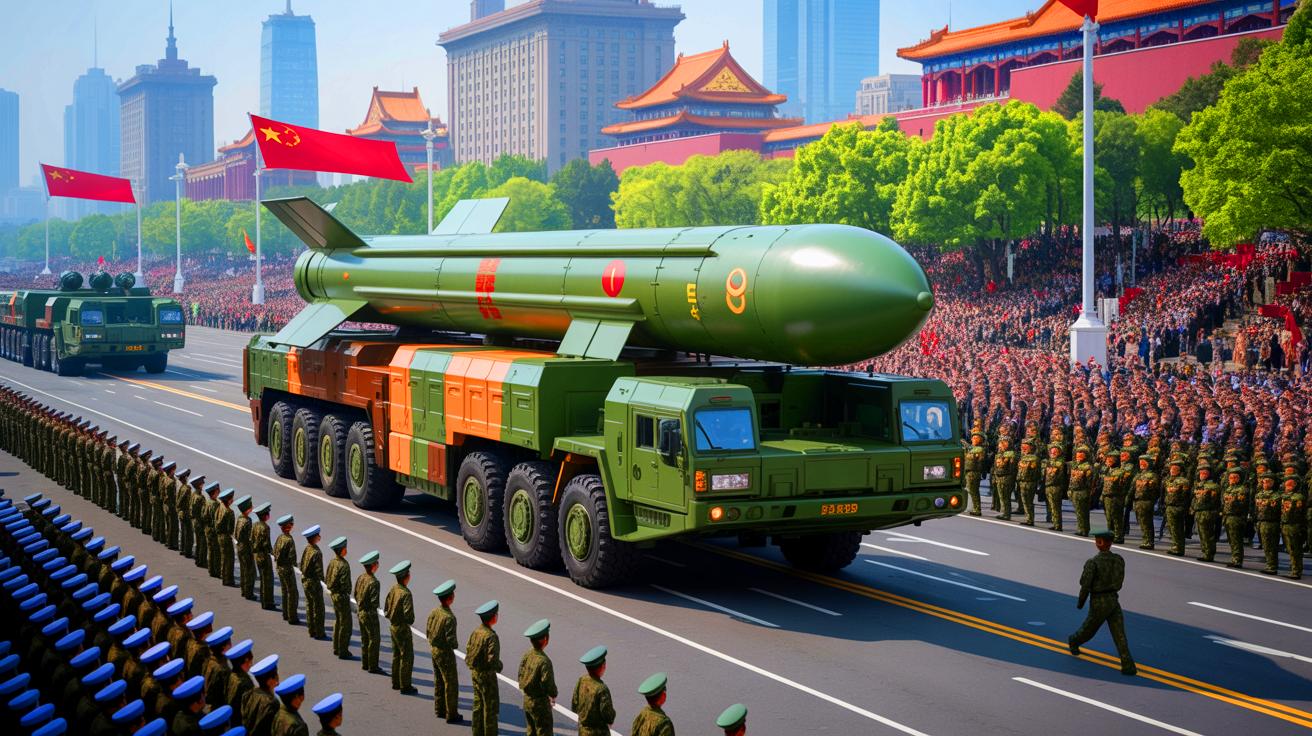
In a striking demonstration of military prowess, China recently showcased its DF-5C intercontinental ballistic missile during a grand Victory Day parade in Beijing. This event commemorated the 80th anniversary of the end of World War II in Asia, attracting global attention for both its historical significance and the advanced military technology on display. The DF-5C missile, with its extensive range and advanced capabilities, stood out as a central highlight. This development marks a significant step in China’s military strategy, as it aims to project power across the globe and reinforce its strategic deterrence capabilities.
Technological Advancements in the DF-5C
The DF-5C represents a leap forward in missile technology, boasting several sophisticated features that enhance its operational capabilities. One of the most notable advancements is its structure, which allows for transportation in three separate sections by three different vehicles. This modular design significantly reduces launch preparation time, offering a strategic advantage over earlier DF-5 models.
Furthermore, the DF-5C’s range exceeds 12,427 miles, effectively placing any target on the globe within reach. This capability is bolstered by the missile’s ability to be launched through multiple methods, drawing on experience from previous iterations in the Dongfeng series. The missile’s flight speed, estimated at several times the speed of sound, presents a formidable challenge to missile defense systems worldwide.
An additional feature of the DF-5C is its ability to carry multiple independently targetable reentry vehicles (MIRVs). These MIRVs can be armed with nuclear or conventional warheads and are capable of deploying decoys, making interception by defense systems exceedingly difficult. The missile’s advanced guidance system, which combines inertial, starlight, and Beidou navigation, ensures remarkable precision, comparable to that of short- and mid-range missiles.
Strategic Role and International Implications
China’s unveiling of the DF-5C underscores its commitment to a nuclear strategy centered on deterrence and defense. Despite the missile’s formidable capabilities, China maintains its policy of no first use of nuclear weapons and pledges not to target non-nuclear states. This stance is intended to reassure the international community while reinforcing China’s strategic deterrent.
Military analysts, like Ma Yan, emphasize the credibility and reliability of China’s strategic deterrence as demonstrated by the DF-5C. The missile’s capacity to carry up to ten warheads allows it to engage multiple targets simultaneously, ensuring effective retaliatory capabilities under adverse conditions. The exhibition of such strategic weapons also serves as a reminder of the complex security landscape China navigates and signals its growing military strength.
Additional Military Displays
The parade featured a wide array of advanced weaponry beyond the DF-5C. Other nuclear-capable missiles, such as the JL-1 and JL-3, highlighted China’s nuclear triad, which comprises land, sea, and air components. The event also showcased developments in naval aviation, with appearances by carrier-based aircraft like the J-35 stealth fighter and J-15T, indicating a shift from near-sea to far-sea defense capabilities.
Air formations included the H-6J long-range bomber, equipped with YJ-12 supersonic anti-ship missiles, as well as new drones demonstrating artificial intelligence-driven swarming and reconnaissance-strike capabilities. These displays underscore China’s focus on integrating cutting-edge technology into its military arsenal, enhancing its ability to project power and defend its interests globally.
Geopolitical Reactions and Future Considerations
The international response to China’s military parade and the unveiling of the DF-5C has been mixed. While some countries view the demonstration as a legitimate assertion of national strength, others express concern over the potential escalation of regional tensions. The presence of world leaders like Russia’s Vladimir Putin and North Korea’s Kim Jong-un at the event further complicates geopolitical dynamics.
As China continues to advance its military capabilities, questions arise about the implications for global security and stability. The strategic decisions made by China and other major powers in response to these developments will shape the international landscape in the coming years. What measures should be taken by the global community to ensure that advancements in military technology contribute to peace rather than conflict?




Wow, 12,427 miles is quite the range! Does this mean nowhere is safe anymore? 😅
Wow, 12,427 miles! That’s like hitting a target on the other side of the planet! 😮
Is this a step towards peace or a new arms race?
Why do world leaders like Putin and Kim Jong-un attend these events? 🤔
Does anyone else feel uneasy about the presence of Putin and Kim Jong-Un at this event?
The DF-5C is impressive, but shouldn’t we focus more on peace than on weapons?
Great article! Thanks for keeping us informed on global military developments. 😊
Is it just me, or does the range of this missile seem a bit excessive? 🌍
How does the DF-5C compare to similar Western missiles in terms of capabilities?
Are we heading towards another Cold War with all these missile advancements?
China’s military advancements are always fascinating. Keep up the great articles! 👍
Why do they always unveil these things at parades? Seems a bit showy. 🤔
Is there any defense system capable of intercepting a missile like the DF-5C?
Can this missile really hit any target on Earth, or is that just a bold claim?
How does China justify such a large military budget? 🤷♂️
Interesting read, but I wish there were more details on the MIRVs.
Spelling error in the title: “unveils” should be “unveil”.
It’s scary how advanced military technology has become. 😨
Does the world need more nuclear weapons? When will we learn?
Thank you for the detailed analysis on the DF-5C missile. Very informative!
Is this a direct challenge to the US’s military dominance?
How does China’s “no first use” policy affect its strategic goals?
Are there any countermeasures that can effectively neutralize the DF-5C?
This article makes me want to read more about geopolitical strategies. 📚
How many more missiles does China have in its arsenal?
The presence of MIRVs makes interception by defense systems exceedingly difficult. That’s a game-changer!
Typo in the article: “strategic deterence” should be “strategic deterrence”.
Why are world leaders attending a military parade? Isn’t that contradictory to peace efforts?
I’m curious, how long does it take to prepare and launch this missile?
Do you think this will lead to other countries developing similar long-range missiles?
The usage of MIRVs is a serious escalation. When will the madness end? 😩
China’s military advancements are impressive, but at what cost to global peace?
Are there any diplomatic negotiations happening to address these developments?
The range of the DF-5C is incredible. How do other countries respond to this?
Is this part of China’s plan to become a superpower by 2050?
Does this missile affect international treaties or agreements on nuclear weapons?
Amazing how technology has advanced, but it’s also terrifying. 🌍
Why are we still investing in such destructive technology?
What role does Russia and North Korea play in this unveiling?
How can we ensure these advancements are used for defense and not aggression?