

Close Menu
  • Last News
    • Cities
    • Climate
    • Energy
    • Impact
    • Markets
    • Opinions
    • Policy
    • Reports
    • Research
  • About Us
  • Advertise
  • Contact Us

Subscribe to Our Newsletter

News, investigations, and analysis — our top stories every morning to start your day right.

Trending
learn effective methods to measure your personal sustainability impact and make mindful choices for a greener future.
How to measure your personal sustainability impact
explore the growth of sustainable investments and green finance, highlighting their impact on the global economy and the shift towards environmentally responsible financial practices.
The rise of sustainable investments and green finance
Region Trade Bank Strengthens Governance as Sustainable Finance Places Greater Emphasis on Institutional Integrity
Facebook X (Twitter) LinkedIn YouTube TikTok
Sustainability Times
Facebook X (Twitter) LinkedIn YouTube TikTok
Subscribe
  • Featured
  • Cities

    The Hidden Carbon Cost of Construction Projects (And Why Better Planning Matters More Than You Think)

    05/13/2026
    explore the future of sustainability in urban development, focusing on innovative strategies and technologies shaping eco-friendly and resilient cities.

    The future of sustainability in urban development

    02/24/2026
    Illustration of a vertical farm in Beijing showcasing sustainable urban agriculture practices.

    “China Just Built Farm Skyscraper”: Beijing Greenhouse Grows Food In 37,673 Square Feet While Solar Panels Power Vertical Agriculture Revolution

    09/30/2025
    Illustration of Trojena Ski Resort's futuristic design in the Saudi Arabian desert.

    “We’re Building Winter Olympics in Pure Desert”: Saudi Arabia’s Trojena Ski Resort Hosts 2029 Asian Games Without Natural Snow

    09/09/2025
    Illustration of the historic Kiruna Church being relocated on self-propelled transporters to its new site in Sweden.

    “Sweden Moved a 700-Ton Church”: Historic Kiruna Building Traveled 3.1 Miles on Robot Transporters While King Watched the Journey

    09/03/2025
  • Climate

    The Hidden Carbon Cost of Construction Projects (And Why Better Planning Matters More Than You Think)

    05/13/2026
    explore the vital link between sustainability and climate change, understanding how sustainable practices can help mitigate environmental impact and promote a healthier planet.

    The connection between sustainability and climate change

    04/07/2026

    How to Turn ESG Commitments into Real Results in Oil & Gas: Mikhail Zubkov on Implementing Practical Solutions

    02/24/2026

    Sustainability in Action—How Straight Six Auto Parts Is Revolutionising Automotive Recycling

    01/05/2026
    Illustration of glaciers retreating due to rising global temperatures.

    New Forecast Reveals When Thousands of Glaciers Will Disappear, Highlighting Urgent Need for Climate Action

    12/20/2025
  • Energy

    How bio-LNG is transforming the maritime sector

    06/29/2026
    explore how technology is accelerating sustainability innovations, driving eco-friendly solutions and creating a greener future for our planet.

    How technology is driving sustainability innovations

    03/24/2026

    How to Turn ESG Commitments into Real Results in Oil & Gas: Mikhail Zubkov on Implementing Practical Solutions

    02/24/2026
    explore the vital role of renewable energy in promoting sustainability and reducing environmental impact for a greener future.

    The role of renewable energy in achieving sustainability

    01/27/2026

    How Ilnar Iakhin’s Practical Field Innovations Are Reducing the Environmental Footprint of Gas Production

    12/19/2025
  • Impact
    learn effective methods to measure your personal sustainability impact and make mindful choices for a greener future.

    How to measure your personal sustainability impact

    07/14/2026

    Region Trade Bank Strengthens Governance as Sustainable Finance Places Greater Emphasis on Institutional Integrity

    06/30/2026
    explore sustainable packaging options designed to reduce environmental impact and promote eco-friendly practices for a greener future.

    Sustainable packaging options to reduce environmental impact

    06/30/2026
    explore how circular economy models promote sustainability by reducing waste, conserving resources, and fostering eco-friendly innovation.

    How circular economy models support sustainability

    06/23/2026
    discover practical tips and actions individuals can take at home to support sustainability and contribute to a greener planet.

    What individuals can do to support sustainability at home

    06/09/2026
  • Markets
    explore the growth of sustainable investments and green finance, highlighting their impact on the global economy and the shift towards environmentally responsible financial practices.

    The rise of sustainable investments and green finance

    07/07/2026
    Switzerland’s regulated online gambling ecosystem is built on strict licensing rules, ensuring that only ESBK-approved casinos tied to land-based establishments can legally operate.

    Are Online Casinos Legal in Switzerland? Understanding the Current Regulatory Framework

    11/21/2025
    Illustration of the abrupt halt of a major lithium mine in China impacting global markets.

    “One Mine Shut Down and Prices Exploded”: CATL Halts Major Chinese Lithium Operation Sending Global Markets Into Chaos

    09/11/2025
    Illustration of the massive iron ore deposit discovered in the Pilbara region of Western Australia.

    Geologists Iron Find Worth $6 Trillion Sparks Geopolitical Firestorm As US-China Trade Rivalry Reaches Unprecedented Flashpoint

    08/24/2025
    Illustration of a colossal 55 billion-ton iron ore deposit discovery in Western Australia. Image generated by AI.

    Worldwide Panic as Monumental Geological Find Disrupts Global Trade and Triggers Market Turmoil on Every Continent

    06/04/2025
  • Opinions
    discover the essentials of sustainability and corporate social responsibility, exploring their impact on businesses and society for a better future.

    Sustainability and corporate social responsibility explained

    04/21/2026

    The Hidden Risks of Nepotism and Conflicts of Interest in Corporate Governance

    03/19/2026

    Sustainability, Family Offices, and Private Equity: A Powerful Alignment for Long-Term Impact

    08/05/2025

    Preserving Heritage While Innovating: How AI is Reshaping Design for a Sustainable Future

    07/23/2025

    Factories Without Real-Time Carbon Data Are Flying Blind: Why MES Must Become the Carbon Control Tower

    07/23/2025
  • Policy
    explore the crucial role of governments in advancing sustainability policies to protect the environment, promote social equity, and ensure economic growth for future generations.

    Role of governments in promoting sustainability policies

    06/16/2026
    explore effective strategies to promote sustainability through education, empowering communities to adopt eco-friendly practices and foster environmental awareness.

    Ways to promote sustainability through education

    03/10/2026
    Illustration of the NUMO Ground Robot Deployed by Ukraine for Military Operations.

    “It’s Doing the Dangerous Work for Us”: This Ukrainian Combat Robot Redefines the Battlefield (and It’s Already Saving Soldiers’ Lives)

    10/15/2025
    Illustration of NATO aircraft participating in the Steadfast Noon nuclear deterrence exercise.

    “You Can Feel the Tension in the Air”: This NATO Nuclear Exercise Sparks Unease Across Europe (and Leaders Call It ‘Routine’)

    10/15/2025
    Illustration of China's newly constructed underground military command center near Beijing.

    “Analysts Warn of Escalation”: Satellite Images Expose China Building World’s Largest Underground Military Command Hub To Counter US Power And Regional Rivals

    10/03/2025
  • Reports
    explore the latest trends and innovative solutions driving sustainability in the food industry, from eco-friendly practices to cutting-edge technologies reshaping the future of food production.

    Sustainability in the food industry: trends and solutions

    06/02/2026

    New Study Finds Drip Irrigation Can Cut Coffee’s Carbon Footprint by Nearly 60%

    05/13/2026
    explore the top sustainable development goals to prioritize in 2026 and learn how to make a meaningful impact towards a greener, more equitable future.

    Top sustainable development goals to focus on in 2026

    04/28/2026

    MFC Asset Management Steps Up Its ESG Agenda

    09/24/2025
    Illustration of naval aviators in training during the Top Gun program.

    “We Push Them Until They Break”: Top Gun Training Forces Pilots Through 7.5 Gs While National Geographic Films

    09/21/2025
  • Research
    Illustration of ancient marine super predators dominating the complex food chains of the Cretaceous period.

    Ancient Super Predators Ruled Oceans: New Discoveries Challenge Our Understanding of Marine Life’s Evolutionary Past

    12/20/2025

    How Ilnar Iakhin’s Practical Field Innovations Are Reducing the Environmental Footprint of Gas Production

    12/19/2025
    Illustration of the body's distinct molecular systems for detecting cold on the skin and internally.

    Your Body’s Cold Sensations: Revealing the Dual Ways Temperature Affects Us and What It Means for Comfort

    12/19/2025
    Illustration of the digital reconstruction of a 1.5-million-year-old Homo erectus face from the DAN5 fossil.

    Scientists Reveal 1.5-Million-Year-Old Human Face, Unveiling New Clues to Our Ancient Ancestry

    12/18/2025
    Illustration of ancient pottery featuring plant motifs reflecting early mathematical thinking.

    Ancient Art Reveals How Early Humans Used Math Concepts 8,000 Years Ago Without Numbers

    12/18/2025
Sustainability Times
Home - Climate - What if the dinos had not gone extinct?

What if the dinos had not gone extinct?

Eirwen WilliamsEirwen Williams11/29/20220
Share Twitter Facebook LinkedIn Telegram WhatsApp Email Copy Link
Follow Us
Google News
Photo: Pixabay/DariuszSankowski
Share
Twitter Facebook LinkedIn WhatsApp Email Copy Link

Photo: Pixabay/DariuszSankowski

Sixty-six million years ago, an asteroid hit the Earth with the force of 10 billion atomic bombs and changed the course of evolution. The skies darkened and plants stopped photosynthesising. The plants died, then the animals that fed on them. The food chain collapsed. Over 90% of all species vanished.

When the dust settled, all dinosaurs except a handful of birds had gone extinct.

But this catastrophic event made human evolution possible. The surviving mammals flourished, including little proto-primates that would evolve into us.

Imagine the asteroid had missed, and dinosaurs survived. Picture highly evolved raptors planting their flag on the moon. Dinosaur scientists, discovering relativity, or discussing a hypothetical world in which, incredibly, mammals took over the Earth.

This might sound like bad science fiction, but it gets at some deep, philosophical questions about evolution. Is humanity just here by chance, or is the evolution of intelligent tool-users inevitable?

Brains, tools, language and big social groups make us the planet’s dominant species. There are 8 billion Homo sapiens on seven continents. By weight, there are more humans than all wild animals.

We’ve modified half of Earth’s land to feed ourselves. You could argue creatures like humans were bound to evolve.

In the 1980s, palaeontologist Dale Russell proposed a thought experiment in which a carnivorous dinosaur evolved into an intelligent tool user. This “dinosauroid” was big-brained with opposable thumbs and walked upright.

It’s not impossible but it’s unlikely. The biology of an animal constrains the direction of its evolution. Your starting point limits your endpoints.

If you drop out of college, you probably won’t be a brain surgeon, lawyer or Nasa rocket scientist. But you might be an artist, actor or entrepreneur. The paths we take in life open some doors and close others. That’s also true in evolution.

Consider the size of dinosaurs. Beginning in the Jurassic, sauropod dinosaurs, Brontosaurus and kin evolved into 30-50 tonne giants up to 30 metres long – ten times the weight of an elephant and as long as a blue whale. This happened in multiple groups, including Diplodocidae, Brachiosauridae, Turiasauridae, Mamenchisauridae and Titanosauria.

This happened on different continents, at different times and in different climates, from deserts to rainforests. But other dinosaurs living in these environments didn’t become supergiants.

The common thread linking these animals was that they were sauropods. Something about sauropod anatomy – lungs, hollow bones with a high strength-to-weight ratio, metabolism or all these things – unlocked their evolutionary potential. It let them grow big in a way that no land animals had ever before, or have since.

Likewise, the carnivorous dinosaurs repeatedly evolved huge, ten-metre, multi-tonne predators. Over 100 million years, megalosaurids, allosaurids, carcharodontosaurids, neovenatorids and finally tyrannosaurs evolved giant apex predators.

Dinosaurs did big bodies well. Big brains not so much. Dinosaurs did show a weak trend towards increased brain size over time. Jurassic dinosaurs like Allosaurus, Stegosaurus and Brachiosaurus had small brains.
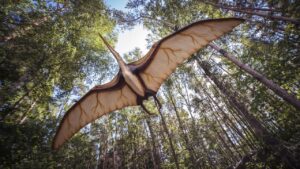
photo: Pixabay/mrganso

By the late Cretaceous, 80 million years later, tyrannosaurs and duckbills had evolved larger brains. But despite its size, the T. rex brain still weighed just 400 grams. A Velociraptor brain weighed 15 grams. The average human brain weighs 1.3 kilograms.

Dinosaurs did enter new niches over time. Small herbivores became more common and birds diversified. Long-legged forms evolved later on, suggesting an arms race between fleet-footed predators and their prey.

Dinosaurs seem to have had increasingly complex social lives. They started living in herds and evolved elaborate horns for fighting and display. Yet dinosaurs mostly seem to repeat themselves, evolving giant herbivores and carnivores with small brains.

There’s little about 100 million years of dinosaur history to hint they’d have done anything radically different if the asteroid hadn’t intervened. We’d likely still have those supergiant, long-necked herbivores and huge tyrannosaur-like predators.

They may have evolved slightly bigger brains, but there’s little evidence they’d have evolved into geniuses. Neither is it likely that mammals would have displaced them. Dinosaurs monopolised their environments to the very end when the asteroid hit.

Mammals, meanwhile, had different constraints. They never evolved supergiant herbivores and carnivores. But they repeatedly evolved big brains. Massive brains (as large as or larger than ours) evolved in orcas, sperm whales, baleen whales, elephants, leopard seals and apes.

Today, a few dinosaur descendants – birds like crows and parrots – have complex brains. They can use tools, talk and count. But it’s mammals like apes, elephants and dolphins that evolved the biggest brains and most complex behaviours.

So did eliminating the dinosaurs guarantee mammals would evolve intelligence?

Well, maybe not.

Starting points may limit endpoints, but they don’t guarantee them either. Steve Jobs, Bill Gates and Mark Zuckerberg all dropped out of college. But if dropping out automatically made you a multibillionaire, every college dropout would be rich. Even starting in the right place, you need opportunities and luck.

The evolutionary history of primates suggests our evolution was anything but inevitable. In Africa, primates did evolve into big-brained apes and, over 7 million years, produced modern humans. But elsewhere primate evolution took very different paths.

When monkeys reached South America 35 million years ago they just evolved into more monkey species. And primates reached North America at least three separate times, 55 million years ago, 50 million years ago, and 20 million years ago. Yet they didn’t evolve into a species who make nuclear weapons and smartphones. Instead, for reasons we don’t understand, they went extinct.

In Africa, and Africa alone, primate evolution took a unique direction. Something about Africa’s fauna, flora or geography drove the evolution of apes: terrestrial, big-bodied, big-brained, tool-using primates. Even with the dinosaurs gone, our evolution needed the right combination of opportunity and luck.

This article was written by Nicholas R. Longrich, a senior lecturer in Paleontology and Evolutionary Biology at the University of Bath. It is republished from The Conversation under a Creative Commons license. Read the original article.

Subscribe to Our Newsletter

News, investigations, and analysis — our top stories every morning to start your day right.

Biodiversity Wildlife
Follow on Google News Follow on X (Twitter)
Share. Facebook Twitter LinkedIn Telegram WhatsApp Email Copy Link
Previous ArticleClimate action in Middle East is doomed to fail without reform and peace
Next Article Turning hard-to-recycle polyethylene into drug treatments
Eirwen Williams
  • X (Twitter)

Eirwen Williams is a New York-based journalist at Sustainability Times, covering science, climate policy, sustainable innovation, and environmental justice. With a background in journalism acquired through a specialized program in New York, he explores how cities adapt to a warming world. With a focus on people-powered change, his stories spotlight the intersection of activism, policy, and green technology. Contact : [email protected]

Keep Reading

The Hidden Carbon Cost of Construction Projects (And Why Better Planning Matters More Than You Think)

discover the essentials of sustainability and corporate social responsibility, exploring their impact on businesses and society for a better future.

Sustainability and corporate social responsibility explained

explore the vital link between sustainability and climate change, understanding how sustainable practices can help mitigate environmental impact and promote a healthier planet.

The connection between sustainability and climate change

Add A Comment

Comments are closed.

Subscribe to Our Newsletter

News, investigations, and analysis — our top stories every morning to start your day right.

Trending
learn effective methods to measure your personal sustainability impact and make mindful choices for a greener future.
How to measure your personal sustainability impact
explore the growth of sustainable investments and green finance, highlighting their impact on the global economy and the shift towards environmentally responsible financial practices.
The rise of sustainable investments and green finance
Region Trade Bank Strengthens Governance as Sustainable Finance Places Greater Emphasis on Institutional Integrity
News by category
  • Featured
  • Cities
  • Climate
  • Energy
  • Impact
  • Markets
  • Opinions
  • Policy
  • Reports
  • Research
Information
  • About Us
  • Meet the Team
  • Advertise
  • Contact Us
  • Legal Mentions
  • Privacy Policy

Subscribe to Our Newsletter

News, investigations, and analysis — our top stories every morning to start your day right.

Facebook X (Twitter) LinkedIn YouTube TikTok
© Sustainability-Times.com. All rights reserved.

Type above and press Enter to search. Press Esc to cancel.