


| IN A NUTSHELL |
|
Orbiting between Mars and Jupiter lies the asteroid belt, a vast region of space populated by approximately 1.9 million asteroids, each over one kilometer in diameter. This belt, a relic from the solar system’s formation, serves as a boundary between the rocky inner planets and the gas giants beyond. Recent studies have revealed a concerning trend: the asteroid belt is losing its mass at a measurable rate, suggesting a gradual disappearance over astronomical timescales. This phenomenon, influenced by the gravitational forces of Jupiter, poses significant implications for our understanding of solar system dynamics and planetary defense.
The Asteroid Belt’s Slow Demise
Recent research highlights a worrying trend in the asteroid belt’s stability. According to a study led by planetary scientist Julio Fernández and his team, the asteroid belt is losing about 0.0088% of its mass every million years. This gradual depletion is attributed to the frequent collisions within the belt, where smaller asteroids collide, break apart, and reduce to cosmic dust. This dust eventually migrates into the zodiacal cloud, a thick dust cloud orbiting the Sun within the inner solar system.
Fernández’s study, published on the preprint server arXiv, underscores the belt’s dynamic nature. The researchers estimate that the belt has lost approximately a third of its mass over the last 3.5 billion years. Furthermore, 20% of these asteroids manage to escape into the inner and outer solar system, while the remaining 80% are pulverized within the belt itself. These findings not only shed light on the belt’s history but also provide a glimpse into its future trajectory.
Planetary Defense Implications
While the complete disappearance of the asteroid belt is unlikely to occur before the death of the Sun in approximately 5 billion years, this slow erosion has significant implications for planetary defense. The rate at which asteroids leave the belt and potentially head toward Earth is a critical factor in assessing threats from space. Understanding these dynamics allows for better preparedness against potential asteroid impacts.
NASA's recent DART mission, which successfully altered the trajectory of the asteroid moonlet Dimorphos, demonstrates the importance of planetary defense research. The data from Fernández's study adds another layer to this field, providing essential insights into the behavior of asteroids and their potential impact on Earth. Additionally, scientists have long hypothesized that asteroids may have played a crucial role in delivering water and the building blocks of life to our planet, making these studies even more pertinent.
The Role of Jupiter’s Gravity
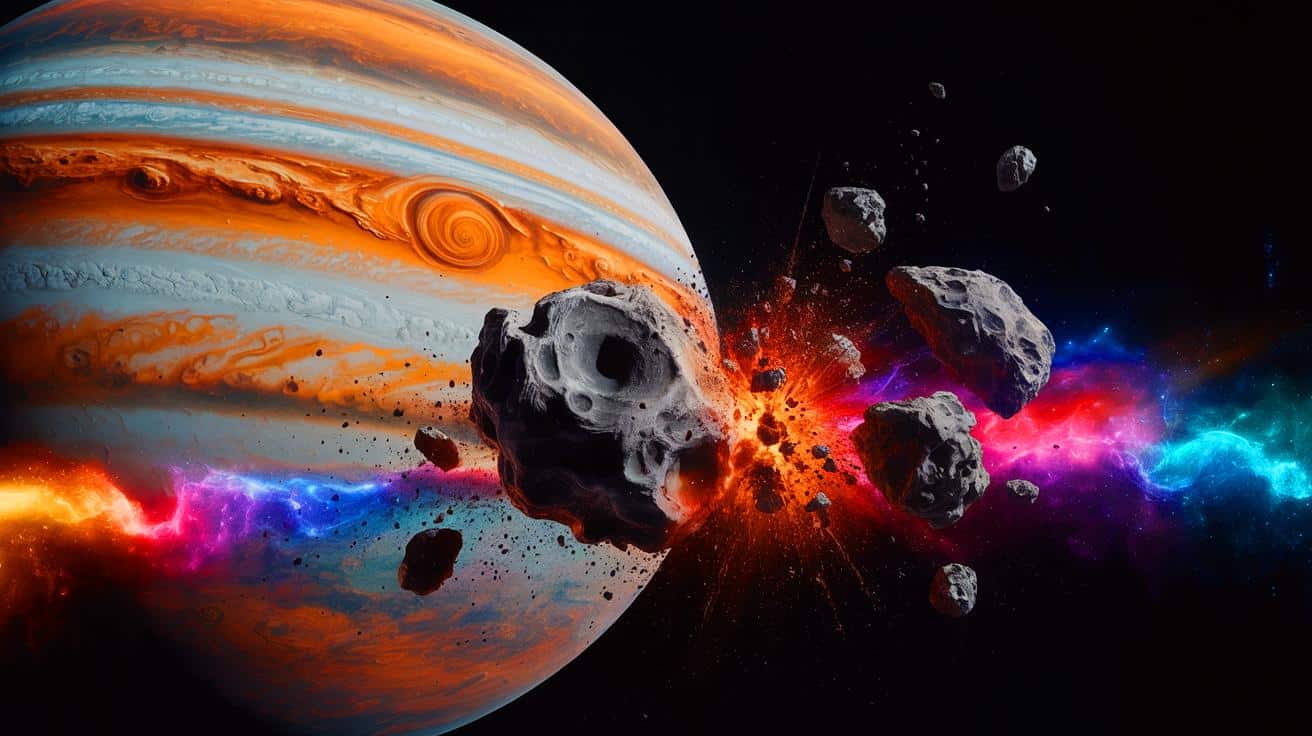
Jupiter, the largest planet in our solar system, exerts a significant gravitational influence on the asteroid belt. Its massive gravitational pull can dislodge large space rocks from their orbits in the belt, sending them on new paths across the solar system. This gravitational interaction not only contributes to the belt's gradual depletion but also to the dynamic nature of these space rocks.
The effect of Jupiter's gravity goes beyond mere ejections; it also causes asteroids to collide within the belt more frequently. These collisions contribute to the fragmentation and eventual pulverization of the asteroids, adding cosmic dust to the solar system. Understanding these gravitational interactions is crucial for predicting the future of the asteroid belt and its potential impacts on planetary dynamics.
The Future of the Asteroid Belt
As the asteroid belt continues to lose mass, scientists are keen to understand the long-term implications of this trend. While the belt's complete disappearance is not imminent, the ongoing loss of mass will inevitably alter the dynamics within our solar system. This slow attrition opens up questions about the future composition of the solar system and the potential for new asteroid formations or collisions.
Researchers are also interested in the broader implications of the belt's erosion. As asteroids continue to break apart and contribute to the zodiacal cloud, the distribution of cosmic dust across the solar system may change, potentially impacting planetary atmospheres and climates over geological timescales. The study of these processes not only enriches our understanding of solar system evolution but also prompts further investigation into the interconnectedness of celestial bodies.
The gradual disappearance of the asteroid belt raises important questions about the future of our solar system. As scientists continue to study these fascinating phenomena, what new insights might we discover about the forces shaping our cosmic neighborhood? How will these findings influence our strategies for planetary defense and our understanding of the origins of life on Earth?


Whoa, is this like a cosmic bowling alley? 🎳
Wow, I never thought about space rocks heading our way thanks to Jupiter! 🌌
Does anyone else find this completely terrifying, or is it just me? 😬
Thank you for the article! How often do these ejections actually reach Earth?
Can someone explain how Jupiter’s gravity affects the asteroid belt in simpler terms?
This is fascinating! Could this mean more meteor showers for us to enjoy at night?
Thanks for the article! It’s fascinating to learn about the dynamics of our solar system.
Isn’t the asteroid belt supposed to be stable? This sounds like a huge problem!
Is this why we see more meteor showers? 🤔
Are we sure the asteroid belt is really disappearing, or is it just a theory?
Wait, so Jupiter’s gravity is both a protector and a menace? Make up your mind, Jupiter! 😅
Great read, but what can we actually do to protect Earth from these asteroids?
How often do asteroids actually hit Earth? Seems like it could be more frequent now.
Thank you for shedding light on this important topic. It’s crucial for planetary defense.
Should we be worried about this or is it just another space scare?
Does this mean we can expect more Hollywood movies about asteroid impacts? 🍿
Is there a way to predict when an asteroid will be flung toward Earth?
Interesting article. I wonder how this affects future space travel plans?
Why is Jupiter so influential in the solar system? It’s like the bully of space!
Maybe we should just build a giant space net to catch these asteroids. 😅
Is there a chance an asteroid could be redirected to Mars instead of Earth?
Gravitational interactions sound complicated. Could we use them to our advantage?
Hope NASA has a good plan for this! 🚀
Does this mean more shooting stars for us to wish upon? 🌠
How accurate are these predictions about the asteroid belt’s future?
I’m curious about the “cosmic highway” concept. Why is it called that?
Could this gravitational effect impact satellites or space stations?
I didn’t realize how dynamic space is. Thanks for the enlightening read!
Why can’t we just send these asteroids into the Sun instead? 🌞
How does the zodiacal cloud affect Earth? Could it change our climate?
Do we have any historical records of asteroid impacts linked to Jupiter’s influence?
Jupiter seems to be causing trouble. Can we do anything about that? 😜
Is there a way to monitor these changes in the asteroid belt in real-time?
What are the chances of a large asteroid hitting Earth in our lifetime?
Big thanks to the scientists working on this! 🙌
Should we be investing more in space defense given this information?
This article makes me want to learn more about space. Any book recommendations?