



| IN A NUTSHELL |
|
China is poised to embark on a groundbreaking mission to test its planetary defense capabilities. The nation is preparing to launch a spacecraft designed to collide with a distant asteroid, aiming to alter its course by a mere inch. This mission could position China as the second nation, after the United States, to achieve such a feat in asteroid redirection. As global interest in planetary defense intensifies, China’s efforts underscore the potential for international cooperation in safeguarding Earth from potential asteroid threats. This mission not only highlights technological advancements but also raises questions about the future of global space collaboration.
China’s Ambitious Asteroid Defense Mission
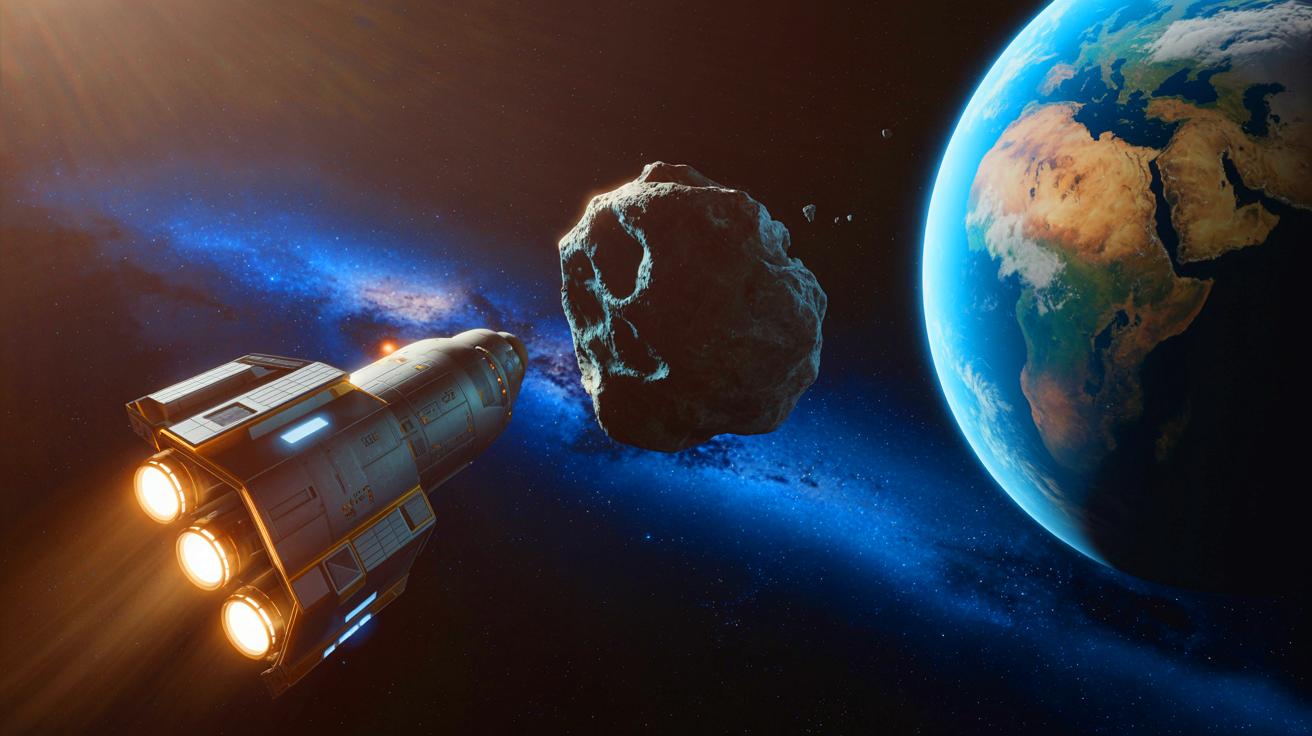
At the core of China’s plan is an innovative mission involving two spacecraft: an observer and an impactor. Wu Weiren, the chief designer of China’s lunar exploration program, unveiled the mission details at the Tiandu International Conference. The mission’s objective is to test the capability of deflecting a near-Earth object by a small margin. The observer spacecraft will first approach the asteroid to gather detailed data before the impactor spacecraft strikes the asteroid at high speed. This approach aims to provide comprehensive insights into the impact’s effectiveness.
The mission represents a significant step in China’s broader strategy to develop a robust planetary defense system. By integrating early warning systems and in-orbit responses, China aims to enhance its preparedness for potential asteroid threats. The strategy focuses on kinetic impact techniques, supplemented by advanced technologies to maximize effectiveness. Significantly, China has expressed openness to international collaboration, emphasizing the importance of data sharing and joint efforts in building a global asteroid defense framework.
Asteroids: A Dual Threat and Opportunity
Asteroids are intriguing celestial bodies, often described as remnants from the solar system’s formation. Rich in valuable metals like iron and nickel, they offer potential resource opportunities. However, they also pose a significant existential threat to Earth. Near-Earth asteroids, especially those classified as potentially hazardous, could cause catastrophic damage if they collide with the planet. Advances in observation technologies have led to the discovery of thousands of these asteroids, underscoring the urgency of planetary defense initiatives.
China’s upcoming mission builds on this awareness, following in the footsteps of NASA’s 2022 planetary defense test. While the goal is to redirect an asteroid’s path, the mission also aims to deepen our understanding of these celestial bodies. By studying their composition and behavior, scientists can better assess the risks they pose and develop more effective strategies to mitigate potential threats. The mission also highlights the potential for asteroids as a resource, prompting discussions on how to balance exploration and defense.
International Collaboration in Space Exploration
As space exploration advances, international collaboration becomes increasingly vital. China’s mission is a testament to the potential for joint efforts in addressing global challenges. By sharing data and technologies, countries can enhance their collective capabilities in planetary defense. This spirit of cooperation is crucial in an era where space exploration is no longer the domain of a few nations but a global endeavor.
China’s willingness to collaborate on its asteroid mission reflects a broader trend in space exploration. As nations invest in their respective programs, there is a growing recognition of the benefits of working together. Collaborative efforts can lead to more comprehensive solutions, pooling resources and expertise to tackle complex challenges. In the context of planetary defense, international cooperation is not just beneficial but essential to ensure the safety and security of Earth.
The Future of Planetary Defense
China’s mission marks a significant milestone in the field of planetary defense. As countries continue to develop their capabilities, the focus will likely shift towards more sophisticated technologies and strategies. The potential for redirecting asteroids poses intriguing possibilities, not only for defense but also for exploration and resource utilization. As the mission progresses, it will be crucial to monitor its outcomes and assess their implications for future initiatives.
Looking ahead, the success of such missions could pave the way for more ambitious projects, potentially involving larger asteroids or more complex maneuvers. The lessons learned from China’s mission will contribute to the growing body of knowledge in planetary defense, informing future strategies and collaborations. As we continue to explore the cosmos, the question remains: how will nations balance the pursuit of knowledge and resources with the imperative of ensuring Earth’s safety?
China’s impending mission to alter an asteroid’s path represents a pivotal moment in planetary defense efforts. By undertaking this ambitious project, China is not only advancing its technological capabilities but also contributing to global security. As the world watches, the mission’s success could inspire further international collaboration in space exploration. Given the potential threats asteroids pose, how will nations continue to innovate and cooperate in the realm of planetary defense?



Wow, China is really stepping up their game in space exploration! 🚀
Wow, China is really stepping up their space game! 🚀
Can we just appreciate how cool it is that we’re literally deflecting space rocks now? #FutureIsNow
How exactly do they plan to measure a one-inch deflection on an asteroid? 🤔
Isn’t this a bit dangerous? What if the asteroid changes course and heads straight for us instead?
This sounds like a plot from a sci-fi movie. Are we sure this is real? 😄
I’m all for planetary defense, but how much does something like this cost? 🤔
Great to see international collaboration emphasized in space efforts!
Just one inch? Seems like a lot of effort for such a small change.
Isn’t this similar to NASA’s DART mission? How is it different?
Great initiative! Hope this sparks more global collaborations in space exploration.
What happens if the asteroid breaks apart and causes more issues? 🤷♂️
Shouldn’t we be focusing on problems here on Earth first?
How big is the asteroid they’re targeting?
Why not use this mission to mine some of those valuable metals while we’re at it? 💎
So, does this mean we can potentially save Earth from a catastrophic asteroid impact?
This sounds like something out of a sci-fi movie. Can’t wait to see how it unfolds! 🎬
Why is international collaboration so important for these kinds of missions?
The US did this first, right? Is this a competition between countries?
Love seeing advancements in space tech. Go China! 🌌
What happens if the impactor misses the asteroid?
Can we call this “billiards in space”? 🎱
How do they even calculate the force needed to move an asteroid by an inch?
Seems like a great way to learn more about asteroids, even if it doesn’t work perfectly.
Hope this doesn’t trigger an international space race. 🚀
Is there a live stream of the mission launch? Would love to watch it! 📺
It’s amazing what technology can achieve today. Hats off to the scientists involved!
Why can’t we just blow the asteroid up instead of redirecting it?
This is a nice step towards ensuring our planet’s safety. Keep it up, China!
Why haven’t more countries joined this mission if collaboration is so important?
Can someone explain what an observer spacecraft does?
Seems like a lot of work for just an inch. Is it really worth it?
So cool! Asteroids could be the new gold mines of space. 💰
Are there any environmental risks associated with this mission?
Is it just me, or does space exploration keep getting more exciting? 🚀
How long will it take for the spacecraft to reach the asteroid?
Why are asteroids considered both a threat and an opportunity?
This could be a game-changer for planetary defense. Fingers crossed! 🤞
Monkey see monkey do. It is not necessary that everyone needs to punch an asteroid. We hardly know much about them. If someone in humanity has the technology then it is sufficient. As people go on punching stuff it is just a matter of time before they wipe eachother out. Why can’t someone use science to explore & learn more? All these look good in Hollywood movies but not worth the effort just to try.
Let’s hope they don’t accidentally send it towards another planet!
When are they planning to launch this mission?
Is this mission part of a larger global initiative on planetary defense?