




| IN A NUTSHELL |
|
The intersection of technology and marine biology has ushered in a new era in aquaculture, thanks to the groundbreaking work of the Research Centre in Robotics and Underwater Technologies (CIRTESU) at Universitat Jaume I. This team has been pioneering ways to integrate robotic systems into underwater environments, with a particular focus on aquaculture. Recently, at the Port of Castelló, researchers put their innovative robot fish to the test in real-world conditions, marking a significant leap from laboratory experiments to practical applications. Through a wireless system, these robot fish work alongside surface robots, aiming to revolutionize the maintenance of fish farms.
The Innovative Design of the Robot Fish
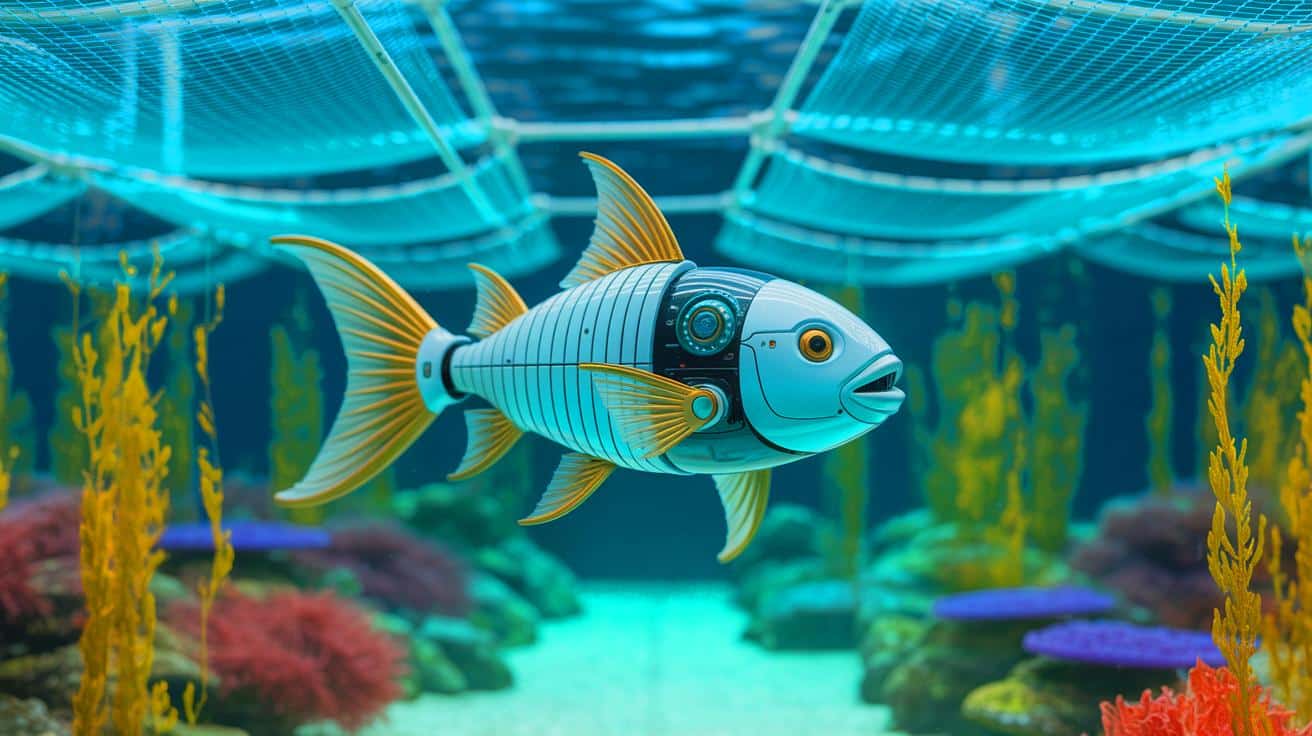
The robot fish, celebrated as a pinnacle of marine automation in Spain, represents a fusion of engineering and biological mimicry. Its design is inspired by the natural movement of real fish, utilizing biomimetic fins that emulate the efficient swimming patterns found in nature. This biomimicry not only enhances the robot’s stability in aquatic environments but also makes it more energy-efficient compared to traditional propeller-driven systems.
Equipped with an umbilical communication system, the robot fish maintains a crucial link to surface equipment, enabling seamless data transmission. An auxiliary sonar system provides the ability to “see” underwater where optical cameras may fail, particularly in murky or low-light conditions. This sophisticated visual inspection capability is pivotal for monitoring fish farm nets, identifying wear, damage, and algae build-up, and ensuring the overall health and productivity of aquaculture facilities.
Research and Development at CIRTESU
The methodical approach to research and development at CIRTESU has been central to the success of the robot fish. According to CIRTESU researcher Raúl Marín, the progression from controlled university settings to real-world environments like the Port of Castelló is essential. This phased approach, boosted by the support of the Port Authority, allows for thorough testing and refinement of the technology.
Marín emphasized the transformative potential of this technology in enhancing the safety and welfare of aquatic life within fish farms. The robot fish offers sustainable solutions that align with the future needs of aquaculture, promising to not only maintain but also improve the conditions under which fish are raised. Looking ahead, CIRTESU plans to focus on developing robotic capabilities that extend to net repair, underscoring their commitment to advancing aquaculture technology further.
PortCastelló's Role as an Innovation Hub
PortCastelló has emerged as a critical partner in this innovative endeavor, providing a controlled environment for testing new technologies. As Rubén Ibáñez, President of the Port Authority, highlighted, the ongoing collaboration with CIRTESU reflects the port's commitment to fostering an ecosystem of innovation and sustainability. This partnership enables researchers to test and elevate the Technology Readiness Level of their innovations, bridging the gap between concept and application.
The agreement between PortCastelló and Universitat Jaume I, established in July 2024, has been instrumental in this process, allowing for regular, real-world trials of publicly funded projects. While the detailed results of the recent experiments are yet to be disclosed, the positive progress reported by researchers suggests promising advancements in the application of robotic technologies in marine environments.
The Future of Aquaculture and Automation
The implications of integrating robotic systems like the robot fish into aquaculture extend beyond mere maintenance. This technology represents a broader shift towards automation and sustainability in the industry. By reducing the need for manual inspection and maintenance, robot fish could lower operational costs and minimize human intervention, thereby reducing the risk of disturbances in aquatic ecosystems.
Moreover, the ability to monitor and repair underwater facilities autonomously could lead to more efficient and responsive aquaculture practices. As the industry grapples with the challenges of sustainability and environmental impact, innovations like the robot fish offer a pathway to balancing production needs with ecological stewardship. The ongoing research and development in this field raise important questions about the future direction of aquaculture technology and its role in global food security.
As CIRTESU continues to refine and expand the capabilities of their robot fish, the potential applications and benefits of this technology in aquaculture seem vast. The collaboration with PortCastelló and the ongoing commitment to innovation suggest a promising future for sustainable fish farming. How will advancements in robotic technology further transform the aquaculture industry, and what new challenges and opportunities will arise as these innovations become more widely adopted?


This sounds like a game-changer! How soon until these robo-fish are widely used? 🤔
Are these robot fish waterproof? 😂
Fascinating! But how do they ensure these robot fish don’t disrupt local marine life?
Thank you for sharing such an insightful article! The potential of robotic fish in aquaculture is truly fascinating.
Can these robots also help clean up underwater pollution? That would be amazing!
🤔 How do these robot fish deal with predators? Are they vulnerable?
Spain is leading the way with this innovation! Kudos to the researchers involved! 🇪🇸
Why does it seem like everything is becoming robotic? Are we going too far?
Wow, this sounds like something out of a sci-fi movie! Can’t wait to see what they come up with next. 🚀
As someone who works in aquaculture, I appreciate the potential here. Thank you for sharing!
Does anyone else think this could lead to a “robotic fish uprising”? Just kidding… I think. 🤖🐟
Wait, does this mean real fish will have robot buddies now? 😂