



| IN A NUTSHELL |
|
The South Atlantic Anomaly (SAA) is a growing concern for scientists and space agencies globally. This region over South America features a weakened magnetic field, posing unique challenges for space technology and mission planning. As the SAA continues to evolve, understanding its origins and effects is crucial for safeguarding satellites and gaining insights into Earth’s magnetic dynamics. This article delves into the anomaly’s origins, its impact on space technology, its dynamic evolution, and how scientists are anticipating its future changes.
Origins of the South Atlantic Anomaly
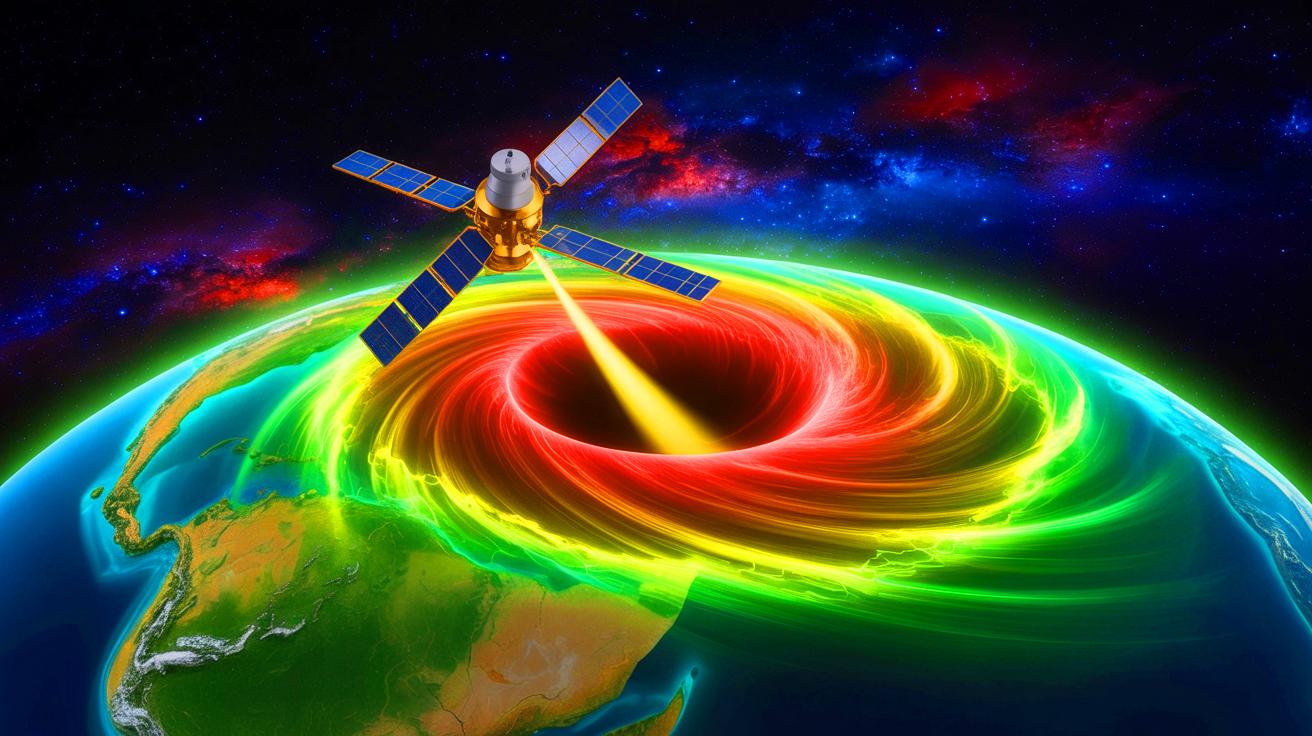
The South Atlantic Anomaly (SAA) is a geopolitical phenomenon characterized by a marked reduction in magnetic intensity. This region acts as a gap in Earth’s protective magnetic shield, allowing high-energy solar particles to approach perilously close to the surface. At the heart of NASA’s investigations is the geodynamo, a dynamic process in Earth’s outer core where molten iron and nickel movements generate the planet’s magnetic field.
Two primary factors influence the SAA’s formation: the tilt of Earth’s magnetic axis and the presence of the African Large Low Shear Velocity Province, a dense structure approximately 1,800 miles beneath Africa. These elements disrupt the magnetic field’s generation, leading to a local polarity reversal and further weakening the magnetic field intensity in the SAA region. This complex interplay of forces makes the SAA a critical area of study for scientists aiming to understand the profound processes shaping our planet’s magnetic environment.
Threats to Space Technology
The South Atlantic Anomaly poses a significant threat to space technology. Satellites passing through this region encounter high levels of energetic protons, which can cause single event upsets (SEUs). These SEUs result in temporary malfunctions, data corruption, and, in severe cases, permanent damage to spacecraft systems. To mitigate these risks, satellite operators often shut down non-essential systems when navigating through the anomaly.
The International Space Station (ISS) also traverses the SAA on each orbit. Although the ISS’s shielding provides adequate protection for astronauts, external instruments remain vulnerable. Bryan Blair, deputy principal investigator for the GEDI instrument on the ISS, reports occasional glitches and resets leading to data loss. Other missions, like the Ionospheric Connection Explorer (ICON), closely monitor the SAA and adjust operations to minimize disruptions, highlighting the anomaly’s ongoing impact on space exploration.
Dynamic Evolution and Emerging Challenges
The South Atlantic Anomaly is not static; it is dynamically evolving. Recent observations from the European Space Agency’s Swarm constellation and historical data from NASA’s SAMPEX mission reveal concerning trends. The anomaly is drifting northwest, expanding in size, and notably, since 2020, splitting into two distinct lobes, creating dual centers of minimum magnetic intensity.
The bifurcation increases the number of hazardous zones for spacecraft.
https://www.sustainability-times.com/research/warship-hangs-over-the-clouds-space-force-races-to-finish-orbital-carrier-set-to-dominate-skies-above-every-nation/
This development complicates the task of developing predictive models for geomagnetic conditions. Understanding the SAA’s changing morphology is essential for ensuring the safety of current and future satellites. Terry Sabaka from NASA emphasizes that these developments necessitate continuous monitoring and adaptation in satellite operations to mitigate potential disruptions, underscoring the ongoing challenges posed by the evolving anomaly.
Anticipating Future Changes
To improve understanding and predictions, NASA combines satellite data with simulations of Earth’s core dynamics. These inputs support global models like the International Geomagnetic Reference Field (IGRF), which track the evolution of Earth’s magnetic field. These models are crucial for planning space missions and gaining insights into our planet’s internal structure. This approach, akin to weather forecasting but on longer timescales, allows scientists to estimate the secular variation—the gradual changes in the magnetic field over years and decades.
Although the current evolution of the SAA is unprecedented in the space era, geological records indicate that similar anomalies are not uncommon over long timescales. Importantly, scientists assert that the current SAA is not an early indicator of a magnetic pole reversal, a rare event occurring over hundreds of thousands of years. Thus, studying the SAA remains a vital research area, critical for protecting our orbiting technologies and deepening our understanding of the forces driving our planet.
As the South Atlantic Anomaly continues to evolve, the scientific community remains vigilant in its efforts to understand and mitigate its impact. With its potential to disrupt satellite operations and influence our understanding of Earth’s magnetic field, the SAA poses intriguing questions about the future of our planet’s magnetic dynamics. How will these changes shape our technological and scientific pursuits in the years to come?



Wow, this sounds like something out of a sci-fi movie! 🌌
Is there any risk to humans on the ground from this anomaly?
Thank you for the detailed explanation. It’s fascinating how complex Earth’s magnetic field is.
Why is China rejecting NASA’s findings? 🤔
Could this be linked to climate change in any way?
Great article! Keep up the good work! 👍
Is the South Atlantic Anomaly affecting GPS systems?
Does this mean satellites are at risk of falling out of orbit?
How often does the ISS pass through this anomaly?
Can we see the effects of this anomaly from Earth?
I’m skeptical about these findings. Could it be an error in data?
What measures are in place to protect astronauts from this anomaly?
This sounds serious. Should we be worried about a pole reversal?
Another reason to invest more in space technology. 🚀
NASA should collaborate more internationally to tackle this issue.
How long has the South Atlantic Anomaly been a known issue?
Could this anomaly affect weather patterns?
China needs to be more cooperative on global issues like this. 🌍
How does this anomaly compare to others in the past?
Are there any visual simulations available for this phenomenon?
The article mentions “secular variation”. Can someone explain what that means?
Why aren’t more countries involved in studying this anomaly?
Fascinating read! This is why space research is crucial. 🛰️
Would love to see more articles on this topic!
What would happen if this anomaly gets worse?
Can this anomaly impact radio communications?
How often do scientists update the geomagnetic models?
Is this related to the “Apocalypse Fish” mentioned in the link? 😂
What does bifurcation mean in the context of the anomaly?
Are there any documentaries on the South Atlantic Anomaly?
Could this affect Earth’s climate in the long term?
Why is it splitting into two lobes? Is this normal?
Is NASA sharing data with other space agencies on this?
Could this anomaly cause any natural disasters?
Thanks for keeping us informed about these important issues. 🙏