




| IN A NUTSHELL |
|
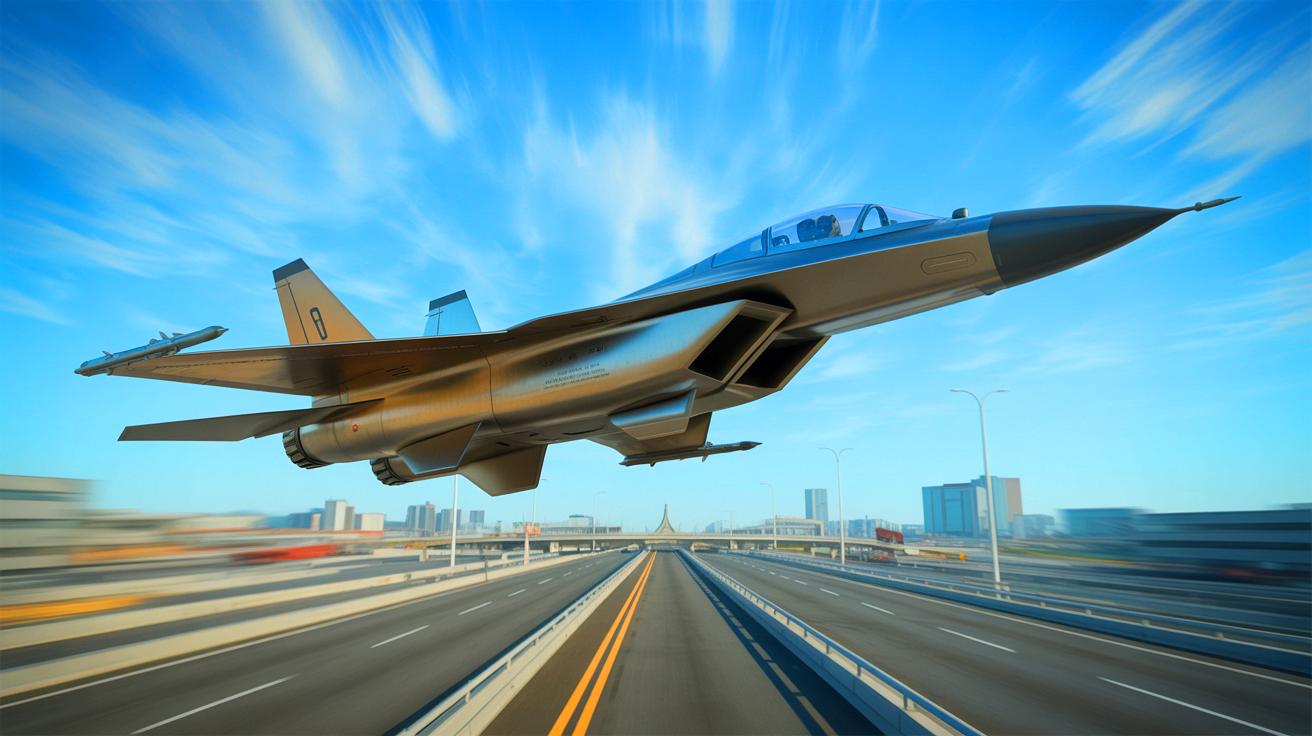
The sighting of a mysterious, futuristic fighter jet soaring over a busy highway in China has captured the attention of both social media users and defense experts worldwide. This six-second video, though blurry and brief, has spurred speculation and concern about the advancements in Chinese military technology, particularly regarding its air combat capabilities. The aircraft is believed to be a prototype of what could be China’s next-generation stealth fighter, tentatively dubbed the J-36. This revelation has reignited discussions about the strategic balance of air power and the evolving dynamics of military technology in the 21st century.
A Radical New Design
The aircraft spotted in the video represents a significant departure from traditional fighter jet designs. It boasts a unique configuration with three engines, a tailless design, and an ultra-smooth airframe—features that suggest cutting-edge stealth technology. This design choice is telling, as the absence of vertical stabilizers indicates a high priority on radar evasion, making it difficult for conventional radar systems to detect the jet.
Defense analysts have noted that the aircraft’s silhouette and propulsion system differ markedly from existing fifth-generation fighters such as the U.S. F-22 Raptor and F-35 Lightning II, as well as China’s own J-20 stealth jet. David Cenciotti, an aviation expert, describes the triple-engine layout as “highly unconventional,” with potential benefits in thrust and long-range missile storage. The radical design not only underscores China’s ambition in aircraft innovation but also highlights its commitment to developing next-generation military technology.
Is China Pulling Ahead in 6th-Generation Development?
The emergence of the J-36 video adds momentum to the theory that China may be leading the race in 6th-generation fighter development. Even though the Chinese government has not officially commented on this aircraft, the evidence suggests a dual-track development strategy by the People’s Liberation Army Air Force (PLAAF). This strategy aims to advance their air dominance capabilities for future scenarios in the Indo-Pacific region.
While the U.S. has also been making strides in this field, with President Trump announcing Boeing’s contract for the F-47—America’s own 6th-generation fighter—the details of these advancements remain largely undisclosed. This raises questions about whether the U.S. will be able to maintain its air dominance in the face of such rapid technological evolution from China. The competitive development of these aircraft is not just about technological advancement but also about maintaining strategic superiority.
What Makes a 6th-Generation Fighter?
6th-generation fighters are expected to surpass their predecessors through several key capabilities. These include advanced stealth and electronic warfare capabilities, artificial intelligence-assisted piloting and decision-making, and the ability for optional manned/unmanned operation. Additionally, network-centric warfare integration, directed energy weapons, and extended range and endurance are anticipated features.
The J-36’s unique design appears to reflect many of these ambitions, particularly regarding stealth, propulsion power, and internal weapons capacity. These advancements are not just about enhancing performance but also about ensuring dominance in increasingly contested airspaces. The development of such aircraft reflects a broader strategy to achieve superiority in future combat scenarios.
Strategic Implications
The potential operational readiness of the J-36 could signify a major leap in Chinese air power, challenging U.S. and allied air superiority in the Indo-Pacific. This development illustrates China’s commitment to advancing its military capabilities and challenging the traditional technological cycles dominated by Western countries. As one Western defense analyst noted, even a prototype’s flight is an indication that China is serious about contesting the skies in the coming decades.
The sighting of the J-36 raises critical questions about the timeline for deploying such advanced fighters and whether the U.S. will be prepared to counter them with its own innovations. The ongoing developments in military aviation technology are not just about who can build the most advanced fighter, but about who can strategically deploy them in real-world scenarios to maintain air superiority.
The emergence of next-generation fighters like the J-36 in China highlights a significant shift in the balance of military technology. As the veil of secrecy around these developments gradually lifts, the world is left wondering how these advancements will reshape global air power dynamics. How will these new capabilities impact future military strategies, and what will it take for other nations to keep pace with these rapid advancements in aerospace technology?




Wow! Did anyone actually capture a clear photo of this jet? 📸
Can’t believe they just flew it over a highway like that. Seems a bit risky, no?
Why does China always have to show off its new toys in such dramatic fashion?
Is it true this jet can outrun the F-22? That would be insane!
Those poor drivers probably thought it was a UFO! 👽
Never thought I’d see the day when China might lead in fighter jet tech.
Is there any official statement from the Chinese government yet?
Three engines? That seems a bit over the top, doesn’t it?
Thank you for the article! It’s fascinating to see how air power dynamics are evolving.
How does this compare to the rumored capabilities of the U.S.’s F-47?
It’s like something out of a sci-fi movie! 🚀
Hope no one crashed their car trying to get a good look at it! 🚗💨
The design sounds revolutionary, but how practical is it really?
Does this mean we’re in an arms race for 6th-gen fighters now?
This is why I don’t trust blurry videos as “evidence”. 🤔
Is it just me or does the J-36 sound eerily similar to something out of Top Gun?
Why do they always test these things in broad daylight?
Thanks for the detailed analysis. Helps understand the implications better.
Can this jet really evade radar systems completely?
Seems like a lot of speculation with no solid proof yet.
How long until we see these jets in active duty, if at all?
Anyone else think this might just be a PR stunt by China? 🤔
Three engines and tailless design? Sounds like a game-changer!
What’s next? Flying it over Beijing during rush hour? 😅
Bet the defense contractors are scrambling now!
Are there any satellite images that confirm this sighting?
Why does China keep pushing the boundaries like this?
Sounds like technology is advancing faster than we can keep up with.
Hope this doesn’t escalate tensions further in the Indo-Pacific region.
Maybe it was just a really fancy drone. 🤷
Great article! Keep us updated on any new developments!
How credible are the sources for this sighting?
I’m skeptical until we see more concrete evidence.
With this kind of tech, the future of air combat looks very different.
Is it possible this is just a prototype and not the final design?
Did they really fly it in daylight just to show off? 😂
China’s 6th gen fighter would barely make it as a USA 4++ gen fighter