



| IN A NUTSHELL |
|
Mars has always captured the imagination of scientists and dreamers alike. With its barren landscapes and potential for colonization, it presents a unique opportunity and challenge for humanity. Recent discoveries have unveiled a gigantic underground energy source on Mars, specifically a geothermal energy reservoir, that could change the future of planetary exploration and settlement. This newfound geothermal power source promises to be a game-changer, offering a sustainable means of energy production far from Earth. As we delve into the possibilities of harnessing this energy, the potential for establishing permanent human presence on Mars becomes increasingly feasible.
The Discovery on Mars
While Mars is often known for its cold, barren surface, recent data from NASA’s InSight lander has brought new warmth to the conversation. The detection of Mars quakes near Cerberus Fossae has highlighted the presence of internal heat that has persisted since the planet’s formation. This geothermal energy, if harnessed effectively, could be key to sustaining human life on Mars.
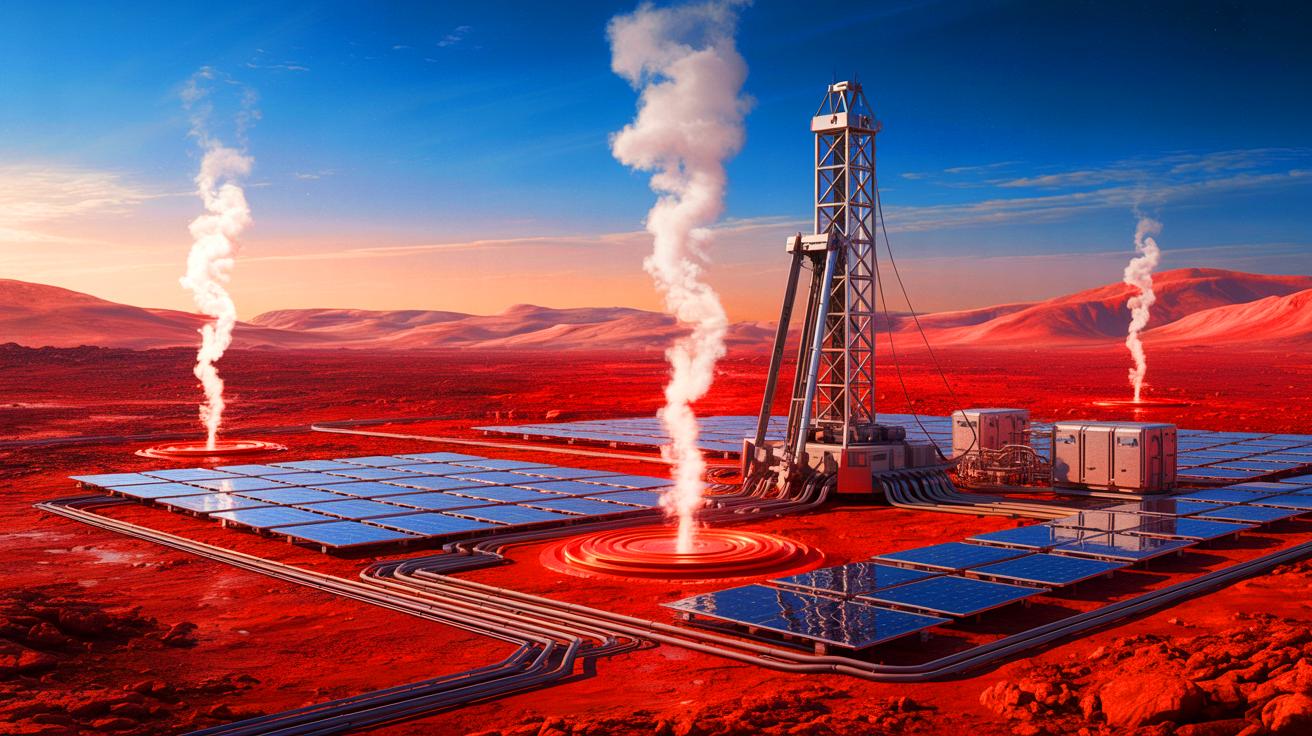
By tapping into these geothermal hotspots, the potential for generating electricity is substantial. The process involves drilling into the Martian crust and injecting fluid, resulting in steam that can turn turbines. The unique atmospheric conditions on Mars, where water boils at lower temperatures, enhance this energy extraction. Additionally, the abundance of CO₂ on Mars allows it to be used as a working fluid, ensuring efficient system performance. According to energy researcher Jess Sia, a 10-megawatt geothermal facility could potentially power a small city on Mars, making this energy source incredibly promising.
Better Than Solar and Nuclear
Traditionally, discussions around Martian energy have centered on solar and nuclear power. While solar arrays have powered Martian probes, they are limited by Mars receiving only about 43% of Earth’s sunlight. Dust storms frequently obscure the sun, making solar power unreliable, especially during winter and at higher latitudes. Nuclear power, though more stable, presents its own challenges. While NASA’s Kilopower reactors can generate approximately 10 kilowatts using a Stirling engine system, the scarcity of fissionable material on Mars and the complexity of scaling nuclear reactors limit their viability for long-term settlements.
Robert Zubrin, founder of the Mars Society, has suggested that while nuclear power may initially be necessary, geothermal energy is ultimately the most sustainable option. The discovery of geothermal hotspots lends credence to this theory, offering a reliable and scalable energy source for future Martian colonies.
Perhaps Not Solar, but the Wind as a Solution
While solar energy may be unreliable on Mars, the Martian wind presents another opportunity. Although the Martian atmosphere is thinner than Earth’s, making strong winds feel like gentle breezes, large turbines with wide blades can still capture usable energy. Wind power has the advantage of being operational throughout the night and during dust storms when solar power is not viable.
Wind turbines can serve as a complementary energy source, providing stability in emergencies. The key to Martian energy may lie in a diverse portfolio, combining solar, wind, nuclear, and geothermal sources to ensure a consistent power supply. With visionaries like Elon Musk aiming to colonize Mars soon, the development of a robust energy infrastructure will be crucial to success.
Providing the Power to Reap the Benefits of the Martian Dream
The discovery of a geothermal hotspot under Mars is a significant step towards realizing the dream of Martian colonization. By expanding our energy options, we can move from temporary habitats to permanent colonies on Mars. This diversification is essential not only for survival but also for thriving on a new planet.
While solar, nuclear, and wind power each have their merits, geothermal energy offers a sustainable solution for the long term. As Elon Musk and other pioneers look to the stars, the ability to harness geothermal energy may prove pivotal. The future of human settlement on Mars hinges on our ability to develop and maintain a reliable energy infrastructure. As we continue to explore these possibilities, one question remains: Can we truly harness the energy needed to make life on Mars a reality?


Wait, are we actually gonna live on Mars? That’s mind-blowing! 🚀
How reliable is geothermal energy on Mars compared to Earth?
This is just another excuse to waste money on space projects. 🙄
Great article! Thank you for shedding light on alternative energy sources!
Could geothermal energy also be a solution for Earth’s energy crisis?
Elon Musk will probably build a geothermal Tesla on Mars next! 😂
Isn’t it risky to rely on geothermal energy with Mars quakes?
This is delusional beyond belief. All the Mars colonization fans are delusional, especially F*Elon Musk.
This web site with sustainable in the name is anything but. As an engineer, I recognize the immense pyramid our and any advance civilization sits atop. The infrastructure requires countless industries beneath it. Even a seemingly humble and necessary profession, plumbing, requires many supporting industries. You think it magically appears? On Mars?
Why aren’t we investing more in nuclear energy if it’s so reliable?