


| IN A NUTSHELL |
|
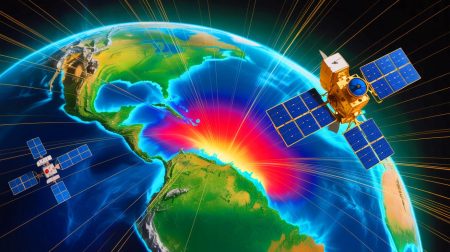
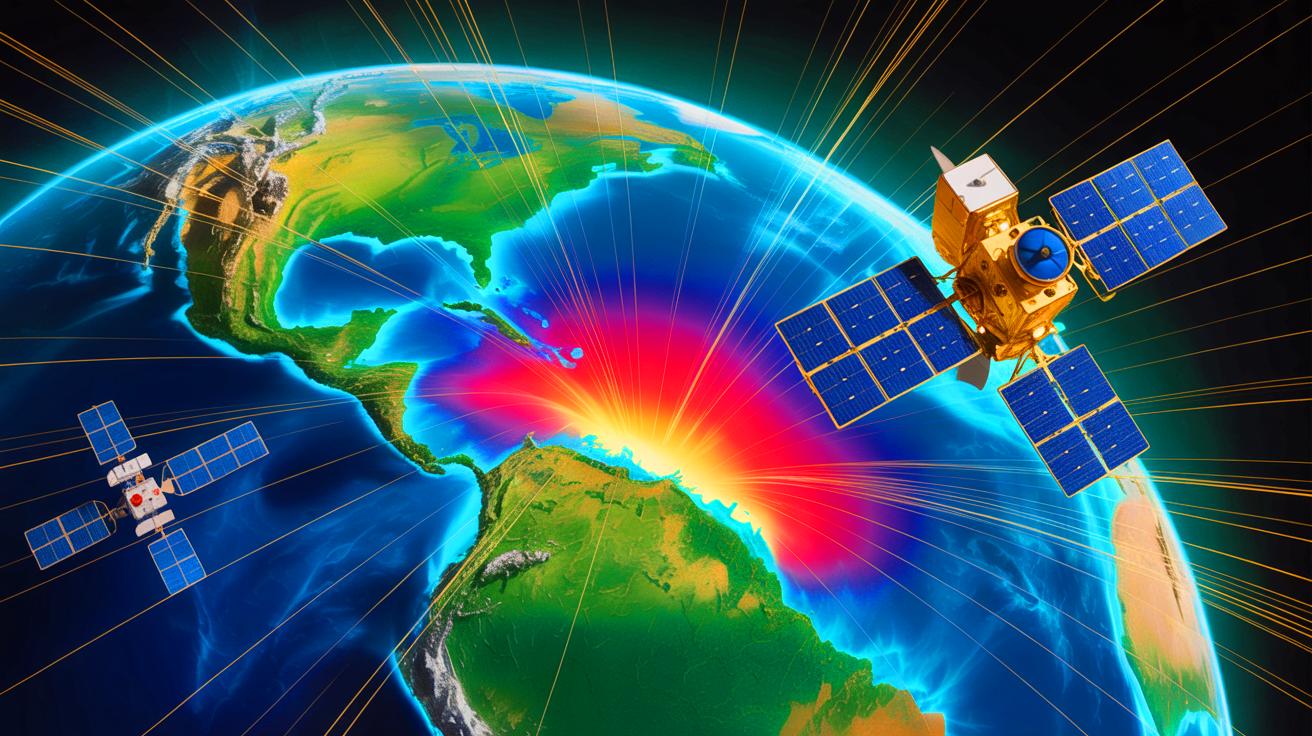
The South Atlantic Anomaly (SAA) represents a significant area of concern for scientists and the technology sector alike. Located over South America and the South Atlantic Ocean, this large region of weakened magnetic field poses risks to space technologies, particularly satellites. As the anomaly continues to evolve, understanding its dynamics has become essential for safeguarding our satellites and broadening our comprehension of Earth’s inner mechanisms. This article explores the origins, implications, and ongoing research related to the SAA, highlighting its importance in both scientific and technological contexts.
Deep Origins and Complex Mechanisms
NASA’s focus on the South Atlantic Anomaly (SAA) is driven by the anomaly’s profound implications. This geomagnetic phenomenon is characterized by a significantly reduced magnetic intensity in its region, creating a breach in Earth’s protective shield. This breach allows high-energy solar particles to reach closer to the Earth’s surface, posing potential risks.
The origin of the SAA is tied to the planet’s core dynamics. The geodynamo, a process in Earth’s outer core involving the movement of molten iron and nickel, generates the magnetic field. However, this field is not uniformly generated, leading to weaknesses like the SAA. Two primary factors contribute to its formation: the tilt of Earth’s magnetic axis and the influence of the African Large Low Shear Velocity Province, a dense structure located deep beneath the African continent. This combination disrupts magnetic field generation, creating a local polarity reversal and further weakening the magnetic field intensity.
“A reversed polarity field has developed, creating a ‘pothole’ in Earth’s magnetic armor,” explains Weijia Kuang from NASA’s Goddard Space Flight Center.
A Threat to Space Technology
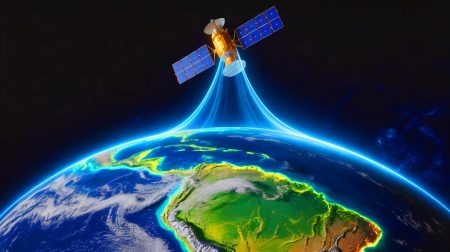
The SAA’s weakened magnetic field poses significant challenges for space technology. Satellites passing through this area encounter high levels of energetic protons, which can cause single event upsets (SEUs). These incidents can result in temporary malfunctions or even permanent damage if critical systems are affected.
To mitigate these risks, satellite operators often shut down non-essential systems while traversing the anomaly. The International Space Station (ISS) also crosses the SAA during its orbits. While astronauts are protected by the station’s shielding, external instruments are more vulnerable. Bryan Blair, deputy principal investigator for the GEDI instrument on the ISS, reports occasional “glitches” and resets, leading to occasional data loss. Other missions, like the Ionospheric Connection Explorer (ICON), also monitor the SAA closely.
The SAA is not a static phenomenon. Recent data shows that it is drifting northwest and expanding. Since 2020, it has begun to split into two distinct lobes, increasing the number of hazardous zones for spacecraft and complicating predictive modeling efforts. Understanding these changes is crucial for the safety of current and future satellites.
Anticipating the Invisible
NASA employs a combination of satellite data and core simulations to enhance understanding and predictions related to the SAA. These inputs fuel global models like the International Geomagnetic Reference Field (IGRF), which tracks the Earth’s magnetic field evolution. Such models are vital for planning space missions and offer insights into our planet’s internal structure.
This approach is akin to weather forecasting but on a much longer timescale. It allows scientists to estimate secular variation, or the slow changes in the magnetic field over years and decades. Geological records suggest that similar anomalies have occurred over millions of years, indicating that the SAA is not necessarily a precursor to a magnetic pole reversal, a rare event occurring over hundreds of thousands of years.
Studying the SAA is crucial for both protecting technology in orbit and deepening our understanding of the forces driving our planet. As it evolves, the scientific community remains vigilant in its efforts to comprehend and mitigate its impacts.
Future Implications and Questions
The South Atlantic Anomaly’s evolution poses intriguing questions for both technology and science. Its potential to disrupt satellite operations and influence our understanding of Earth’s magnetic field makes it a focal point of research. The continued study of the SAA is essential for anticipating its effects and preparing for future challenges.
The anomaly’s dynamics may shape the future of space technology and scientific inquiry, raising questions about the long-term impacts on Earth’s magnetic environment. As researchers strive to unravel the complexities of the SAA, they are driven by a fundamental question: How will these changes influence technological and scientific pursuits in the years to come?


Wow, this sounds like something out of a sci-fi movie! 🌌