



| IN A NUTSHELL |
|
Astrophysicist Adam Becker presents a contrarian view against the popular idea of Mars colonization, famously advocated by Elon Musk. Musk’s vision of humanity as a multiplanetary species relies heavily on the notion that Mars could serve as a “lifeboat” in the event of a catastrophic disaster on Earth. However, Becker argues that even under the direst scenarios, Earth would remain infinitely more habitable than the barren, freezing expanse of Mars. This article delves into the arguments posed by Becker, comparing the environmental conditions of Earth and Mars, and evaluating the feasibility of terraforming as a solution for long-term human survival.
The Martian Dream: Elon Musk’s Vision Under Scrutiny
Elon Musk, CEO of SpaceX, is known for his audacious goal of making humanity a multiplanetary species, with Mars as the focal point of his ambitious plans. To Musk, Mars represents a potential refuge in the event of a global catastrophe on Earth. Yet, Adam Becker, an astrophysicist and author, strongly challenges this notion. He criticizes Musk’s vision as an example of technological optimism that is largely disconnected from physical realities. In a candid interview with Rolling Stone, Becker did not hold back his criticism, labeling the idea as “one of the stupidest things someone could say.” Such a statement underscores Becker’s belief that the challenges of Mars colonization are insurmountable with current technologies and understandings.
Becker’s skepticism is rooted in scientific facts and practical concerns. He believes that the challenges posed by the Martian environment are too great to overcome, especially when compared to the potential for recovery and adaptation on Earth. This perspective invites us to rethink the feasibility of Mars as a viable alternative for human habitation, urging a more grounded approach to future extraterrestrial endeavors.
Apocalyptic Scenarios: Earth vs. Mars
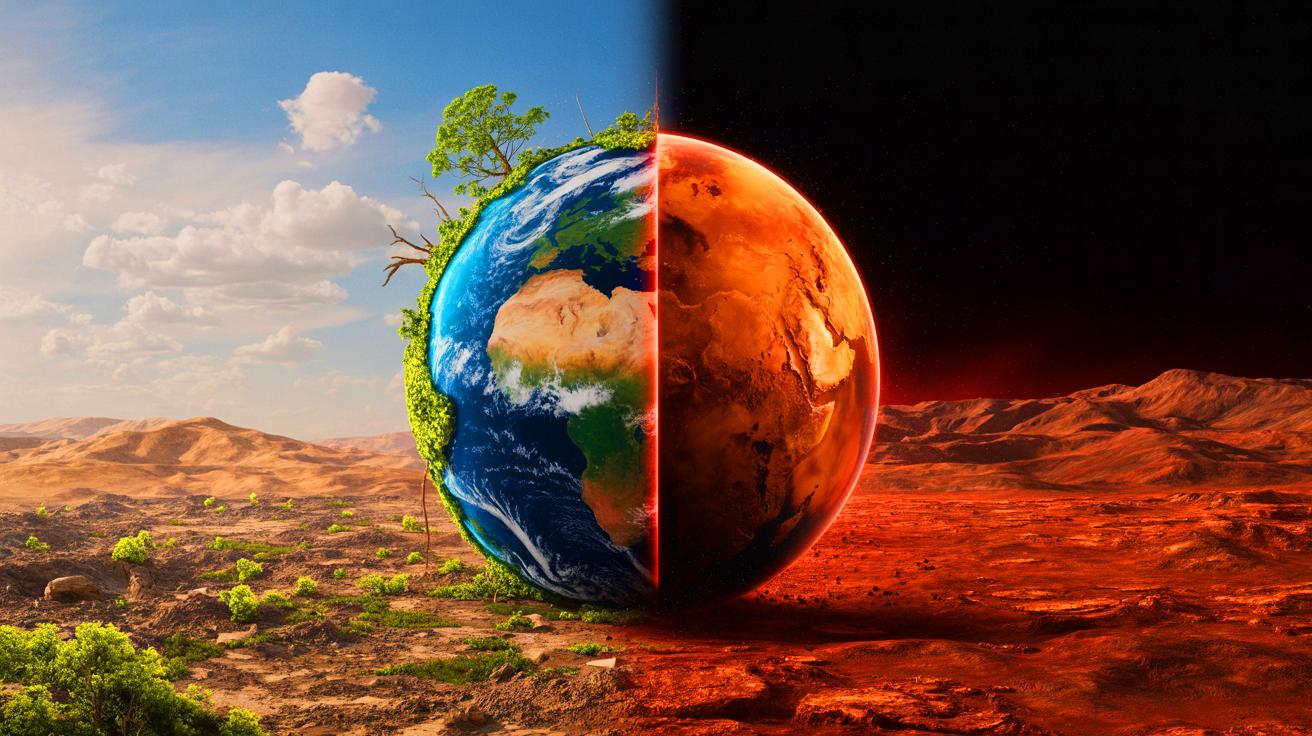
To substantiate his arguments, Adam Becker envisions three catastrophic scenarios that could potentially devastate Earth: an asteroid impact similar to the one that wiped out the dinosaurs, the detonation of all nuclear bombs on the planet, and uncontrolled climate change. Even in these extreme conditions, Becker asserts that Earth would still be more hospitable than Mars. This is because our home planet retains critical elements for life, such as a breathable atmosphere, suitable gravity, accessible water, and protection against harmful radiation.
The comparison between Earth and Mars highlights stark differences. Earth, even when ravaged, has pockets of resilience that Mars simply cannot offer. The Martian atmosphere, composed mostly of carbon dioxide, is irrespirable and lacks the necessary density to support life. In contrast, Earth’s atmosphere, although potentially tainted in a disaster, remains fundamentally supportive of life. This stark contrast emphasizes the importance of preserving and protecting our planet, as it inherently possesses the life-sustaining qualities that Mars lacks.
Mars: A Frigid and Sterile Hellscape
Examining the environmental conditions of both planets reveals the formidable challenges of living on Mars:
| Criteria | Earth (Post-Cataclysm) | Mars (Current State) |
| Atmosphere | Rich in oxygen and nitrogen, dense | 95% CO₂, pressure 0.006 bar, irrespirable |
| Average Temperature | Potentially reduced but manageable | -81°F, extreme cold |
| Water Presence | Contaminated oceans but present | Deep ice, largely inaccessible |
| Magnetic Field | Present, protective | Absent, direct cosmic radiation |
| Soil | Contains organic matter | Toxic, rich in carcinogenic perchlorates |
Life on Mars would necessitate living under pressurized domes, with any failure in vital systems resulting in immediate death. Conversely, Earth, even post-disaster, could support surviving life forms capable of rebuilding and adaptation. The contrast is clear: while Earth offers the possibility of regeneration, Mars remains an unyielding and hostile environment.
Terraforming Mars: A Futile Fantasy?
Elon Musk envisions transforming Mars into a habitable planet through human ingenuity, suggesting methods like detonating nuclear bombs at the poles, deploying space mirrors, and building climate-controlled greenhouses. To achieve a Terra-like environment, it would be necessary to:
- Release enough CO₂ to thicken the atmosphere.
- Create a sustainable greenhouse effect to warm the planet.
- Develop an artificial magnetic field for protection.
Despite these ambitious ideas, releasing all of Mars’s CO₂ would only achieve 7% of Earth’s atmospheric pressure, insufficient for survival without pressurized suits. The logistical and financial challenges of transporting materials, food, water, and humans across 34 million miles are monumental. Becker succinctly concludes that investing in Mars colonization equates to abandoning a damaged hospital for a barren, radiation-filled desert without oxygen. He emphasizes, “Better to preserve our wounded planet than to exile to a giant open-air coffin.”
At the heart of this debate is the recognition that, without a credible interplanetary plan B, the focus should remain on safeguarding our unique blue planet. Given its inherent life-sustaining qualities, Earth remains our best hope for survival. This raises an essential question: Are we investing enough in preserving the one planet we know can support life, or are we letting dreams of Mars distract us from the urgent task at hand?


Is this really about Musk vs. Mars or just a plea for Earth? 🤔
Wait, Mars is a “frigid and sterile hellscape”? Guess I’m canceling my vacation plans! 😂
Thank you, Adam Becker, for bringing some realism to the Mars hype. 🙏
Why are we dreaming about Mars when we have a planet to save here?
Elon Musk should focus on making Earth a better place first. 🌍
Becker makes valid points, but isn’t space exploration about pushing boundaries?
Terraforming Mars sounds like science fiction. Can it really be done?