




| IN A NUTSHELL |
|
The majestic Himalayas have long captured the fascination of scientists and adventurers alike. As the highest mountain range on Earth, their towering peaks have been the subject of numerous scientific studies aiming to unravel the mysteries of their formation and sustainability. Recent groundbreaking research has challenged the long-held belief that the Himalayas are solely supported by the Earth’s crust. Instead, scientists now propose that the mantle, a layer beneath the crust, plays a crucial role in sustaining these colossal mountains. This new perspective not only reshapes our understanding of the Himalayas but also has significant implications for the study of mountain formations worldwide.
The Traditional View: Crustal Support
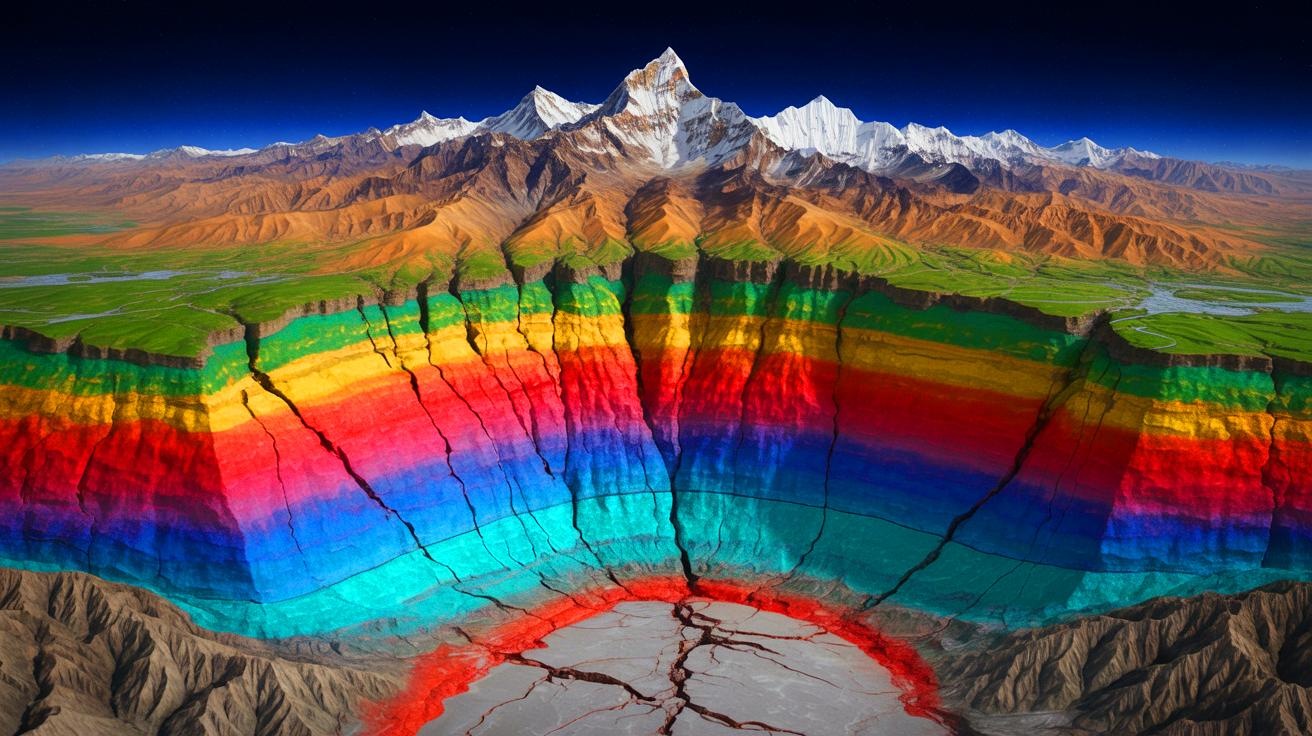
For decades, the scientific community largely agreed that the immense height and mass of the Himalayas were supported by a thickened crust. This idea was first proposed by Swiss geologist Émile Argand in 1924. He suggested that the collision of the Indian and Asian tectonic plates caused the Earth’s crust to thicken, forming a strong base that extended 45 to 50 miles deep. This thickened crust was thought to provide the necessary support for the mountain range’s weight.
However, this theory has significant limitations. As the crust descends, the increasing temperatures cause rocks to become molten, transforming them into a ductile material at depths of around 25 miles. As Pietro Sternai, a geophysicist leading the new study, pointed out, “You can’t build a mountain on top of yogurt,” referring to the viscous nature of the molten crust. This analogy highlights the challenge of relying solely on the crust to support the Himalayas.
Unveiling the Mantle’s Role
Pietro Sternai and his team have introduced a paradigm shift in the understanding of the Himalayas’ structural support. Their research proposes that the mantle, a layer situated beneath the Earth’s crust, also plays a pivotal role. According to their findings, when the Indian plate slid beneath the Eurasian plate, some mantle material did not flow away as previously thought. Instead, it rose and was trapped between the two crusts, providing additional support.
This mantle material does not liquefy as easily as the crust, which adds strength and buoyancy to the region, sustaining the Himalayas and the Tibetan Plateau. The new model aligns with seismic data and direct geological observations, offering a more comprehensive understanding of the region’s geology. Sternai’s colleague, Simone Pilia, noted that with this new model, “Things actually start to make sense now,” as previously enigmatic observations can now be explained.
Implications for Global Tectonic Studies
This new understanding of the Himalayas has far-reaching implications for tectonic studies worldwide. Traditionally, any new geological data from the region had been interpreted through the lens of the double-thickened crust theory. However, with the inclusion of the mantle layer, scientists are now urged to reconsider their interpretations.
Could other mountain ranges possess similar structural compositions involving mantle support? This raises important questions about the formation and sustainability of mountain ranges across the globe. By examining the possible presence of mantle material beneath other tectonic boundaries, researchers may unlock new insights into the forces driving mountain uplift.
The Future of Himalayan Research
As researchers delve deeper into the complexities of the Himalayas’ geological structure, the focus is shifting towards understanding the broader implications of these findings. The presence of mantle material between crustal layers invites a reevaluation of existing tectonic and geological models. It challenges researchers to explore new methodologies and perspectives in mountain formation studies.
The new insights gained from this research may lead to more accurate predictions of seismic activity in the region, potentially enhancing our ability to mitigate natural disasters. Moreover, understanding the role of the mantle in mountain formation could have implications for resource exploration and environmental conservation efforts in mountainous regions.
The recent discoveries about the Himalayas invite us to reconsider long-held geological theories and highlight the importance of continuous scientific inquiry. As we explore the depths of our planet’s structure, we are reminded of the vastness of what remains to be understood. What other geological secrets might be hidden beneath the Earth’s surface, waiting to reshape our understanding of the world?




Wow, mind blown! 🌋 I always thought it was just the crust. Science is amazing!
Wow, the Himalayas have a secret foundation? Who would’ve thought! 🤯
Isn’t it amazing how science keeps challenging what we thought we knew?
So does this mean other mountain ranges might have the same mantle support? 🤔
So, does this mean other mountain ranges could also have mantle support? 🤔
Thank you for the fascinating article! Science never ceases to amaze me. 🌍
Isn’t this just another theory? How sure are we that the mantle is actually supporting the Himalayas?
I’m curious, how did the researchers discover the mantle’s role here?
Great article, but could you explain how they measured the mantle’s involvement?
This makes me wonder what other geological mysteries are out there waiting to be discovered!
So, does this mean the Himalayas are less stable than we thought? 😮
Wait, does this mean the crust is like yogurt? That’s a funny analogy! 😂
Love the analogy of building a mountain on yogurt! So vivid! 😂
Does this study have any implications for the mining industry? 🏔️
Could this new model potentially predict volcanic activities in the region?
Is this a widely accepted theory now, or is it still debated among scientists?
How long did it take the team to come to this conclusion? Seems like a massive undertaking.
More research is always a good thing. But what about the practical applications?
Why haven’t scientists looked into this before? The mantle’s role seems crucial!
Thank you for sharing this! It makes me appreciate the complexity of our planet even more. 🌎
Wasn’t this theory proposed before, or is it completely new?
I’m not sure I buy this. What if the data is wrong? 🤷
How can we ensure this new model is accurate and reliable? 🧐
I’m skeptical about this. How can the mantle support mountains? 🤨
Wow, this is groundbreaking! How does it change the way we view mountain formations?
So, what does this mean for future expeditions to the Himalayas? 🏔️
Absolutely fascinating! What could be the next steps in this research?
Thanks for the article! It’s fascinating to learn about new geological perspectives.
Are there any environmental impacts because of the mantle’s role in the Himalayas?
Interesting article, but how does this affect local populations living near the Himalayas?
Is the mantle’s role unique to the Himalayas, or could it be a common feature in other ranges?
Great read! How might this discovery impact tourism in the region?
Thanks for the article! Science truly is like peeling an onion, layer by layer! 🧅
Interesting read! How might this affect earthquake predictions in the area?
I’m skeptical. How come no one noticed this before?
This is revolutionary! Kudos to the researchers for unveiling such a mystery. 👏
I guess I’m the only one who thought mountains were coming out the closet.
Does this discovery have any implications for global warming or climate change?
Can someone explain how the mantle material doesn’t liquefy like the crust? I’m confused 🤷♂️
Fantastic work by the scientists! This is a game-changer for tectonic studies.