



| IN A NUTSHELL |
|
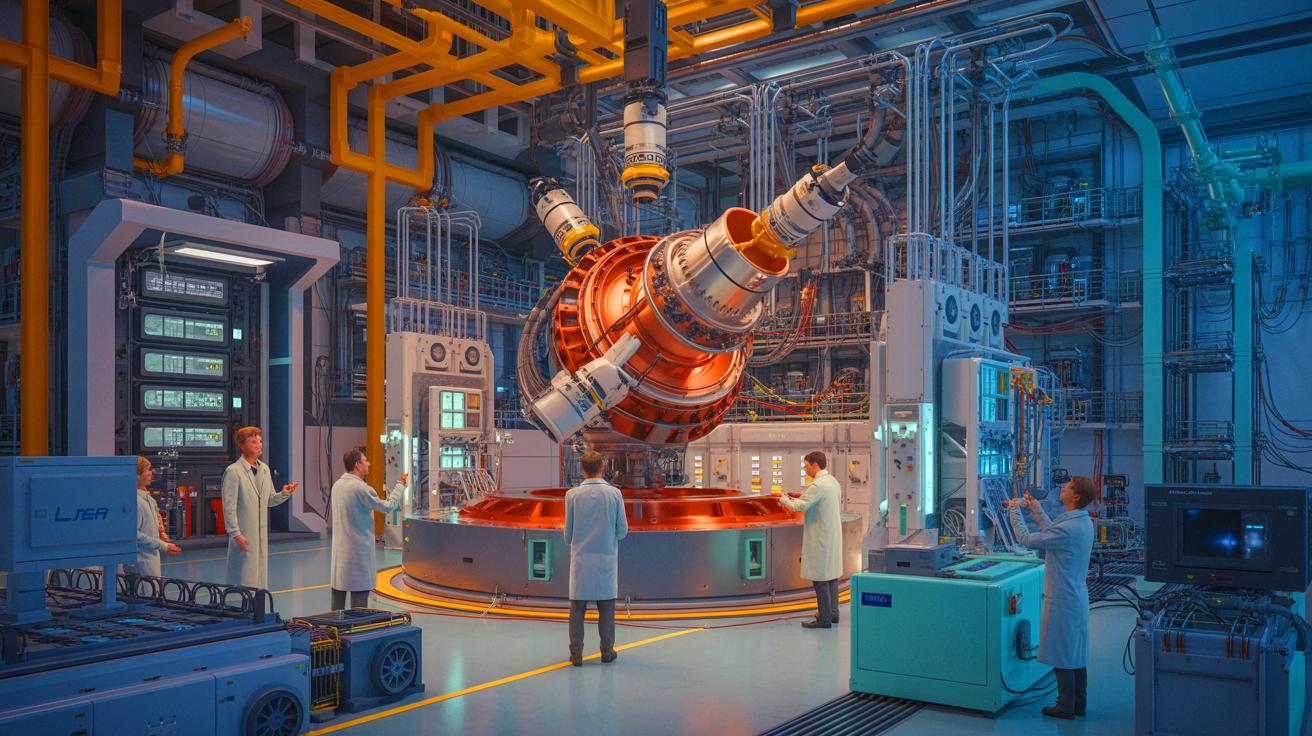
In a groundbreaking development for nuclear fusion technology, a prototype of the outer vertical target for the ITER fusion reactor’s divertor has successfully passed certification tests. Developed by Hitachi and Japan’s National Institutes for Quantum Science and Technology (QST), this component is integral to the ITER reactor, which is being constructed in Southern France. Acting as the reactor’s exhaust system, the divertor is the only part of the tokamak that directly touches the plasma, playing a crucial role in maintaining the stability of the fusion reaction. This achievement not only marks a significant milestone for the ITER project but also sets the stage for future advancements in fusion energy.
Crucial Role of the Divertor in Fusion Reactors
The divertor is an essential component of the ITER reactor, and its primary function is to remove impurities from the plasma, such as fuel residue and helium ash produced during the fusion reaction. By doing so, it helps maintain the necessary conditions for a stable nuclear fusion reaction. This component operates in an environment characterized by extreme conditions, including high heat and particle loads from the plasma.
In this severe environment, the divertor must be constructed from special materials that can withstand such conditions. For instance, tungsten, a material capable of withstanding temperatures as high as 36,032 degrees Fahrenheit (20 megawatts per square meter), is used. Additionally, the divertor must endure electromagnetic forces of up to approximately 33,000 pounds. Achieving this requires a high level of structural integrity and innovation in material science and engineering.
Challenges in Manufacturing the Divertor
The manufacturing of the divertor is a complex endeavor, given the extreme environment in which it operates. QST and Hitachi collaborated closely, with each bringing their expertise to the table. QST led the development of materials, focusing on producing tungsten monoblocks and high-strength copper alloy cooling pipes that maintain thermal conductivity despite intense heat. Additionally, they developed a high-heat-resistant brazing technology for bonding materials.
Hitachi, on the other hand, focused on the precise manufacturing processes required for the divertor. This involved machining and assembly with tolerances as tight as 0.02 inches, ensuring the component met the rigorous standards set by the ITER Organization. Their efforts included specific welding techniques, non-destructive inspections, and an automated robotic welding system to ensure precision and quality.
Ongoing Developments and Future Applications
The successful certification of the divertor prototype is a promising development for the ITER Project, which aims to demonstrate the scientific and technological feasibility of fusion energy on a large scale. This achievement is not just a testament to the collaborative efforts of Hitachi and QST but also a step toward realizing the potential of fusion energy as a sustainable and clean energy source.
Both Hitachi and QST plan to continue their work on the ITER Project and explore applications of this technology in other fusion energy projects. QST is also investigating a prototype fusion reactor, indicating the potential for further innovation and progress. Additionally, engineers and scientists at ITER are developing new techniques, such as boronization, to enhance reactor performance by reducing plasma impurities and improving overall stability.
Impact on the Future of Energy
The advancements in the ITER Project and the successful development of the divertor prototype signal a significant shift in the pursuit of clean energy. Fusion energy, with its potential to provide an almost limitless and pollution-free power source, could revolutionize the energy industry, reducing dependence on fossil fuels and minimizing environmental impact.
As technology continues to evolve, the achievements of the ITER Project and similar initiatives could pave the way for commercial fusion reactors, bringing humanity closer to harnessing the power of the stars. The question remains: how quickly can we transition to this sustainable energy future, and what challenges must we overcome along the way?

Wow, fusion energy sounds like sci-fi becoming reality! 🌌
Is it really hotter than an asteroid impact? That’s insane!
How does this compare to other renewable energy sources?
Incredible achievement! Kudos to the team behind this. 🎉
Why do they need such extreme temperatures for fusion?
Hope this leads to a sustainable future for our planet.
Does this mean cheaper electricity bills in the future? 💡
What are the main challenges still facing the ITER project?
The term “hotter than hellfire” is quite dramatic! 😆
Thank you for the informative article. Very exciting news!
How long before this tech becomes commercially viable?
Are there any safety concerns with these extreme temperatures?
I’m not convinced fusion energy will be affordable anytime soon.
Thank you for shedding light on such a complex topic. 🙏
How does this development affect global energy policies?
Is there a backup plan if fusion doesn’t pan out?
Why is tungsten chosen over other materials? 🧐
Can this technology be adapted for other uses outside energy?
Great, now we just need to figure out how to cool it down! 🥶
What’s the estimated timeline for completing the ITER reactor?
I heard fusion energy has no radioactive waste. Is that true?
Are there any similar projects in other countries?
So, when can I get a fusion reactor in my backyard? 😂
Why is QST involved in this project? What do they bring to the table?
Are there any potential downsides to fusion energy?
Does this mean the end of nuclear fission reactors?
How do they simulate asteroid impacts to test these parts? 🤯
Fusion energy: too good to be true, or the future? 🤔
Does this mean we can finally move away from fossil fuels?
How does tungsten handle such high temperatures? 🤔
This sounds great, but what about the cost of production?
Are there any environmental risks with fusion reactors?
ITER sounds promising, but isn’t it always “just around the corner”?
I’m skeptical about the timeline. How soon can we see results?