



| IN A NUTSHELL |
|
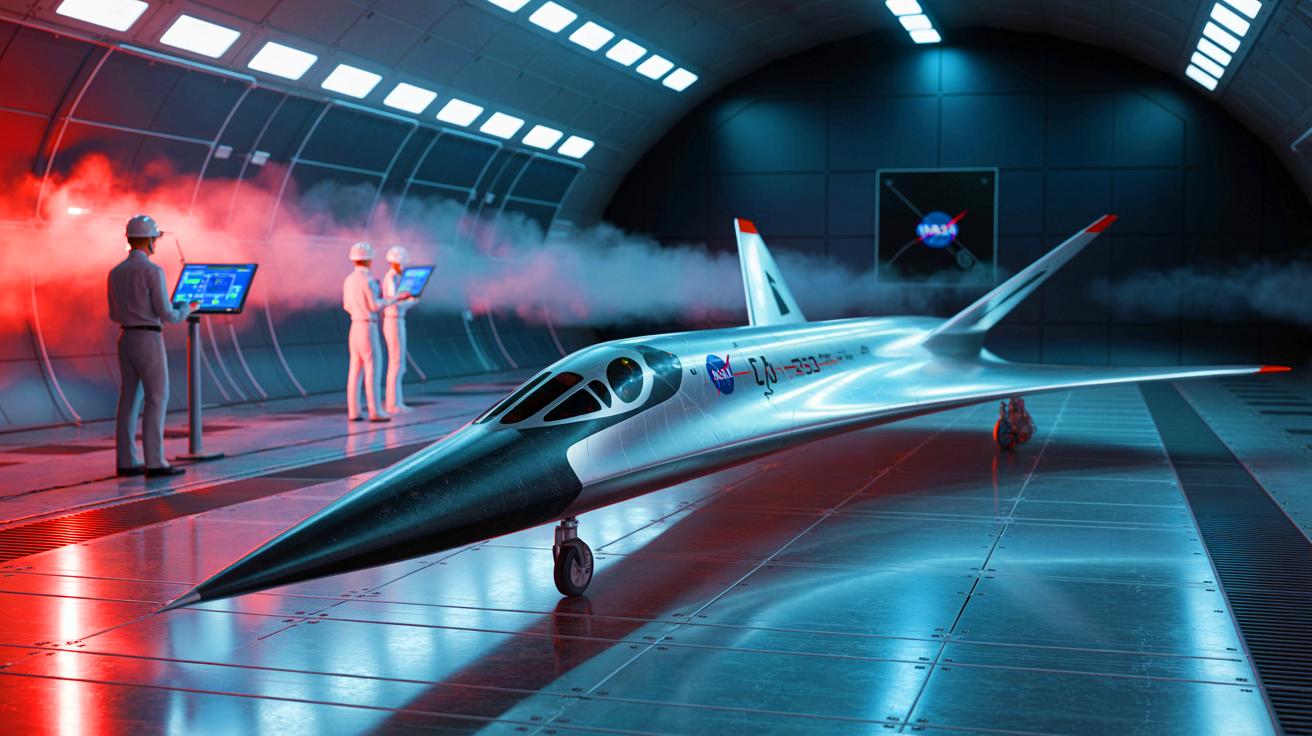
In an era where innovation is the cornerstone of progress, NASA and the Japanese Aerospace Exploration Agency (JAXA) are collaboratively pushing the boundaries of aviation technology. Recently, in Chofu, Japan, a 1.62% scale model of the X-59 aircraft underwent rigorous testing, reaching astonishing speeds of Mach 1.4 within a compact 3-by-3-foot wind tunnel. This miniature marvel is not just a testament to engineering prowess but a crucial step toward revolutionizing supersonic travel. The data collected from these tests are invaluable, setting the stage for quieter, overland supersonic flights that could redefine air travel as we know it.
Tiny Model, Full-Scale Stakes
The X-59 demonstrator, a remarkable feat of engineering, measures an impressive 99.7 feet in length with a wingspan of 29.7 feet. However, the recent tests in the Chofu wind tunnel used a much smaller 19-inch model, representing just 1.62 percent of the actual aircraft. Despite its diminutive size, this model was subjected to airflow conditions matching the aircraft’s anticipated cruise speed of Mach 1.4, equivalent to approximately 925 miles per hour. These conditions were crucial for collecting critical experimental data that could validate the aircraft’s design.
By comparing the results from these wind-tunnel tests with detailed Computational Fluid Dynamics predictions, NASA aims to confirm how the air will flow over the jet’s slender fuselage and long, swept wings. The primary goal is to understand the behavior of shock waves, which, unlike in conventional supersonic aircraft, are designed in the X-59 to separate, resulting in a subtle “sonic thump” instead of a loud boom. This breakthrough could pave the way for overland supersonic passenger flights, making them viable and socially acceptable.
Milestones on the Road to First Flight
The recent wind-tunnel experiments are just one step in a series of significant milestones for the X-59 program. In December 2024, a critical engine-burning test was successfully completed at Lockheed Martin’s Skunk Works facility in Palmdale, California. This test marked the first time the integrated propulsion system was pushed to full power, underscoring the readiness of the X-59 for real-world conditions. Earlier, in October 2024, a preliminary engine shakedown ensured all systems were leak-free and operational.
Progress continued with high-fidelity simulations in May 2025, which rigorously tested the aircraft’s flight computer and subsystems. These simulations ensured that the sensors, control surfaces, and redundant computers could communicate seamlessly, simulating the high-altitude, high-speed missions the X-59 is designed for. As part of NASA’s Quesst mission, these efforts are geared towards proving that quiet supersonic flight is both technically feasible and socially acceptable. Once airborne, the X-59 will perform community overflights across the United States, gathering public feedback on its muted acoustic footprint.
Unveiling the Future of Supersonic Travel
The X-59 project represents a significant leap forward in aviation technology. The successful tests of the 19-inch model in Chofu are a critical step toward achieving flights that could potentially reshape air travel. By turning the dreaded boom into a manageable thump, engineers are not only addressing noise pollution but also opening the door to commercial supersonic airliners capable of crossing continents at unprecedented speeds. This innovation could provide future commercial aircraft designers with the tools necessary to revolutionize air travel without disturbing the peace below.
The potential for overland supersonic flight remains high, with the promise of reduced travel times and increased efficiency. The X-59 is at the forefront of this journey, offering a glimpse into a future where lengthy flights become a thing of the past. The data collected from these tests and future community feedback will be instrumental in shaping regulations and guiding the next generation of supersonic aircraft design.
Data and Feedback: Paving the Path Forward
As the X-59 moves closer to its first flight, the importance of data collection and community feedback cannot be overstated. The data gathered from wind-tunnel tests, combined with real-world overflight assessments, will provide regulators with the information needed to reconsider the current ban on supersonic flight over land. This potential change in policy could have a profound impact on the aviation industry, enabling faster, more efficient travel.
The collaboration between NASA and JAXA exemplifies how international cooperation can drive technological advancements. By harnessing the expertise of both agencies, the X-59 project is poised to make significant contributions to the future of air travel. As we look to the skies, one cannot help but wonder: will the dream of quiet, overland supersonic flight soon become a reality for travelers worldwide?




Wow, Mach 1.4 with a 19-inch model? Can’t wait to fly supersonic without the annoying boom! 🚀
Impressive test results! How soon do you think we can expect commercial flights using this tech?
Sounds like a game-changer for air travel! But how much is this going to cost the taxpayers? 🤔
Why Japan for the test? Is their wind tunnel better than others?
This is absolutely amazing. Thank you, NASA and JAXA, for pushing the boundaries of what’s possible! ✈️
Is there any environmental impact from these supersonic flights?
Am I the only one who thinks ‘sonic thump’ sounds like a great band name? 🎸
So when can we start buying tickets for these supersonic flights? Asking for a friend! 😊
Really curious about the engineering challenges behind creating a ‘sonic thump’.
Great job on the test! But how reliable is the data from a 19-inch model?
Can this technology be applied to military aircraft as well?
Why is the model so small? Doesn’t that affect the accuracy of the tests?
What about safety? Are there any risks associated with supersonic travel?
This could revolutionize air travel! Can’t help but feel excited about the future! 🌍
Can this technology be retrofitted to existing aircraft, or do they need to be built from scratch?
Are there any noise restrictions for supersonic flights over urban areas?
Sounds great in theory, but how long before we see it implemented in commercial flights?
Hope this doesn’t turn into another Concorde—a great idea but not practical! 😅
Could this technology also reduce flight times for cargo airlines?
Is there a video of the test available? Would love to see it in action! 📹
What’s next for the X-59 project after these tests?
The future of air travel seems bright! But are we addressing all potential challenges?
How do they reduce the ‘sonic boom’ to a ‘thump’? Sounds like magic! 🪄
Great work by NASA and JAXA! Will other countries join this effort?
Does anyone else think the X-59 looks kind of like a futuristic bird? 🦅
How will airlines justify the cost of these new supersonic planes?
Isn’t Japan too far for testing? Why not test in the US?
Another milestone achieved! How soon till we see a full-scale flight test?
Are there any plans for public demonstrations of this technology?
Would love to see this tech applied to space travel next! 🚀
What about pilot training for supersonic flights? Is it different from regular flights?
Can’t wait to travel faster than the speed of sound, but will ticket prices be sky-high? 🌠
How does a small model provide accurate data for a full-size aircraft?
Hope this tech can be used for humanitarian missions too! 🌍