


| IN A NUTSHELL |
|
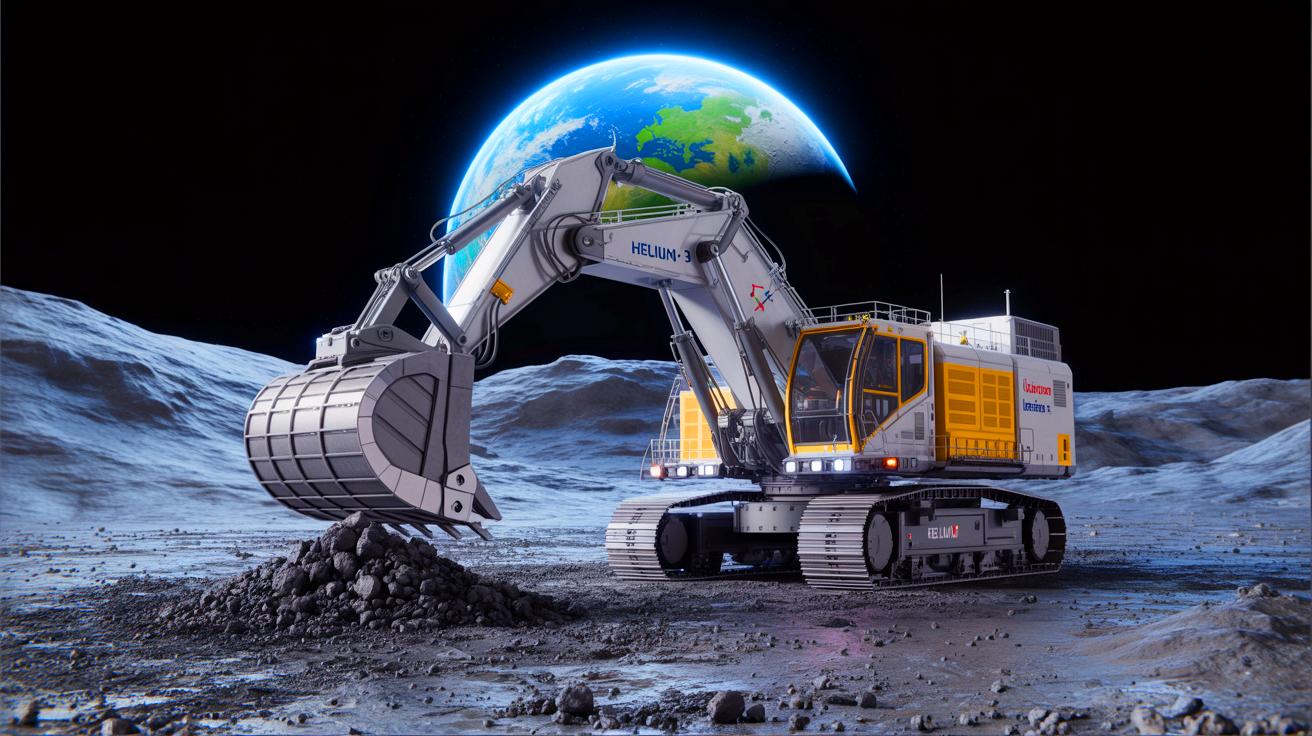
The race to harness lunar resources is reaching a new milestone with the unveiling of a groundbreaking lunar excavator prototype. Developed by Interlune, a startup backed by NASA and the US Department of Energy, in partnership with Iowa-based industrial equipment manufacturer Vermeer, this innovative machine is designed to extract valuable resources like helium-3 from the moon’s surface. Helium-3, a rare isotope on Earth, holds the potential to revolutionize the technology and energy sectors. As Earth’s reserves dwindle, the importance of lunar mining grows, promising not just technological advancement but possibly a shift in global energy dynamics.
Moon Mining Could Soon Be a Reality
The advent of lunar mining technology is no longer a distant dream. The collaboration between Interlune and Vermeer has resulted in a full-scale prototype of a lunar excavator that can dig through 100 metric tons of lunar regolith per hour. This machine is engineered to withstand the moon’s harsh conditions, including extreme temperatures and vacuum environments, and it autonomously sorts and extracts helium-3 for shipment back to Earth. According to Rob Meyerson, CEO and co-founder of Interlune, reliability and performance are paramount in extraterrestrial operations. Vermeer, with its legacy of innovation, is the ideal partner to meet these challenges.
The race for lunar resources is not limited to the United States. Japan, with its industrial giant Komatsu, is also in the fray. Komatsu’s fully electric lunar excavators, showcased at CES 2025, are equipped to handle the moon’s temperature extremes, from +230°F to -274°F. The lack of oxygen on the moon’s surface makes traditional combustion engines unfeasible, necessitating electric machinery powered by solar energy. However, as Komatsu notes, this solution presents its own set of challenges.
Interlune Targets Lunar Mission by 2030
Interlune, with Vermeer, is rapidly advancing towards a lunar mission targeted for 2030. Despite Komatsu’s early lead, the Vermeer-Interlune collaboration has made significant strides, producing a larger, full-scale prototype with greater excavation capacity. Gary Lai, Interlune’s co-founder and CTO, underscores the unprecedented nature of high-rate helium-3 excavation. The prototype has shown promising results in tests, and both companies are eager to enter the next development phase.
This progress is part of a broader trend towards lunar industrialization, akin to historical terrestrial endeavors like deep-sea mining or early oil drilling. The strategic importance of controlling helium-3 reserves could reshape global geopolitics and the energy economy, making lunar mining a critical frontier.
The Strategic Importance of Helium-3
Helium-3 is not just a technological marvel; it is a strategic asset. This rare isotope is essential for the manufacturing of semiconductors, fiber optics, and superconductors. More importantly, it could be the key to achieving nuclear fusion, the ‘Holy Grail’ of energy generation. With Earth’s helium reserves dwindling, the moon presents a unique opportunity to secure a new energy source that could redefine power dynamics globally.
The quest for helium-3 is not merely scientific or commercial; it is geopolitical. The nation or entity that controls these resources could gain a significant advantage in technology and energy, potentially altering global power structures. As nations and companies vie for lunar dominance, the implications for international relations and economic strategies are profound.
The Future of Lunar Exploration
The development of lunar excavators marks a pivotal step in humanity’s quest to explore and utilize extraterrestrial resources. As Interlune and Vermeer push towards a lunar mission by 2030, the potential for lunar industrialization becomes increasingly tangible. With nations like Japan also advancing their lunar technologies, the landscape of space exploration is evolving rapidly.
These endeavors highlight the growing importance of lunar resources in addressing Earth’s technological and energy challenges. As we stand on the brink of a new era of exploration and resource utilization, the question remains: How will this race for lunar resources shape our future on Earth and beyond?

Wow, mining the Moon? What’s next, a Starbucks on Mars? ☕🌌
How does Japan’s Komatsu compare to Interlune and Vermeer? Competition is heating up! 🔥
Are there any plans to involve international space agencies like ESA or Roscosmos?
This is fascinating, but I’m worried about the long-term implications of lunar mining.
Like what… there’s no environment to damage.
Helium-3 and nuclear fusion… does this mean we are closer to limitless clean energy?
What are the main technical challenges that Interlune and Vermeer are facing?
Moon mining today, asteroid mining tomorrow! 🌌
How will this affect geopolitics? The country that controls helium-3 could have a huge advantage.
This sounds like science fiction becoming reality. How will they transport helium-3 back to Earth?
Has there been any feedback from environmental groups on this project?
Exciting times for space exploration! Keep us updated on the progress! 🚀
This sounds like a James Bond villain’s plot. Hope it doesn’t end like one! 😂
How much helium-3 do they expect to extract per mission?
This is such a bold move. Kudos to Interlune and Vermeer for pushing boundaries! 👏
Do they have a backup plan if the excavator fails? Space missions are quite unforgiving.
Imagine the possibilities if this succeeds! A whole new frontier for energy. ⚡
Are there any ethical concerns with extracting resources from the Moon?
This could lead to a new era of sustainable energy. Fingers crossed! 🤞
Will there be any collaboration with other countries, or is this a US-only project?
Is there a timeline for when they expect to actually start mining operations?
Isn’t it risky to alter the Moon’s surface? What about potential environmental impacts? 🌕
That’s a joke, right?
What kind of technology is used to autonomously operate the excavator?
I’m curious about the cost implications. How expensive is this mission going to be?
Space mining is a game-changer, but are we ready for the consequences?
Moon mining today sounds like something straight out of a sci-fi movie! 🎬🌑
Great article! Can’t wait to see how this develops. Thanks for sharing! 😊
100 metric tons per hour sounds impressive, but how do they plan to handle the extreme lunar conditions?
Why helium-3? What makes it so valuable compared to other elements?
This kind of innovation is exactly what we need for the future. Go Interlune! 🚀
Mining the moon? Next they’ll be selling lunar real estate. 🏠🌙
How do they plan to deal with the legal aspects of mining on the Moon? Is there a framework in place?
The partnership with Vermeer is interesting. What does their experience bring to the table?
Is it possible that this could trigger a new kind of space race?
How do you get a beast like that on the Moon’s surface? Starship is the only vehicle big enough, but that flimsy elevator pictured on images I’ve seen is not going to get it down to the ground. Perhaps a specialized Starship?
I’d have to see it to believe it. Helium 3 is worth 40k an ounce though. However, heating trapping purification and shipping let alone digging will be interesting hurdles. At 50ppb 100 tons is 7000 bucks an hour value, 1ppm ore block gold at 3000 tons an hour is 27000 bucks an hour, maybe 9 to 1 stripping for 3000 bucks an hour. So can you do this for about twice the revenue of one digger at a gold mine? Sounds unlikely, does space travel cost less than a half dozen CATs….